
Settings & customization
General, language & proofreading
Choose the desktop language, configure local proofreading, prepare offline compilation, and control guided tours.
Dieser Inhalt ist noch nicht in deiner Sprache verfügbar.
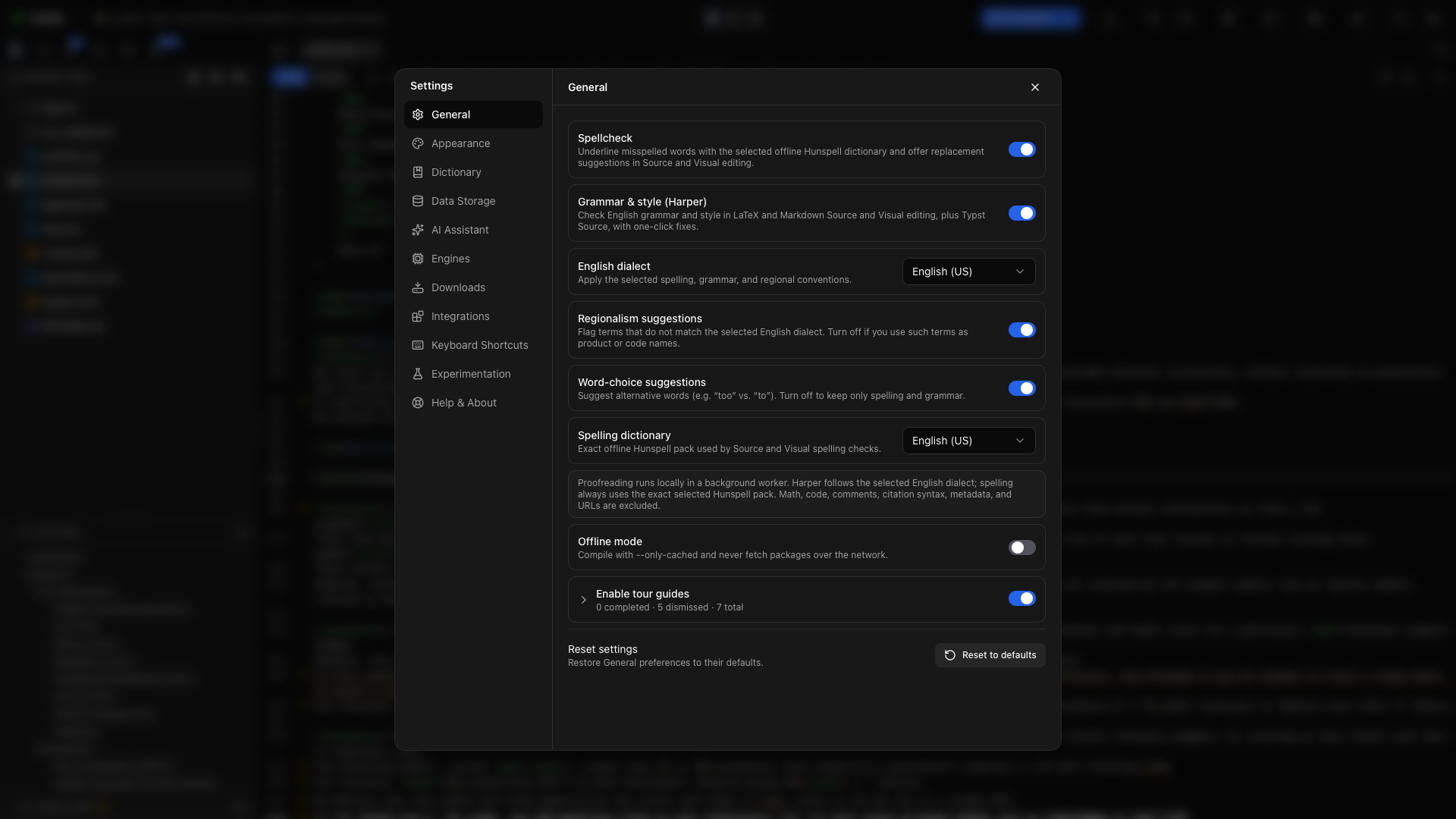
Open Settings → General for preferences that shape everyday work on this device. Changing these settings does not rewrite a project file.
Language
Section titled “Language”Choose System, English, or 简体中文. The interface updates while Oleafly is open.
- System follows the operating system language.
- English keeps the app in English even when the computer uses another language.
- 简体中文 switches Oleafly’s menus, settings, tools, messages, and workspace controls to Simplified Chinese.
The setting does not translate your manuscript, change proofreading, or choose the language of an assistant reply. See Language & localization for the exact boundary.
Spellcheck
Section titled “Spellcheck”Turn on Spellcheck to underline words missing from the selected local Hunspell dictionary. Choose a suggestion or ignore the term for this project, everywhere, or for the current session.
Grammar & style
Section titled “Grammar & style”Turn on Grammar & style (Harper) for English grammar and style suggestions in LaTeX and Markdown Source and Visual editing, plus Typst Source editing. Read a finding’s message and rule name before applying its fix.
English dialect
Section titled “English dialect”Choose US, UK, Australian, Canadian, or Indian English for Harper. This changes the conventions it checks; it does not rewrite existing text automatically.
Regionalism and word choice
Section titled “Regionalism and word choice”- Regionalism suggestions flags terms that differ from the chosen English dialect. Turn it off for intentional product names, code, or quoted language.
- Word-choice suggestions catches context-sensitive alternatives such as “too” and “to.” Turn it off for a narrower grammar pass.
Spelling dictionary
Section titled “Spelling dictionary”Choose English (US), English (UK), English (Australia), German, or French. Hunspell uses that exact offline pack in Source and Visual editing.
The dictionary and Harper dialect do not have to match, but most English papers are easier to review when they do. German and French dictionaries provide spelling, not German or French grammar through Harper.
The full proofreading guide covers source masking, project and global dictionaries, dismissed findings, academic-profile rules, and the current Harper limitation.
Offline mode
Section titled “Offline mode”Turn on Offline mode to make Tectonic compile with cached packages only. The setting also blocks online citation and metadata lookups.
Compile a project successfully while connected before taking it offline, so its required packages are present. An uncached package produces a clear build failure rather than a hidden network request.
Local AI is separate. Follow Ollama and offline work to install a model and test an offline assistant workflow.
Tour guides
Section titled “Tour guides”Turn on Enable tour guides to allow walkthroughs around the Library and workspace. Individual toggles decide which tours may appear.
Tour progress shows completed, dismissed, and remaining guidance. Reset a tour when you want to follow it again. Open Help & About → Start tour to launch the guide for your current area.
Manage proofreading choices
Section titled “Manage proofreading choices”Open Settings → Dictionary to manage:
- words ignored only in the current project;
- words ignored across every project;
- grammar findings dismissed in the current project;
- Harper rules you turned off;
- academic-profile rules you want to turn back on.
Removing an item makes it eligible for checking again immediately.
Reset General
Section titled “Reset General”Choose Reset to defaults at the bottom of the page to restore General preferences. Read the confirmation before applying it; Dictionary and other Settings sections have their own separate resets.