


Lecture Notes
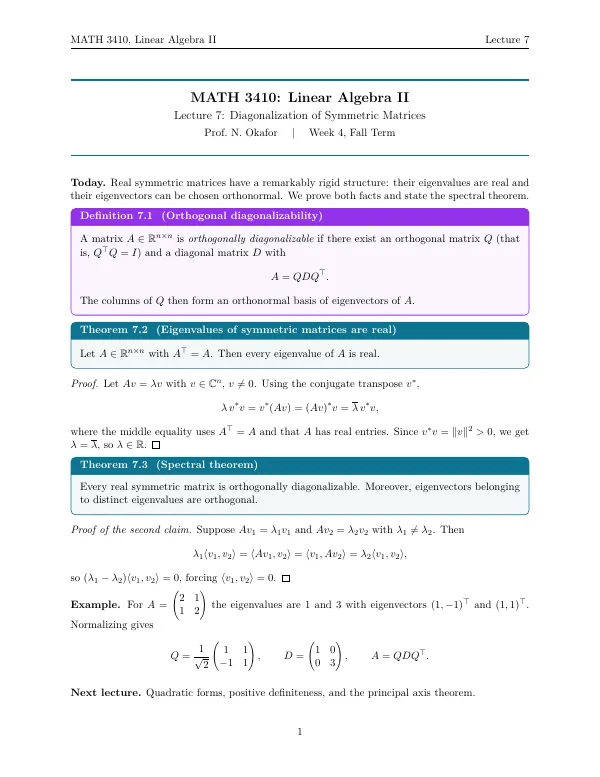
Course lecture notes with a two-part header and colored theorem and definition boxes.
main.tex
\documentclass[11pt]{article}
\usepackage[margin=1in]{geometry}
\usepackage{amsmath,amssymb,amsthm}
\usepackage{lmodern}
\usepackage{xcolor}
\usepackage[most]{tcolorbox}
\usepackage{fancyhdr}

\definecolor{accent}{HTML}{0E7490}
\definecolor{defcolor}{HTML}{9333EA}

\pagestyle{fancy}
\fancyhf{}
\fancyhead[L]{MATH 3410, Linear Algebra II}
\fancyhead[R]{Lecture 7}
\fancyfoot[C]{\thepage}

\newcounter{thmc}[section]
\newtcolorbox{thmbox}[1]{enhanced, colback=accent!5, colframe=accent,
  boxrule=0.8pt, arc=1.5mm, left=6pt, right=6pt,
  title={\refstepcounter{thmc}Theorem 7.\arabic{thmc}\ \ (#1)}, fonttitle=\bfseries}
\newtcolorbox{defbox}[1]{enhanced, colback=defcolor!5, colframe=defcolor,
  boxrule=0.8pt, arc=1.5mm, left=6pt, right=6pt,
  title={\refstepcounter{thmc}Definition 7.\arabic{thmc}\ \ (#1)}, fonttitle=\bfseries}

\setlength{\parindent}{0pt}
\setlength{\parskip}{0.5em}

\begin{document}

\begin{center}
  {\color{accent}\rule{\linewidth}{2pt}}\\[8pt]
  {\Large\bfseries MATH 3410: Linear Algebra II}\\[4pt]
  {\large Lecture 7: Diagonalization of Symmetric Matrices}\\[4pt]
  Prof.\ N.\ Okafor \quad | \quad Week 4, Fall Term\\[6pt]
  {\color{accent}\rule{\linewidth}{0.8pt}}
\end{center}

\textbf{Today.} Real symmetric matrices have a remarkably rigid structure:
their eigenvalues are real and their eigenvectors can be chosen orthonormal.
We prove both facts and state the spectral theorem.

\begin{defbox}{Orthogonal diagonalizability}
A matrix $A \in \mathbb{R}^{n \times n}$ is \emph{orthogonally
diagonalizable} if there exist an orthogonal matrix $Q$ (that is,
$Q^{\top}Q = I$) and a diagonal matrix $D$ with
\[
  A = Q D Q^{\top}.
\]
The columns of $Q$ then form an orthonormal basis of eigenvectors of $A$.
\end{defbox}

\begin{thmbox}{Eigenvalues of symmetric matrices are real}
Let $A \in \mathbb{R}^{n \times n}$ with $A^{\top} = A$. Then every
eigenvalue of $A$ is real.
\end{thmbox}

\emph{Proof.} Let $Av = \lambda v$ with $v \in \mathbb{C}^n$, $v \neq 0$.
Using the conjugate transpose $v^{*}$,
\[
  \lambda\, v^{*}v = v^{*}(Av) = (Av)^{*}v = \overline{\lambda}\, v^{*}v,
\]
where the middle equality uses $A^{\top} = A$ and that $A$ has real entries.
Since $v^{*}v = \lVert v \rVert^2 > 0$, we get
$\lambda = \overline{\lambda}$, so $\lambda \in \mathbb{R}$. \qedsymbol

\begin{thmbox}{Spectral theorem}
Every real symmetric matrix is orthogonally diagonalizable. Moreover,
eigenvectors belonging to distinct eigenvalues are orthogonal.
\end{thmbox}

\emph{Proof of the second claim.} Suppose $Av_1 = \lambda_1 v_1$ and
$Av_2 = \lambda_2 v_2$ with $\lambda_1 \neq \lambda_2$. Then
\[
  \lambda_1 \langle v_1, v_2 \rangle
  = \langle A v_1, v_2 \rangle
  = \langle v_1, A v_2 \rangle
  = \lambda_2 \langle v_1, v_2 \rangle,
\]
so $(\lambda_1 - \lambda_2)\langle v_1, v_2 \rangle = 0$, forcing
$\langle v_1, v_2 \rangle = 0$. \qedsymbol

\textbf{Example.} For
$A = \begin{pmatrix} 2 & 1 \\ 1 & 2 \end{pmatrix}$ the eigenvalues are
$1$ and $3$ with eigenvectors $(1,-1)^{\top}$ and $(1,1)^{\top}$.
Normalizing gives
\[
  Q = \frac{1}{\sqrt{2}}\begin{pmatrix} 1 & 1 \\ -1 & 1 \end{pmatrix},
  \qquad
  D = \begin{pmatrix} 1 & 0 \\ 0 & 3 \end{pmatrix},
  \qquad A = QDQ^{\top}.
\]

\textbf{Next lecture.} Quadratic forms, positive definiteness, and the
principal axis theorem.

\end{document}
In the app: open the New Project gallery, install the Coursework pack under "Get more templates", and this template appears with a live preview and one-click project creation. Compilation runs locally on the bundled engine.