


Ghi chú bài giảng
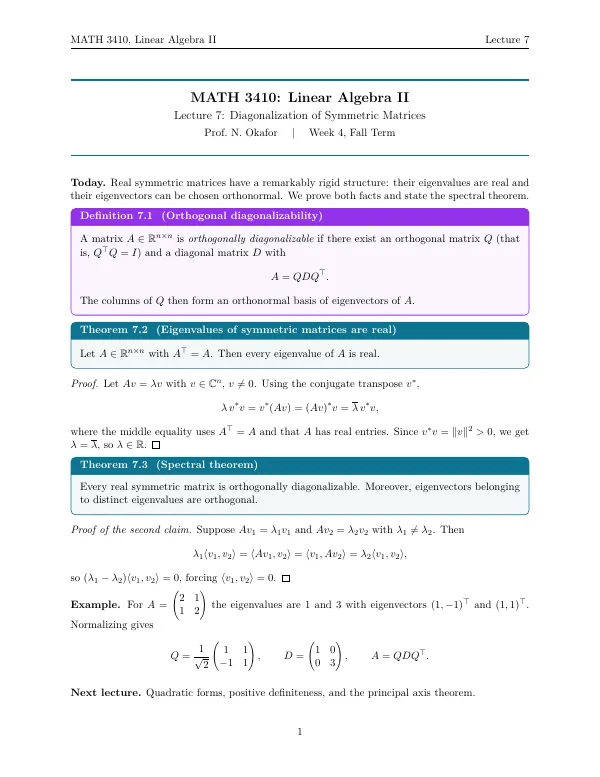
Ghi chú bài giảng của khóa học với tiêu đề gồm hai phần và các hộp định lý và định nghĩa được tô màu.
main.tex
\documentclass[11pt]{article}
\usepackage[margin=1in]{geometry}
\usepackage{amsmath,amssymb,amsthm}
\usepackage{lmodern}
\usepackage{xcolor}
\usepackage[most]{tcolorbox}
\usepackage{fancyhdr}

\definecolor{accent}{HTML}{0E7490}
\definecolor{defcolor}{HTML}{9333EA}

\pagestyle{fancy}
\fancyhf{}
\fancyhead[L]{MATH 3410, Linear Algebra II}
\fancyhead[R]{Lecture 7}
\fancyfoot[C]{\thepage}

\newcounter{thmc}[section]
\newtcolorbox{thmbox}[1]{enhanced, colback=accent!5, colframe=accent,
  boxrule=0.8pt, arc=1.5mm, left=6pt, right=6pt,
  title={\refstepcounter{thmc}Theorem 7.\arabic{thmc}\ \ (#1)}, fonttitle=\bfseries}
\newtcolorbox{defbox}[1]{enhanced, colback=defcolor!5, colframe=defcolor,
  boxrule=0.8pt, arc=1.5mm, left=6pt, right=6pt,
  title={\refstepcounter{thmc}Definition 7.\arabic{thmc}\ \ (#1)}, fonttitle=\bfseries}

\setlength{\parindent}{0pt}
\setlength{\parskip}{0.5em}

\begin{document}

\begin{center}
  {\color{accent}\rule{\linewidth}{2pt}}\\[8pt]
  {\Large\bfseries MATH 3410: Linear Algebra II}\\[4pt]
  {\large Lecture 7: Diagonalization of Symmetric Matrices}\\[4pt]
  Prof.\ N.\ Okafor \quad | \quad Week 4, Fall Term\\[6pt]
  {\color{accent}\rule{\linewidth}{0.8pt}}
\end{center}

\textbf{Today.} Real symmetric matrices have a remarkably rigid structure:
their eigenvalues are real and their eigenvectors can be chosen orthonormal.
We prove both facts and state the spectral theorem.

\begin{defbox}{Orthogonal diagonalizability}
A matrix $A \in \mathbb{R}^{n \times n}$ is \emph{orthogonally
diagonalizable} if there exist an orthogonal matrix $Q$ (that is,
$Q^{\top}Q = I$) and a diagonal matrix $D$ with
\[
  A = Q D Q^{\top}.
\]
The columns of $Q$ then form an orthonormal basis of eigenvectors of $A$.
\end{defbox}

\begin{thmbox}{Eigenvalues of symmetric matrices are real}
Let $A \in \mathbb{R}^{n \times n}$ with $A^{\top} = A$. Then every
eigenvalue of $A$ is real.
\end{thmbox}

\emph{Proof.} Let $Av = \lambda v$ with $v \in \mathbb{C}^n$, $v \neq 0$.
Using the conjugate transpose $v^{*}$,
\[
  \lambda\, v^{*}v = v^{*}(Av) = (Av)^{*}v = \overline{\lambda}\, v^{*}v,
\]
where the middle equality uses $A^{\top} = A$ and that $A$ has real entries.
Since $v^{*}v = \lVert v \rVert^2 > 0$, we get
$\lambda = \overline{\lambda}$, so $\lambda \in \mathbb{R}$. \qedsymbol

\begin{thmbox}{Spectral theorem}
Every real symmetric matrix is orthogonally diagonalizable. Moreover,
eigenvectors belonging to distinct eigenvalues are orthogonal.
\end{thmbox}

\emph{Proof of the second claim.} Suppose $Av_1 = \lambda_1 v_1$ and
$Av_2 = \lambda_2 v_2$ with $\lambda_1 \neq \lambda_2$. Then
\[
  \lambda_1 \langle v_1, v_2 \rangle
  = \langle A v_1, v_2 \rangle
  = \langle v_1, A v_2 \rangle
  = \lambda_2 \langle v_1, v_2 \rangle,
\]
so $(\lambda_1 - \lambda_2)\langle v_1, v_2 \rangle = 0$, forcing
$\langle v_1, v_2 \rangle = 0$. \qedsymbol

\textbf{Example.} For
$A = \begin{pmatrix} 2 & 1 \\ 1 & 2 \end{pmatrix}$ the eigenvalues are
$1$ and $3$ with eigenvectors $(1,-1)^{\top}$ and $(1,1)^{\top}$.
Normalizing gives
\[
  Q = \frac{1}{\sqrt{2}}\begin{pmatrix} 1 & 1 \\ -1 & 1 \end{pmatrix},
  \qquad
  D = \begin{pmatrix} 1 & 0 \\ 0 & 3 \end{pmatrix},
  \qquad A = QDQ^{\top}.
\]

\textbf{Next lecture.} Quadratic forms, positive definiteness, and the
principal axis theorem.

\end{document}
Trong ứng dụng: mở thư viện Dự án mới, cài đặt gói {nhãn} trong "Nhận thêm mẫu" và mẫu này xuất hiện cùng với bản xem trước trực tiếp và tạo dự án chỉ bằng một cú nhấp chuột. Quá trình biên dịch chạy cục bộ trên công cụ đi kèm.