


ICML Style Preprint
Two column machine learning preprint in the ICML look with a ruled running title bar on every page.
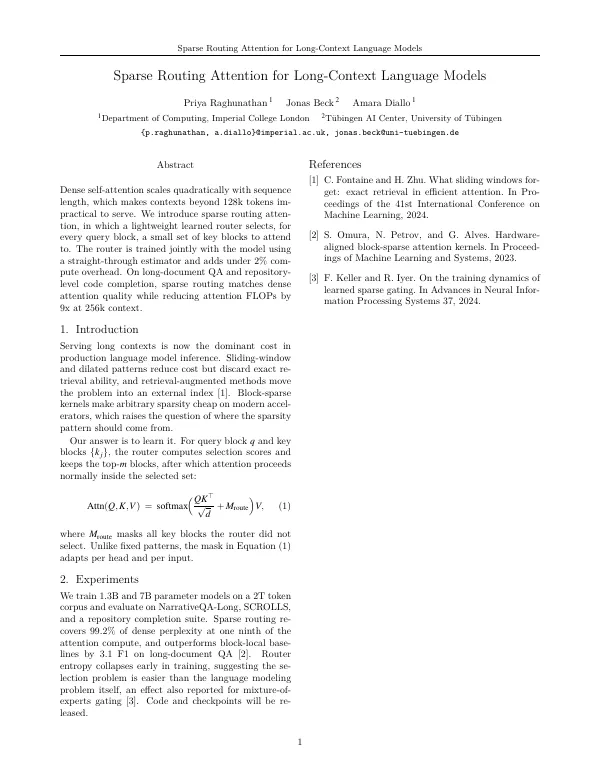
main.tex
% ICML style preprint, recreated with standard packages only.
\documentclass[10pt,twocolumn]{article}
\usepackage[letterpaper,margin=0.85in,top=1in,headheight=14pt,headsep=16pt]{geometry}
\usepackage{mathptmx}
\usepackage{amsmath}
\usepackage{titlesec}
\usepackage{fancyhdr}

\setlength{\columnsep}{0.25in}
\pagestyle{fancy}
\fancyhf{}
\fancyhead[C]{\small\bfseries Sparse Routing Attention for Long-Context Language Models}
\renewcommand{\headrulewidth}{0.4pt}
\fancyfoot[C]{\thepage}

\titleformat{\section}{\large\bfseries}{\thesection.}{0.6em}{}
\titleformat{\subsection}{\normalsize\bfseries}{\thesubsection.}{0.6em}{}
\titlespacing*{\section}{0pt}{1.4ex plus .4ex}{0.8ex}

\begin{document}

\twocolumn[{
  \centering
  {\Large\bfseries Sparse Routing Attention for Long-Context Language Models\par}
  \vskip 14pt
  {\bfseries Priya Raghunathan\,$^{1}$ \quad Jonas Beck\,$^{2}$ \quad Amara Diallo\,$^{1}$}\\[4pt]
  {\small $^{1}$Department of Computing, Imperial College London \quad
          $^{2}$T\"ubingen AI Center, University of T\"ubingen}\\[2pt]
  {\small\texttt{\{p.raghunathan, a.diallo\}@imperial.ac.uk, [email protected]}}
  \vskip 22pt
}]

\begin{center}{\bfseries Abstract}\end{center}
\noindent\textit{Dense self-attention scales quadratically with sequence
length, which makes contexts beyond 128k tokens impractical to serve. We
introduce sparse routing attention, in which a lightweight learned router
selects, for every query block, a small set of key blocks to attend to. The
router is trained jointly with the model using a straight-through estimator
and adds under 2\% compute overhead. On long-document QA and repository-level
code completion, sparse routing matches dense attention quality while reducing
attention FLOPs by 9x at 256k context.}

\section{Introduction}
Serving long contexts is now the dominant cost in production language model
inference. Sliding-window and dilated patterns reduce cost but discard exact
retrieval ability, and retrieval-augmented methods move the problem into an
external index~\cite{fontaine2024window}. Block-sparse kernels make arbitrary
sparsity cheap on modern accelerators, which raises the question of where the
sparsity pattern should come from.

Our answer is to learn it. For query block $q$ and key blocks $\{k_j\}$, the
router computes selection scores and keeps the top-$m$ blocks, after which
attention proceeds normally inside the selected set:
\begin{equation}
  \mathrm{Attn}(Q, K, V) \;=\; \mathrm{softmax}\!\Big(\frac{Q K^{\top}}{\sqrt{d}} + M_{\mathrm{route}}\Big)\, V,
  \label{eq:route}
\end{equation}
where $M_{\mathrm{route}}$ masks all key blocks the router did not select.
Unlike fixed patterns, the mask in Equation~\eqref{eq:route} adapts per head
and per input.

\section{Experiments}
We train 1.3B and 7B parameter models on a 2T token corpus and evaluate on
NarrativeQA-Long, SCROLLS, and a repository completion suite. Sparse routing
recovers 99.2\% of dense perplexity at one ninth of the attention compute,
and outperforms block-local baselines by 3.1 F1 on long-document
QA~\cite{omura2023blocksparse}. Router entropy collapses early in training,
suggesting the selection problem is easier than the language modeling problem
itself, an effect also reported for mixture-of-experts
gating~\cite{keller2024gating}. Code and checkpoints will be released.

\begin{thebibliography}{9}
\bibitem{fontaine2024window} C. Fontaine and H. Zhu.
What sliding windows forget: exact retrieval in efficient attention.
In \textit{Proceedings of the 41st International Conference on Machine Learning}, 2024.
\bibitem{omura2023blocksparse} S. Omura, N. Petrov, and G. Alves.
Hardware-aligned block-sparse attention kernels.
In \textit{Proceedings of Machine Learning and Systems}, 2023.
\bibitem{keller2024gating} F. Keller and R. Iyer.
On the training dynamics of learned sparse gating.
In \textit{Advances in Neural Information Processing Systems 37}, 2024.
\end{thebibliography}

\end{document}
In the app: open the New Project gallery, install the Conference preprint styles pack under "Get more templates", and this template appears with a live preview and one-click project creation. Compilation runs locally on the bundled engine.