


Bản in sẵn theo phong cách ICML
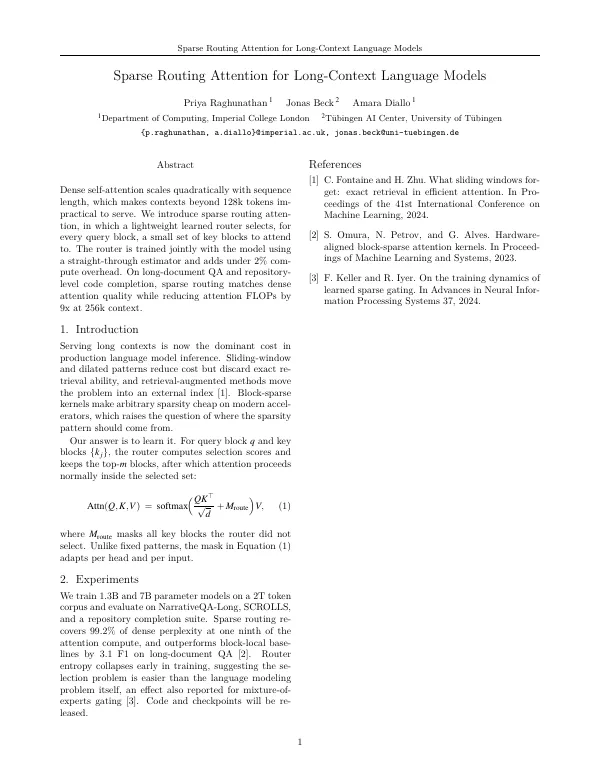
Bản in trước máy học hai cột trong giao diện ICML với thanh tiêu đề chạy theo quy tắc trên mỗi trang.
main.tex
% ICML style preprint, recreated with standard packages only.
\documentclass[10pt,twocolumn]{article}
\usepackage[letterpaper,margin=0.85in,top=1in,headheight=14pt,headsep=16pt]{geometry}
\usepackage{mathptmx}
\usepackage{amsmath}
\usepackage{titlesec}
\usepackage{fancyhdr}

\setlength{\columnsep}{0.25in}
\pagestyle{fancy}
\fancyhf{}
\fancyhead[C]{\small\bfseries Sparse Routing Attention for Long-Context Language Models}
\renewcommand{\headrulewidth}{0.4pt}
\fancyfoot[C]{\thepage}

\titleformat{\section}{\large\bfseries}{\thesection.}{0.6em}{}
\titleformat{\subsection}{\normalsize\bfseries}{\thesubsection.}{0.6em}{}
\titlespacing*{\section}{0pt}{1.4ex plus .4ex}{0.8ex}

\begin{document}

\twocolumn[{
  \centering
  {\Large\bfseries Sparse Routing Attention for Long-Context Language Models\par}
  \vskip 14pt
  {\bfseries Priya Raghunathan\,$^{1}$ \quad Jonas Beck\,$^{2}$ \quad Amara Diallo\,$^{1}$}\\[4pt]
  {\small $^{1}$Department of Computing, Imperial College London \quad
          $^{2}$T\"ubingen AI Center, University of T\"ubingen}\\[2pt]
  {\small\texttt{\{p.raghunathan, a.diallo\}@imperial.ac.uk, [email protected]}}
  \vskip 22pt
}]

\begin{center}{\bfseries Abstract}\end{center}
\noindent\textit{Dense self-attention scales quadratically with sequence
length, which makes contexts beyond 128k tokens impractical to serve. We
introduce sparse routing attention, in which a lightweight learned router
selects, for every query block, a small set of key blocks to attend to. The
router is trained jointly with the model using a straight-through estimator
and adds under 2\% compute overhead. On long-document QA and repository-level
code completion, sparse routing matches dense attention quality while reducing
attention FLOPs by 9x at 256k context.}

\section{Introduction}
Serving long contexts is now the dominant cost in production language model
inference. Sliding-window and dilated patterns reduce cost but discard exact
retrieval ability, and retrieval-augmented methods move the problem into an
external index~\cite{fontaine2024window}. Block-sparse kernels make arbitrary
sparsity cheap on modern accelerators, which raises the question of where the
sparsity pattern should come from.

Our answer is to learn it. For query block $q$ and key blocks $\{k_j\}$, the
router computes selection scores and keeps the top-$m$ blocks, after which
attention proceeds normally inside the selected set:
\begin{equation}
  \mathrm{Attn}(Q, K, V) \;=\; \mathrm{softmax}\!\Big(\frac{Q K^{\top}}{\sqrt{d}} + M_{\mathrm{route}}\Big)\, V,
  \label{eq:route}
\end{equation}
where $M_{\mathrm{route}}$ masks all key blocks the router did not select.
Unlike fixed patterns, the mask in Equation~\eqref{eq:route} adapts per head
and per input.

\section{Experiments}
We train 1.3B and 7B parameter models on a 2T token corpus and evaluate on
NarrativeQA-Long, SCROLLS, and a repository completion suite. Sparse routing
recovers 99.2\% of dense perplexity at one ninth of the attention compute,
and outperforms block-local baselines by 3.1 F1 on long-document
QA~\cite{omura2023blocksparse}. Router entropy collapses early in training,
suggesting the selection problem is easier than the language modeling problem
itself, an effect also reported for mixture-of-experts
gating~\cite{keller2024gating}. Code and checkpoints will be released.

\begin{thebibliography}{9}
\bibitem{fontaine2024window} C. Fontaine and H. Zhu.
What sliding windows forget: exact retrieval in efficient attention.
In \textit{Proceedings of the 41st International Conference on Machine Learning}, 2024.
\bibitem{omura2023blocksparse} S. Omura, N. Petrov, and G. Alves.
Hardware-aligned block-sparse attention kernels.
In \textit{Proceedings of Machine Learning and Systems}, 2023.
\bibitem{keller2024gating} F. Keller and R. Iyer.
On the training dynamics of learned sparse gating.
In \textit{Advances in Neural Information Processing Systems 37}, 2024.
\end{thebibliography}

\end{document}
Trong ứng dụng: mở thư viện Dự án mới, cài đặt gói {nhãn} trong "Nhận thêm mẫu" và mẫu này xuất hiện cùng với bản xem trước trực tiếp và tạo dự án chỉ bằng một cú nhấp chuột. Quá trình biên dịch chạy cục bộ trên công cụ đi kèm.