


Homework Solutions
A homework write-up with a course header box, numbered problems, and solution environments.
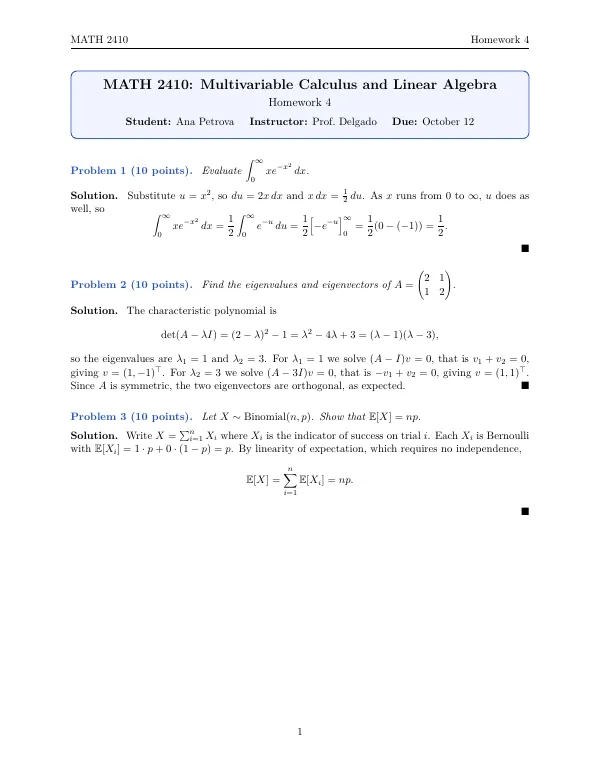
main.tex
\documentclass[11pt]{article}
\usepackage[margin=1in]{geometry}
\usepackage{amsmath,amssymb,amsthm}
\usepackage{lmodern}
\usepackage{xcolor}
\usepackage{tcolorbox}
\usepackage{fancyhdr}

\definecolor{accent}{HTML}{1D4ED8}

\pagestyle{fancy}
\fancyhf{}
\fancyhead[L]{MATH 2410}
\fancyhead[R]{Homework 4}
\fancyfoot[C]{\thepage}

\newcounter{problem}
\newenvironment{problem}[1][]{%
  \refstepcounter{problem}%
  \par\medskip\noindent
  {\color{accent}\bfseries Problem \theproblem\ #1.}\ \itshape}{\par\medskip}
\newenvironment{solution}{%
  \par\noindent{\bfseries Solution.}\ }{\hfill$\blacksquare$\par\bigskip}

\begin{document}

\begin{tcolorbox}[colback=accent!6,colframe=accent,boxrule=0.8pt,arc=2mm]
  \begin{center}
    {\Large\bfseries MATH 2410: Multivariable Calculus and Linear Algebra}\\[4pt]
    {\large Homework 4}\\[6pt]
    \begin{tabular}{lll}
      \textbf{Student:} Ana Petrova \quad &
      \textbf{Instructor:} Prof.\ Delgado \quad &
      \textbf{Due:} October 12
    \end{tabular}
  \end{center}
\end{tcolorbox}

\bigskip

\begin{problem}[(10 points)]
Evaluate $\displaystyle\int_0^{\infty} x e^{-x^2}\,dx$.
\end{problem}

\begin{solution}
Substitute $u = x^2$, so $du = 2x\,dx$ and $x\,dx = \tfrac{1}{2}\,du$. As $x$
runs from $0$ to $\infty$, $u$ does as well, so
\[
  \int_0^{\infty} x e^{-x^2}\,dx
  = \frac{1}{2}\int_0^{\infty} e^{-u}\,du
  = \frac{1}{2}\Bigl[-e^{-u}\Bigr]_0^{\infty}
  = \frac{1}{2}(0 - (-1)) = \frac{1}{2}.
\]
\end{solution}

\begin{problem}[(10 points)]
Find the eigenvalues and eigenvectors of
$A = \begin{pmatrix} 2 & 1 \\ 1 & 2 \end{pmatrix}$.
\end{problem}

\begin{solution}
The characteristic polynomial is
\[
  \det(A - \lambda I) = (2-\lambda)^2 - 1 = \lambda^2 - 4\lambda + 3
  = (\lambda - 1)(\lambda - 3),
\]
so the eigenvalues are $\lambda_1 = 1$ and $\lambda_2 = 3$. For $\lambda_1 = 1$
we solve $(A - I)v = 0$, that is $v_1 + v_2 = 0$, giving
$v = (1, -1)^{\top}$. For $\lambda_2 = 3$ we solve $(A - 3I)v = 0$, that is
$-v_1 + v_2 = 0$, giving $v = (1, 1)^{\top}$. Since $A$ is symmetric, the two
eigenvectors are orthogonal, as expected.
\end{solution}

\begin{problem}[(10 points)]
Let $X \sim \operatorname{Binomial}(n, p)$. Show that $\mathbb{E}[X] = np$.
\end{problem}

\begin{solution}
Write $X = \sum_{i=1}^{n} X_i$ where $X_i$ is the indicator of success on
trial $i$. Each $X_i$ is Bernoulli with
$\mathbb{E}[X_i] = 1 \cdot p + 0 \cdot (1-p) = p$. By linearity of
expectation, which requires no independence,
\[
  \mathbb{E}[X] = \sum_{i=1}^{n} \mathbb{E}[X_i] = np.
\]
\end{solution}

\end{document}
In the app: open the New Project gallery, install the Coursework pack under "Get more templates", and this template appears with a live preview and one-click project creation. Compilation runs locally on the bundled engine.