


Giải pháp bài tập về nhà
Bài tập về nhà có hộp tiêu đề khóa học, các bài toán được đánh số và môi trường giải pháp.
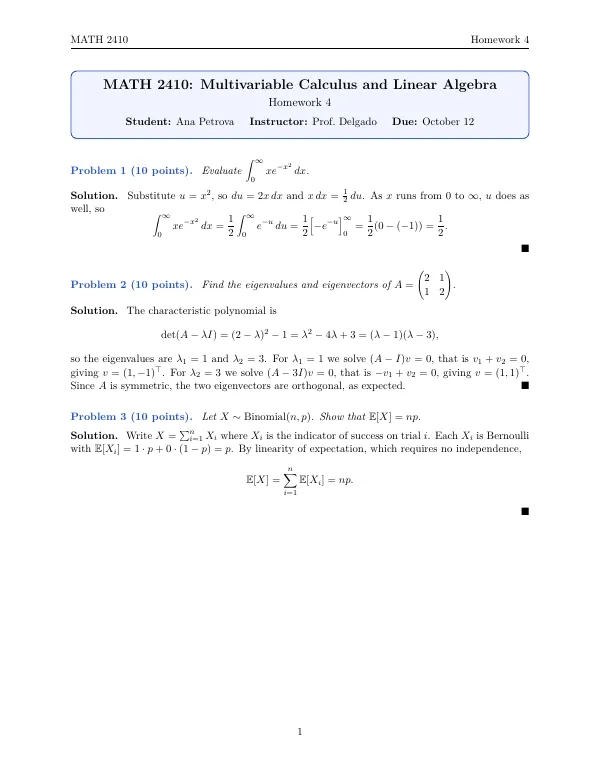
main.tex
\documentclass[11pt]{article}
\usepackage[margin=1in]{geometry}
\usepackage{amsmath,amssymb,amsthm}
\usepackage{lmodern}
\usepackage{xcolor}
\usepackage{tcolorbox}
\usepackage{fancyhdr}

\definecolor{accent}{HTML}{1D4ED8}

\pagestyle{fancy}
\fancyhf{}
\fancyhead[L]{MATH 2410}
\fancyhead[R]{Homework 4}
\fancyfoot[C]{\thepage}

\newcounter{problem}
\newenvironment{problem}[1][]{%
  \refstepcounter{problem}%
  \par\medskip\noindent
  {\color{accent}\bfseries Problem \theproblem\ #1.}\ \itshape}{\par\medskip}
\newenvironment{solution}{%
  \par\noindent{\bfseries Solution.}\ }{\hfill$\blacksquare$\par\bigskip}

\begin{document}

\begin{tcolorbox}[colback=accent!6,colframe=accent,boxrule=0.8pt,arc=2mm]
  \begin{center}
    {\Large\bfseries MATH 2410: Multivariable Calculus and Linear Algebra}\\[4pt]
    {\large Homework 4}\\[6pt]
    \begin{tabular}{lll}
      \textbf{Student:} Ana Petrova \quad &
      \textbf{Instructor:} Prof.\ Delgado \quad &
      \textbf{Due:} October 12
    \end{tabular}
  \end{center}
\end{tcolorbox}

\bigskip

\begin{problem}[(10 points)]
Evaluate $\displaystyle\int_0^{\infty} x e^{-x^2}\,dx$.
\end{problem}

\begin{solution}
Substitute $u = x^2$, so $du = 2x\,dx$ and $x\,dx = \tfrac{1}{2}\,du$. As $x$
runs from $0$ to $\infty$, $u$ does as well, so
\[
  \int_0^{\infty} x e^{-x^2}\,dx
  = \frac{1}{2}\int_0^{\infty} e^{-u}\,du
  = \frac{1}{2}\Bigl[-e^{-u}\Bigr]_0^{\infty}
  = \frac{1}{2}(0 - (-1)) = \frac{1}{2}.
\]
\end{solution}

\begin{problem}[(10 points)]
Find the eigenvalues and eigenvectors of
$A = \begin{pmatrix} 2 & 1 \\ 1 & 2 \end{pmatrix}$.
\end{problem}

\begin{solution}
The characteristic polynomial is
\[
  \det(A - \lambda I) = (2-\lambda)^2 - 1 = \lambda^2 - 4\lambda + 3
  = (\lambda - 1)(\lambda - 3),
\]
so the eigenvalues are $\lambda_1 = 1$ and $\lambda_2 = 3$. For $\lambda_1 = 1$
we solve $(A - I)v = 0$, that is $v_1 + v_2 = 0$, giving
$v = (1, -1)^{\top}$. For $\lambda_2 = 3$ we solve $(A - 3I)v = 0$, that is
$-v_1 + v_2 = 0$, giving $v = (1, 1)^{\top}$. Since $A$ is symmetric, the two
eigenvectors are orthogonal, as expected.
\end{solution}

\begin{problem}[(10 points)]
Let $X \sim \operatorname{Binomial}(n, p)$. Show that $\mathbb{E}[X] = np$.
\end{problem}

\begin{solution}
Write $X = \sum_{i=1}^{n} X_i$ where $X_i$ is the indicator of success on
trial $i$. Each $X_i$ is Bernoulli with
$\mathbb{E}[X_i] = 1 \cdot p + 0 \cdot (1-p) = p$. By linearity of
expectation, which requires no independence,
\[
  \mathbb{E}[X] = \sum_{i=1}^{n} \mathbb{E}[X_i] = np.
\]
\end{solution}

\end{document}
Trong ứng dụng: mở thư viện Dự án mới, cài đặt gói {nhãn} trong "Nhận thêm mẫu" và mẫu này xuất hiện cùng với bản xem trước trực tiếp và tạo dự án chỉ bằng một cú nhấp chuột. Quá trình biên dịch chạy cục bộ trên công cụ đi kèm.