


CVPR Style Paper
Two column computer vision paper in the CVPR look with Times type, a header rule, and an italic abstract.
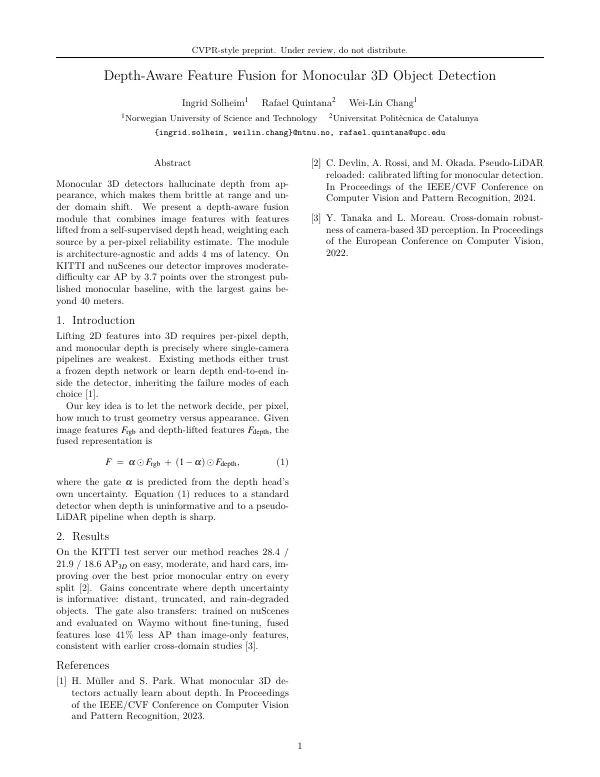
main.tex
% CVPR style paper, recreated with standard packages only.
\documentclass[10pt,twocolumn]{article}
\usepackage[letterpaper,margin=0.8in,top=1in,headheight=14pt,headsep=14pt]{geometry}
\usepackage{mathptmx}
\usepackage{amsmath}
\usepackage{titlesec}
\usepackage{fancyhdr}

\setlength{\columnsep}{0.3125in}
\pagestyle{fancy}
\fancyhf{}
\fancyhead[C]{\small CVPR-style preprint. Under review, do not distribute.}
\renewcommand{\headrulewidth}{0.5pt}
\fancyfoot[C]{\thepage}

\titleformat{\section}{\large\bfseries}{\thesection.}{0.6em}{}
\titleformat{\subsection}{\normalsize\bfseries}{\thesubsection.}{0.6em}{}
\titlespacing*{\section}{0pt}{1.5ex plus .4ex}{0.8ex}

\begin{document}

\twocolumn[{
  \centering
  {\Large\bfseries Depth-Aware Feature Fusion for Monocular 3D Object Detection\par}
  \vskip 14pt
  {Ingrid Solheim$^{1}$ \quad Rafael Quintana$^{2}$ \quad Wei-Lin Chang$^{1}$}\\[4pt]
  {\small $^{1}$Norwegian University of Science and Technology \quad $^{2}$Universitat Polit\`ecnica de Catalunya}\\[2pt]
  {\small\texttt{\{ingrid.solheim, weilin.chang\}@ntnu.no, [email protected]}}
  \vskip 20pt
}]

\begin{center}{\bfseries Abstract}\end{center}
\noindent\textit{Monocular 3D detectors hallucinate depth from appearance,
which makes them brittle at range and under domain shift. We present a
depth-aware fusion module that combines image features with features lifted
from a self-supervised depth head, weighting each source by a per-pixel
reliability estimate. The module is architecture-agnostic and adds 4 ms of
latency. On KITTI and nuScenes our detector improves moderate-difficulty car
AP by 3.7 points over the strongest published monocular baseline, with the
largest gains beyond 40 meters.}

\section{Introduction}
Lifting 2D features into 3D requires per-pixel depth, and monocular depth is
precisely where single-camera pipelines are weakest. Existing methods either
trust a frozen depth network or learn depth end-to-end inside the detector,
inheriting the failure modes of each choice~\cite{muller2023monodepth}.

Our key idea is to let the network decide, per pixel, how much to trust
geometry versus appearance. Given image features $F_{\mathrm{rgb}}$ and
depth-lifted features $F_{\mathrm{depth}}$, the fused representation is
\begin{equation}
  F \;=\; \alpha \odot F_{\mathrm{rgb}} \;+\; (1 - \alpha) \odot F_{\mathrm{depth}},
  \label{eq:fusion}
\end{equation}
where the gate $\alpha$ is predicted from the depth head's own uncertainty.
Equation~\eqref{eq:fusion} reduces to a standard detector when depth is
uninformative and to a pseudo-LiDAR pipeline when depth is sharp.

\section{Results}
On the KITTI test server our method reaches 28.4 / 21.9 / 18.6 AP$_{3D}$ on
easy, moderate, and hard cars, improving over the best prior monocular entry
on every split~\cite{devlin2024pseudolidar}. Gains concentrate where depth
uncertainty is informative: distant, truncated, and rain-degraded objects.
The gate also transfers: trained on nuScenes and evaluated on Waymo without
fine-tuning, fused features lose 41\% less AP than image-only features,
consistent with earlier cross-domain studies~\cite{tanaka2022crossdomain}.

\begin{thebibliography}{9}
\bibitem{muller2023monodepth} H. M\"uller and S. Park.
What monocular 3D detectors actually learn about depth.
In \textit{Proceedings of the IEEE/CVF Conference on Computer Vision and Pattern Recognition}, 2023.
\bibitem{devlin2024pseudolidar} C. Devlin, A. Rossi, and M. Okada.
Pseudo-LiDAR reloaded: calibrated lifting for monocular detection.
In \textit{Proceedings of the IEEE/CVF Conference on Computer Vision and Pattern Recognition}, 2024.
\bibitem{tanaka2022crossdomain} Y. Tanaka and L. Moreau.
Cross-domain robustness of camera-based 3D perception.
In \textit{Proceedings of the European Conference on Computer Vision}, 2022.
\end{thebibliography}

\end{document}
In the app: open the New Project gallery, install the Conference preprint styles pack under "Get more templates", and this template appears with a live preview and one-click project creation. Compilation runs locally on the bundled engine.