


Giấy kiểu CVPR
Giấy thị giác máy tính hai cột ở dạng CVPR với loại Thời gian, quy tắc tiêu đề và phần tóm tắt in nghiêng.
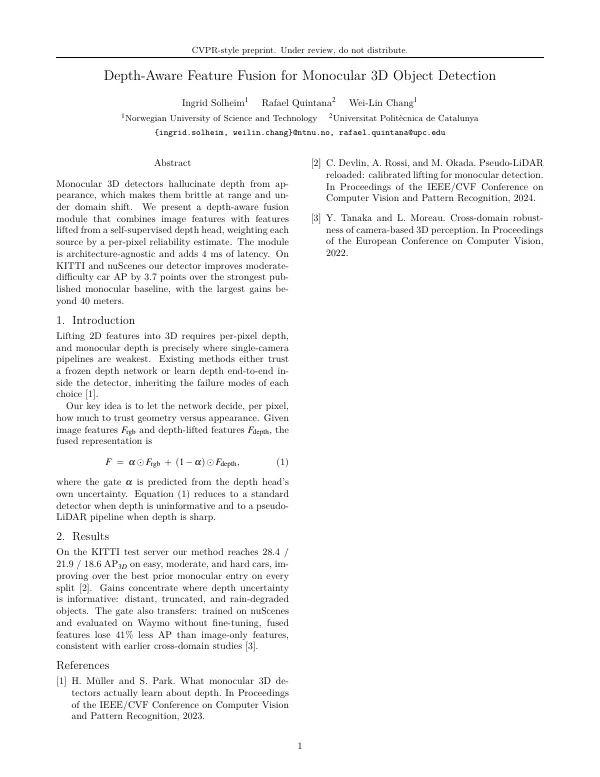
main.tex
% CVPR style paper, recreated with standard packages only.
\documentclass[10pt,twocolumn]{article}
\usepackage[letterpaper,margin=0.8in,top=1in,headheight=14pt,headsep=14pt]{geometry}
\usepackage{mathptmx}
\usepackage{amsmath}
\usepackage{titlesec}
\usepackage{fancyhdr}

\setlength{\columnsep}{0.3125in}
\pagestyle{fancy}
\fancyhf{}
\fancyhead[C]{\small CVPR-style preprint. Under review, do not distribute.}
\renewcommand{\headrulewidth}{0.5pt}
\fancyfoot[C]{\thepage}

\titleformat{\section}{\large\bfseries}{\thesection.}{0.6em}{}
\titleformat{\subsection}{\normalsize\bfseries}{\thesubsection.}{0.6em}{}
\titlespacing*{\section}{0pt}{1.5ex plus .4ex}{0.8ex}

\begin{document}

\twocolumn[{
  \centering
  {\Large\bfseries Depth-Aware Feature Fusion for Monocular 3D Object Detection\par}
  \vskip 14pt
  {Ingrid Solheim$^{1}$ \quad Rafael Quintana$^{2}$ \quad Wei-Lin Chang$^{1}$}\\[4pt]
  {\small $^{1}$Norwegian University of Science and Technology \quad $^{2}$Universitat Polit\`ecnica de Catalunya}\\[2pt]
  {\small\texttt{\{ingrid.solheim, weilin.chang\}@ntnu.no, [email protected]}}
  \vskip 20pt
}]

\begin{center}{\bfseries Abstract}\end{center}
\noindent\textit{Monocular 3D detectors hallucinate depth from appearance,
which makes them brittle at range and under domain shift. We present a
depth-aware fusion module that combines image features with features lifted
from a self-supervised depth head, weighting each source by a per-pixel
reliability estimate. The module is architecture-agnostic and adds 4 ms of
latency. On KITTI and nuScenes our detector improves moderate-difficulty car
AP by 3.7 points over the strongest published monocular baseline, with the
largest gains beyond 40 meters.}

\section{Introduction}
Lifting 2D features into 3D requires per-pixel depth, and monocular depth is
precisely where single-camera pipelines are weakest. Existing methods either
trust a frozen depth network or learn depth end-to-end inside the detector,
inheriting the failure modes of each choice~\cite{muller2023monodepth}.

Our key idea is to let the network decide, per pixel, how much to trust
geometry versus appearance. Given image features $F_{\mathrm{rgb}}$ and
depth-lifted features $F_{\mathrm{depth}}$, the fused representation is
\begin{equation}
  F \;=\; \alpha \odot F_{\mathrm{rgb}} \;+\; (1 - \alpha) \odot F_{\mathrm{depth}},
  \label{eq:fusion}
\end{equation}
where the gate $\alpha$ is predicted from the depth head's own uncertainty.
Equation~\eqref{eq:fusion} reduces to a standard detector when depth is
uninformative and to a pseudo-LiDAR pipeline when depth is sharp.

\section{Results}
On the KITTI test server our method reaches 28.4 / 21.9 / 18.6 AP$_{3D}$ on
easy, moderate, and hard cars, improving over the best prior monocular entry
on every split~\cite{devlin2024pseudolidar}. Gains concentrate where depth
uncertainty is informative: distant, truncated, and rain-degraded objects.
The gate also transfers: trained on nuScenes and evaluated on Waymo without
fine-tuning, fused features lose 41\% less AP than image-only features,
consistent with earlier cross-domain studies~\cite{tanaka2022crossdomain}.

\begin{thebibliography}{9}
\bibitem{muller2023monodepth} H. M\"uller and S. Park.
What monocular 3D detectors actually learn about depth.
In \textit{Proceedings of the IEEE/CVF Conference on Computer Vision and Pattern Recognition}, 2023.
\bibitem{devlin2024pseudolidar} C. Devlin, A. Rossi, and M. Okada.
Pseudo-LiDAR reloaded: calibrated lifting for monocular detection.
In \textit{Proceedings of the IEEE/CVF Conference on Computer Vision and Pattern Recognition}, 2024.
\bibitem{tanaka2022crossdomain} Y. Tanaka and L. Moreau.
Cross-domain robustness of camera-based 3D perception.
In \textit{Proceedings of the European Conference on Computer Vision}, 2022.
\end{thebibliography}

\end{document}
Trong ứng dụng: mở thư viện Dự án mới, cài đặt gói {nhãn} trong "Nhận thêm mẫu" và mẫu này xuất hiện cùng với bản xem trước trực tiếp và tạo dự án chỉ bằng một cú nhấp chuột. Quá trình biên dịch chạy cục bộ trên công cụ đi kèm.