


Algorithm Writeup
An algorithms assignment with pseudocode blocks and complexity analysis.
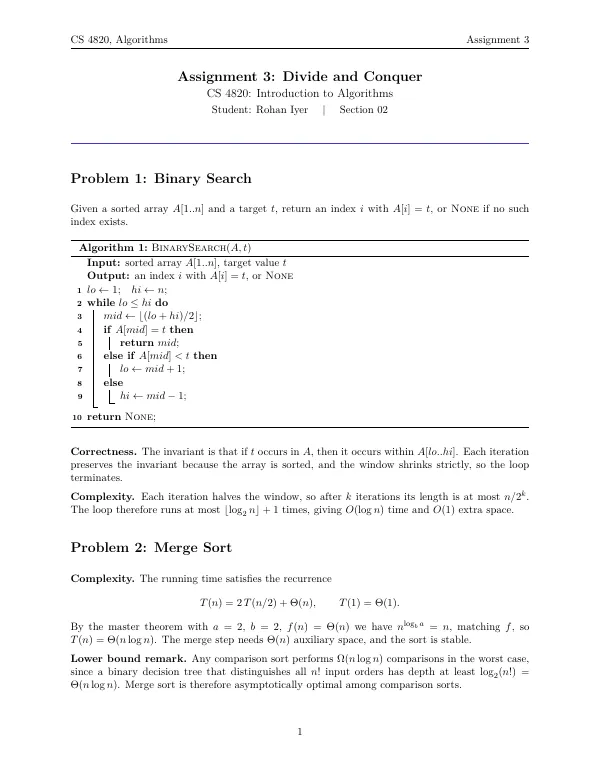
main.tex
\documentclass[11pt]{article}
\usepackage[margin=1in]{geometry}
\usepackage{amsmath,amssymb}
\usepackage{lmodern}
\usepackage{xcolor}
\usepackage[ruled,vlined,linesnumbered]{algorithm2e}
\usepackage{fancyhdr}

\definecolor{accent}{HTML}{4338CA}

\pagestyle{fancy}
\fancyhf{}
\fancyhead[L]{CS 4820, Algorithms}
\fancyhead[R]{Assignment 3}
\fancyfoot[C]{\thepage}

\setlength{\parindent}{0pt}
\setlength{\parskip}{0.5em}

\begin{document}

\begin{center}
  {\Large\bfseries Assignment 3: Divide and Conquer}\\[3pt]
  {\large CS 4820: Introduction to Algorithms}\\[3pt]
  Student: Rohan Iyer \quad | \quad Section 02
\end{center}

{\color{accent}\rule{\linewidth}{1.2pt}}

\section*{Problem 1: Binary Search}

Given a sorted array $A[1..n]$ and a target $t$, return an index $i$ with
$A[i] = t$, or \textsc{None} if no such index exists.

\begin{algorithm}[h]
\caption{\textsc{BinarySearch}$(A, t)$}
\KwIn{sorted array $A[1..n]$, target value $t$}
\KwOut{an index $i$ with $A[i] = t$, or \textsc{None}}
$lo \leftarrow 1$;\quad $hi \leftarrow n$\;
\While{$lo \le hi$}{
  $mid \leftarrow \lfloor (lo + hi)/2 \rfloor$\;
  \uIf{$A[mid] = t$}{\Return $mid$\;}
  \uElseIf{$A[mid] < t$}{$lo \leftarrow mid + 1$\;}
  \Else{$hi \leftarrow mid - 1$\;}
}
\Return \textsc{None}\;
\end{algorithm}

\textbf{Correctness.} The invariant is that if $t$ occurs in $A$, then it
occurs within $A[lo..hi]$. Each iteration preserves the invariant because
the array is sorted, and the window shrinks strictly, so the loop
terminates.

\textbf{Complexity.} Each iteration halves the window, so after $k$
iterations its length is at most $n / 2^{k}$. The loop therefore runs at
most $\lfloor \log_2 n \rfloor + 1$ times, giving $O(\log n)$ time and
$O(1)$ extra space.

\section*{Problem 2: Merge Sort}

\begin{algorithm}[h]
\caption{\textsc{MergeSort}$(A)$}
\KwIn{array $A[1..n]$}
\KwOut{the elements of $A$ in nondecreasing order}
\If{$n \le 1$}{\Return $A$\;}
$m \leftarrow \lfloor n/2 \rfloor$\;
$L \leftarrow \textsc{MergeSort}(A[1..m])$\;
$R \leftarrow \textsc{MergeSort}(A[m+1..n])$\;
\Return $\textsc{Merge}(L, R)$ \tcp*{two-pointer merge, $O(n)$ time}
\end{algorithm}

\textbf{Complexity.} The running time satisfies the recurrence
\[
  T(n) = 2\,T(n/2) + \Theta(n), \qquad T(1) = \Theta(1).
\]
By the master theorem with $a = 2$, $b = 2$, $f(n) = \Theta(n)$ we have
$n^{\log_b a} = n$, matching $f$, so $T(n) = \Theta(n \log n)$. The merge
step needs $\Theta(n)$ auxiliary space, and the sort is stable.

\textbf{Lower bound remark.} Any comparison sort performs
$\Omega(n \log n)$ comparisons in the worst case, since a binary decision
tree that distinguishes all $n!$ input orders has depth at least
$\log_2(n!) = \Theta(n \log n)$. Merge sort is therefore asymptotically
optimal among comparison sorts.

\end{document}
In the app: open the New Project gallery, install the Coursework pack under "Get more templates", and this template appears with a live preview and one-click project creation. Compilation runs locally on the bundled engine.