


Viết thuật toán
Một bài tập thuật toán với các khối mã giả và phân tích độ phức tạp.
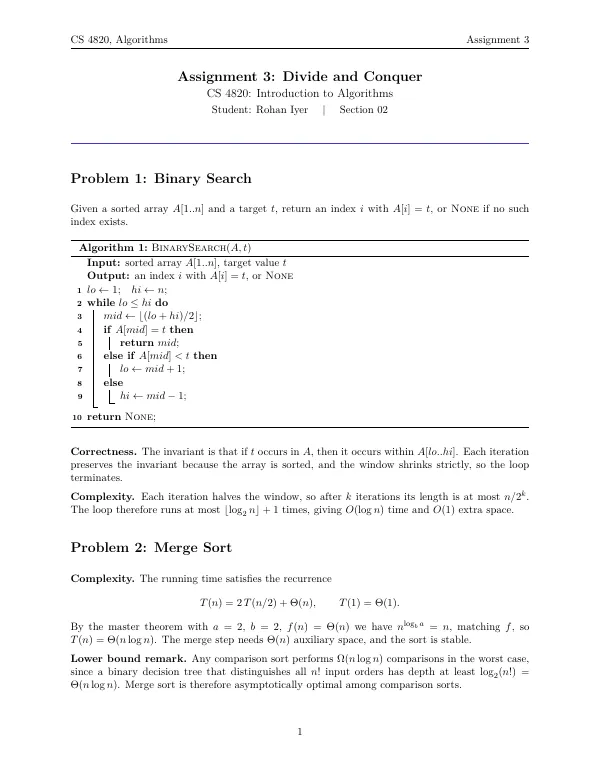
main.tex
\documentclass[11pt]{article}
\usepackage[margin=1in]{geometry}
\usepackage{amsmath,amssymb}
\usepackage{lmodern}
\usepackage{xcolor}
\usepackage[ruled,vlined,linesnumbered]{algorithm2e}
\usepackage{fancyhdr}

\definecolor{accent}{HTML}{4338CA}

\pagestyle{fancy}
\fancyhf{}
\fancyhead[L]{CS 4820, Algorithms}
\fancyhead[R]{Assignment 3}
\fancyfoot[C]{\thepage}

\setlength{\parindent}{0pt}
\setlength{\parskip}{0.5em}

\begin{document}

\begin{center}
  {\Large\bfseries Assignment 3: Divide and Conquer}\\[3pt]
  {\large CS 4820: Introduction to Algorithms}\\[3pt]
  Student: Rohan Iyer \quad | \quad Section 02
\end{center}

{\color{accent}\rule{\linewidth}{1.2pt}}

\section*{Problem 1: Binary Search}

Given a sorted array $A[1..n]$ and a target $t$, return an index $i$ with
$A[i] = t$, or \textsc{None} if no such index exists.

\begin{algorithm}[h]
\caption{\textsc{BinarySearch}$(A, t)$}
\KwIn{sorted array $A[1..n]$, target value $t$}
\KwOut{an index $i$ with $A[i] = t$, or \textsc{None}}
$lo \leftarrow 1$;\quad $hi \leftarrow n$\;
\While{$lo \le hi$}{
  $mid \leftarrow \lfloor (lo + hi)/2 \rfloor$\;
  \uIf{$A[mid] = t$}{\Return $mid$\;}
  \uElseIf{$A[mid] < t$}{$lo \leftarrow mid + 1$\;}
  \Else{$hi \leftarrow mid - 1$\;}
}
\Return \textsc{None}\;
\end{algorithm}

\textbf{Correctness.} The invariant is that if $t$ occurs in $A$, then it
occurs within $A[lo..hi]$. Each iteration preserves the invariant because
the array is sorted, and the window shrinks strictly, so the loop
terminates.

\textbf{Complexity.} Each iteration halves the window, so after $k$
iterations its length is at most $n / 2^{k}$. The loop therefore runs at
most $\lfloor \log_2 n \rfloor + 1$ times, giving $O(\log n)$ time and
$O(1)$ extra space.

\section*{Problem 2: Merge Sort}

\begin{algorithm}[h]
\caption{\textsc{MergeSort}$(A)$}
\KwIn{array $A[1..n]$}
\KwOut{the elements of $A$ in nondecreasing order}
\If{$n \le 1$}{\Return $A$\;}
$m \leftarrow \lfloor n/2 \rfloor$\;
$L \leftarrow \textsc{MergeSort}(A[1..m])$\;
$R \leftarrow \textsc{MergeSort}(A[m+1..n])$\;
\Return $\textsc{Merge}(L, R)$ \tcp*{two-pointer merge, $O(n)$ time}
\end{algorithm}

\textbf{Complexity.} The running time satisfies the recurrence
\[
  T(n) = 2\,T(n/2) + \Theta(n), \qquad T(1) = \Theta(1).
\]
By the master theorem with $a = 2$, $b = 2$, $f(n) = \Theta(n)$ we have
$n^{\log_b a} = n$, matching $f$, so $T(n) = \Theta(n \log n)$. The merge
step needs $\Theta(n)$ auxiliary space, and the sort is stable.

\textbf{Lower bound remark.} Any comparison sort performs
$\Omega(n \log n)$ comparisons in the worst case, since a binary decision
tree that distinguishes all $n!$ input orders has depth at least
$\log_2(n!) = \Theta(n \log n)$. Merge sort is therefore asymptotically
optimal among comparison sorts.

\end{document}
Trong ứng dụng: mở thư viện Dự án mới, cài đặt gói {nhãn} trong "Nhận thêm mẫu" và mẫu này xuất hiện cùng với bản xem trước trực tiếp và tạo dự án chỉ bằng một cú nhấp chuột. Quá trình biên dịch chạy cục bộ trên công cụ đi kèm.