


ACL Style Paper
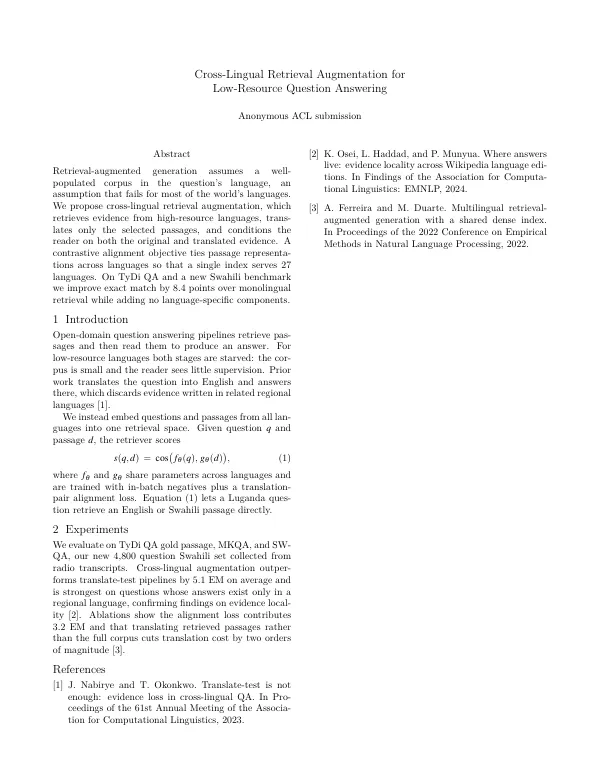
Two column NLP paper in the ACL look with a centered title block and an anonymous submission author block.
main.tex
% ACL style paper, recreated with standard packages only.
\documentclass[10pt,twocolumn]{article}
\usepackage[letterpaper,margin=0.75in,top=1in]{geometry}
\usepackage{mathptmx}
\usepackage{amsmath}
\usepackage{titlesec}

\setlength{\columnsep}{0.25in}
\pagestyle{empty}

\titleformat{\section}{\large\bfseries}{\thesection}{0.6em}{}
\titleformat{\subsection}{\normalsize\bfseries}{\thesubsection}{0.6em}{}
\titlespacing*{\section}{0pt}{1.4ex plus .4ex}{0.8ex}

\begin{document}

\twocolumn[{
  \centering
  {\large\bfseries Cross-Lingual Retrieval Augmentation for\\ Low-Resource Question Answering\par}
  \vskip 16pt
  {\bfseries Anonymous ACL submission}
  \vskip 26pt
}]
\thispagestyle{empty}

\begin{center}{\bfseries Abstract}\end{center}
\noindent Retrieval-augmented generation assumes a well-populated corpus in
the question's language, an assumption that fails for most of the world's
languages. We propose cross-lingual retrieval augmentation, which retrieves
evidence from high-resource languages, translates only the selected passages,
and conditions the reader on both the original and translated evidence. A
contrastive alignment objective ties passage representations across languages
so that a single index serves 27 languages. On TyDi QA and a new Swahili
benchmark we improve exact match by 8.4 points over monolingual retrieval
while adding no language-specific components.

\section{Introduction}
Open-domain question answering pipelines retrieve passages and then read them
to produce an answer. For low-resource languages both stages are starved: the
corpus is small and the reader sees little supervision. Prior work translates
the question into English and answers there, which discards evidence written
in related regional languages~\cite{nabirye2023translate}.

We instead embed questions and passages from all languages into one retrieval
space. Given question $q$ and passage $d$, the retriever scores
\begin{equation}
  s(q, d) \;=\; \cos\bigl(f_{\theta}(q),\, g_{\theta}(d)\bigr),
  \label{eq:score}
\end{equation}
where $f_{\theta}$ and $g_{\theta}$ share parameters across languages and are
trained with in-batch negatives plus a translation-pair alignment loss.
Equation~\eqref{eq:score} lets a Luganda question retrieve an English or
Swahili passage directly.

\section{Experiments}
We evaluate on TyDi QA gold passage, MKQA, and SW-QA, our new 4{,}800
question Swahili set collected from radio transcripts. Cross-lingual
augmentation outperforms translate-test pipelines by 5.1 EM on average and is
strongest on questions whose answers exist only in a regional language,
confirming findings on evidence locality~\cite{osei2024locality}. Ablations
show the alignment loss contributes 3.2 EM and that translating retrieved
passages rather than the full corpus cuts translation cost by two orders of
magnitude~\cite{ferreira2022mrag}.

\begin{thebibliography}{9}
\bibitem{nabirye2023translate} J. Nabirye and T. Okonkwo.
Translate-test is not enough: evidence loss in cross-lingual QA.
In \textit{Proceedings of the 61st Annual Meeting of the Association for Computational Linguistics}, 2023.
\bibitem{osei2024locality} K. Osei, L. Haddad, and P. Munyua.
Where answers live: evidence locality across Wikipedia language editions.
In \textit{Findings of the Association for Computational Linguistics: EMNLP}, 2024.
\bibitem{ferreira2022mrag} A. Ferreira and M. Duarte.
Multilingual retrieval-augmented generation with a shared dense index.
In \textit{Proceedings of the 2022 Conference on Empirical Methods in Natural Language Processing}, 2022.
\end{thebibliography}

\end{document}
In the app: open the New Project gallery, install the Conference preprint styles pack under "Get more templates", and this template appears with a live preview and one-click project creation. Compilation runs locally on the bundled engine.