


Giấy kiểu ACL
Bài viết NLP hai cột trong giao diện ACL với khối tiêu đề ở giữa và khối tác giả gửi ẩn danh.
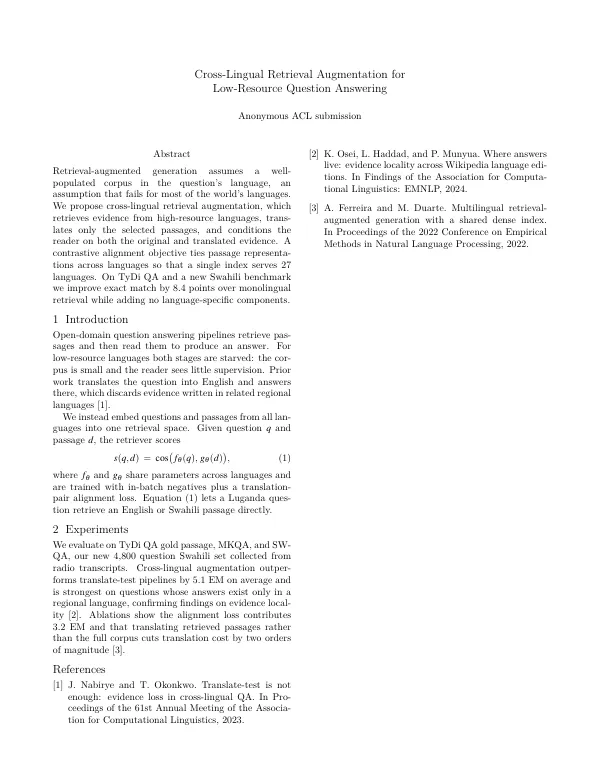
main.tex
% ACL style paper, recreated with standard packages only.
\documentclass[10pt,twocolumn]{article}
\usepackage[letterpaper,margin=0.75in,top=1in]{geometry}
\usepackage{mathptmx}
\usepackage{amsmath}
\usepackage{titlesec}

\setlength{\columnsep}{0.25in}
\pagestyle{empty}

\titleformat{\section}{\large\bfseries}{\thesection}{0.6em}{}
\titleformat{\subsection}{\normalsize\bfseries}{\thesubsection}{0.6em}{}
\titlespacing*{\section}{0pt}{1.4ex plus .4ex}{0.8ex}

\begin{document}

\twocolumn[{
  \centering
  {\large\bfseries Cross-Lingual Retrieval Augmentation for\\ Low-Resource Question Answering\par}
  \vskip 16pt
  {\bfseries Anonymous ACL submission}
  \vskip 26pt
}]
\thispagestyle{empty}

\begin{center}{\bfseries Abstract}\end{center}
\noindent Retrieval-augmented generation assumes a well-populated corpus in
the question's language, an assumption that fails for most of the world's
languages. We propose cross-lingual retrieval augmentation, which retrieves
evidence from high-resource languages, translates only the selected passages,
and conditions the reader on both the original and translated evidence. A
contrastive alignment objective ties passage representations across languages
so that a single index serves 27 languages. On TyDi QA and a new Swahili
benchmark we improve exact match by 8.4 points over monolingual retrieval
while adding no language-specific components.

\section{Introduction}
Open-domain question answering pipelines retrieve passages and then read them
to produce an answer. For low-resource languages both stages are starved: the
corpus is small and the reader sees little supervision. Prior work translates
the question into English and answers there, which discards evidence written
in related regional languages~\cite{nabirye2023translate}.

We instead embed questions and passages from all languages into one retrieval
space. Given question $q$ and passage $d$, the retriever scores
\begin{equation}
  s(q, d) \;=\; \cos\bigl(f_{\theta}(q),\, g_{\theta}(d)\bigr),
  \label{eq:score}
\end{equation}
where $f_{\theta}$ and $g_{\theta}$ share parameters across languages and are
trained with in-batch negatives plus a translation-pair alignment loss.
Equation~\eqref{eq:score} lets a Luganda question retrieve an English or
Swahili passage directly.

\section{Experiments}
We evaluate on TyDi QA gold passage, MKQA, and SW-QA, our new 4{,}800
question Swahili set collected from radio transcripts. Cross-lingual
augmentation outperforms translate-test pipelines by 5.1 EM on average and is
strongest on questions whose answers exist only in a regional language,
confirming findings on evidence locality~\cite{osei2024locality}. Ablations
show the alignment loss contributes 3.2 EM and that translating retrieved
passages rather than the full corpus cuts translation cost by two orders of
magnitude~\cite{ferreira2022mrag}.

\begin{thebibliography}{9}
\bibitem{nabirye2023translate} J. Nabirye and T. Okonkwo.
Translate-test is not enough: evidence loss in cross-lingual QA.
In \textit{Proceedings of the 61st Annual Meeting of the Association for Computational Linguistics}, 2023.
\bibitem{osei2024locality} K. Osei, L. Haddad, and P. Munyua.
Where answers live: evidence locality across Wikipedia language editions.
In \textit{Findings of the Association for Computational Linguistics: EMNLP}, 2024.
\bibitem{ferreira2022mrag} A. Ferreira and M. Duarte.
Multilingual retrieval-augmented generation with a shared dense index.
In \textit{Proceedings of the 2022 Conference on Empirical Methods in Natural Language Processing}, 2022.
\end{thebibliography}

\end{document}
Trong ứng dụng: mở thư viện Dự án mới, cài đặt gói {nhãn} trong "Nhận thêm mẫu" và mẫu này xuất hiện cùng với bản xem trước trực tiếp và tạo dự án chỉ bằng một cú nhấp chuột. Quá trình biên dịch chạy cục bộ trên công cụ đi kèm.