


IEEE 会议论文 (IEEEtran)
IEEEtran 会议论文,包含作者块、关键词、方程、结果表、致谢和编号参考文献。
main.tex
\documentclass[conference]{IEEEtran}
\usepackage{amsmath,amssymb}
\usepackage{booktabs}
\usepackage[hidelinks]{hyperref}

\title{Energy-Aware Scheduling for Edge Inference Clusters}

\author{
\IEEEauthorblockN{Mina Okafor, Luca Bianchi, and Hana Sato}
\IEEEauthorblockA{Department of Electrical and Computer Engineering\\
Northgate Institute of Technology\\
\{mina.okafor,luca.bianchi,hana.sato\}@example.edu}
}

\begin{document}
\maketitle

\begin{abstract}
Edge inference clusters must meet latency targets while operating under a
tight power envelope. We present a scheduler that predicts batch-level energy
and jointly selects model variants and accelerators. On three production-like
workloads it reduces energy per request by 29\% while preserving p99 latency.
\end{abstract}

\begin{IEEEkeywords}
edge computing, inference serving, energy efficiency, scheduling
\end{IEEEkeywords}

\section{Introduction}
Accelerator-rich edge sites serve bursty workloads with less cooling and power
headroom than data centers. Static placement wastes energy during quiet periods,
while purely reactive policies violate tail-latency objectives after bursts.
Our controller combines a calibrated energy model with a short-horizon queue
forecast and makes three contributions: a constrained scheduler, a trace-driven
evaluation, and an analysis of model error.

The design targets a practical deployment constraint: model quality may change
only within an application-approved set, and each request must carry the model
version that served it. This makes every scheduling decision auditable and
prevents a power-saving policy from silently changing the product metric.

\section{Method}
For assignment $x$ over model variants and devices, the controller solves
\begin{equation}
  \min_x \sum_{j} E_j(x_j)
  \quad \text{subject to} \quad
  \widehat L_{99}(x) \leq L_{\mathrm{SLO}} .
\end{equation}
The fallback policy reserves one device whenever the forecast interval crosses
the latency constraint.

Energy models are fitted per device from hardware counters and updated only
after a drift test. The online solver receives point forecasts and calibrated
upper bounds, so it can reject an apparently efficient placement when its
latency uncertainty is too large. A deterministic safe policy handles solver
timeouts and missing telemetry.

\section{Evaluation}
We replay six weeks of anonymized request traces against CPU, GPU, and neural
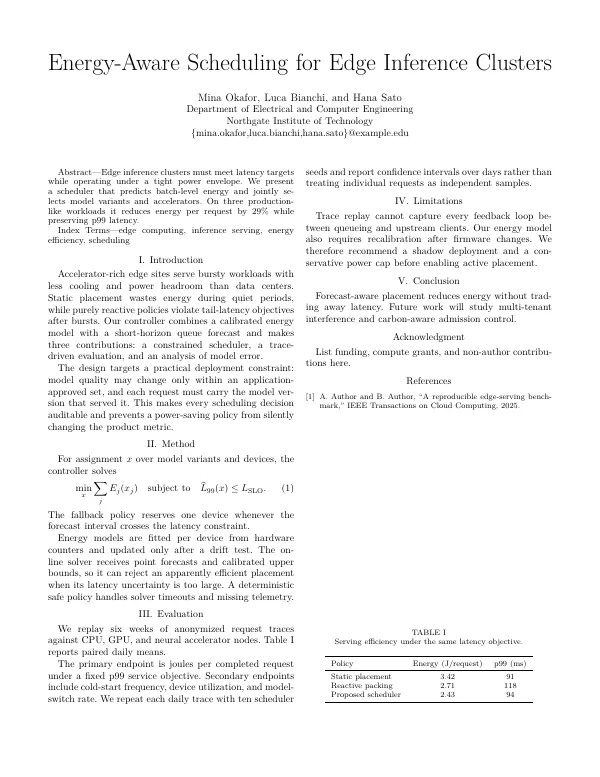
accelerator nodes. Table~\ref{tab:results} reports paired daily means.

The primary endpoint is joules per completed request under a fixed p99 service
objective. Secondary endpoints include cold-start frequency, device
utilization, and model-switch rate. We repeat each daily trace with ten
scheduler seeds and report confidence intervals over days rather than treating
individual requests as independent samples.

\begin{table}[b]
\caption{Serving efficiency under the same latency objective.}
\label{tab:results}
\centering
\begin{tabular}{lcc}
\toprule
Policy & Energy (J/request) & p99 (ms) \\
\midrule
Static placement & 3.42 & 91 \\
Reactive packing & 2.71 & 118 \\
Proposed scheduler & \textbf{2.43} & \textbf{94} \\
\bottomrule
\end{tabular}
\end{table}

\section{Limitations}
Trace replay cannot capture every feedback loop between queueing and upstream
clients. Our energy model also requires recalibration after firmware changes.
We therefore recommend a shadow deployment and a conservative power cap before
enabling active placement.

\section{Conclusion}
Forecast-aware placement reduces energy without trading away latency. Future
work will study multi-tenant interference and carbon-aware admission control.

\section*{Acknowledgment}
List funding, compute grants, and non-author contributions here.

\begin{thebibliography}{1}
\bibitem{example} A. Author and B. Author, ``A reproducible edge-serving
benchmark,'' \emph{IEEE Transactions on Cloud Computing}, 2025.
\end{thebibliography}
\end{document}
应用内:打开新建项目图库,在「获取更多模板」下安装 期刊和会议课程 包,即可带实时预览并一键创建项目。编译在捆绑引擎上本地运行。