


Tài liệu hội thảo của IEEE (IEEEtran)
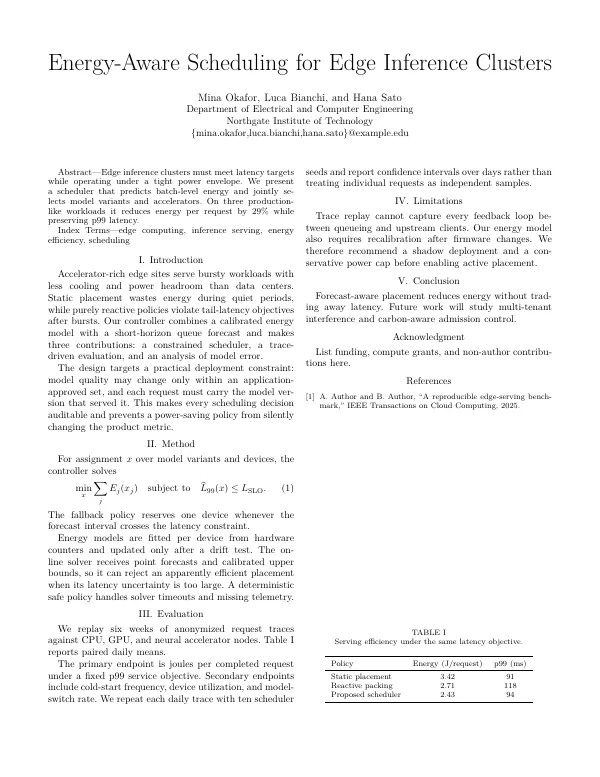
Tài liệu hội thảo của IEEEtran với các khối tác giả, từ khóa, phương trình, bảng kết quả, lời cảm ơn và tài liệu tham khảo được đánh số.
main.tex
\documentclass[conference]{IEEEtran}
\usepackage{amsmath,amssymb}
\usepackage{booktabs}
\usepackage[hidelinks]{hyperref}

\title{Energy-Aware Scheduling for Edge Inference Clusters}

\author{
\IEEEauthorblockN{Mina Okafor, Luca Bianchi, and Hana Sato}
\IEEEauthorblockA{Department of Electrical and Computer Engineering\\
Northgate Institute of Technology\\
\{mina.okafor,luca.bianchi,hana.sato\}@example.edu}
}

\begin{document}
\maketitle

\begin{abstract}
Edge inference clusters must meet latency targets while operating under a
tight power envelope. We present a scheduler that predicts batch-level energy
and jointly selects model variants and accelerators. On three production-like
workloads it reduces energy per request by 29\% while preserving p99 latency.
\end{abstract}

\begin{IEEEkeywords}
edge computing, inference serving, energy efficiency, scheduling
\end{IEEEkeywords}

\section{Introduction}
Accelerator-rich edge sites serve bursty workloads with less cooling and power
headroom than data centers. Static placement wastes energy during quiet periods,
while purely reactive policies violate tail-latency objectives after bursts.
Our controller combines a calibrated energy model with a short-horizon queue
forecast and makes three contributions: a constrained scheduler, a trace-driven
evaluation, and an analysis of model error.

The design targets a practical deployment constraint: model quality may change
only within an application-approved set, and each request must carry the model
version that served it. This makes every scheduling decision auditable and
prevents a power-saving policy from silently changing the product metric.

\section{Method}
For assignment $x$ over model variants and devices, the controller solves
\begin{equation}
  \min_x \sum_{j} E_j(x_j)
  \quad \text{subject to} \quad
  \widehat L_{99}(x) \leq L_{\mathrm{SLO}} .
\end{equation}
The fallback policy reserves one device whenever the forecast interval crosses
the latency constraint.

Energy models are fitted per device from hardware counters and updated only
after a drift test. The online solver receives point forecasts and calibrated
upper bounds, so it can reject an apparently efficient placement when its
latency uncertainty is too large. A deterministic safe policy handles solver
timeouts and missing telemetry.

\section{Evaluation}
We replay six weeks of anonymized request traces against CPU, GPU, and neural
accelerator nodes. Table~\ref{tab:results} reports paired daily means.

The primary endpoint is joules per completed request under a fixed p99 service
objective. Secondary endpoints include cold-start frequency, device
utilization, and model-switch rate. We repeat each daily trace with ten
scheduler seeds and report confidence intervals over days rather than treating
individual requests as independent samples.

\begin{table}[b]
\caption{Serving efficiency under the same latency objective.}
\label{tab:results}
\centering
\begin{tabular}{lcc}
\toprule
Policy & Energy (J/request) & p99 (ms) \\
\midrule
Static placement & 3.42 & 91 \\
Reactive packing & 2.71 & 118 \\
Proposed scheduler & \textbf{2.43} & \textbf{94} \\
\bottomrule
\end{tabular}
\end{table}

\section{Limitations}
Trace replay cannot capture every feedback loop between queueing and upstream
clients. Our energy model also requires recalibration after firmware changes.
We therefore recommend a shadow deployment and a conservative power cap before
enabling active placement.

\section{Conclusion}
Forecast-aware placement reduces energy without trading away latency. Future
work will study multi-tenant interference and carbon-aware admission control.

\section*{Acknowledgment}
List funding, compute grants, and non-author contributions here.

\begin{thebibliography}{1}
\bibitem{example} A. Author and B. Author, ``A reproducible edge-serving
benchmark,'' \emph{IEEE Transactions on Cloud Computing}, 2025.
\end{thebibliography}
\end{document}
Trong ứng dụng: mở thư viện Dự án mới, cài đặt gói {nhãn} trong "Nhận thêm mẫu" và mẫu này xuất hiện cùng với bản xem trước trực tiếp và tạo dự án chỉ bằng một cú nhấp chuột. Quá trình biên dịch chạy cục bộ trên công cụ đi kèm.