


Bản thảo ban đầu phong cách tự nhiên
Bản thảo lấy cảm hứng từ Thiên nhiên sẵn sàng để xem xét với số dòng, đoạn tóm tắt, phương pháp, tính khả dụng, đóng góp và các lợi ích cạnh tranh.
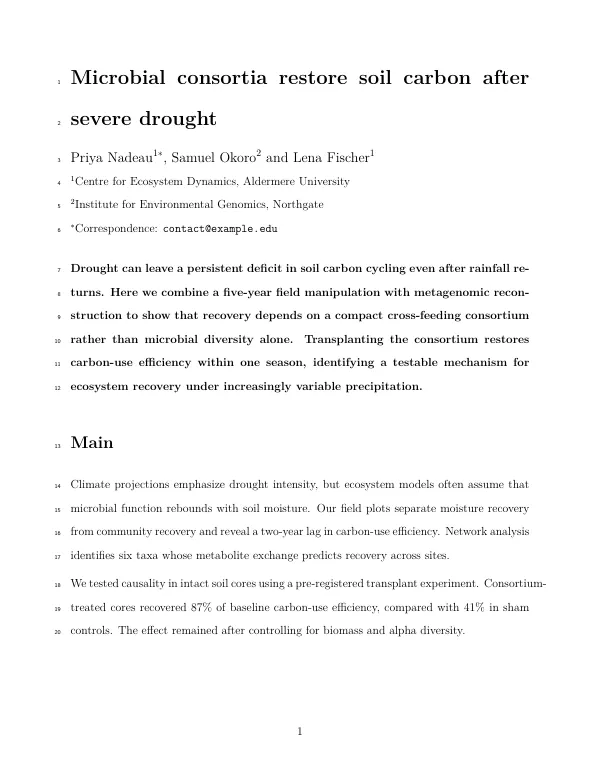
main.tex
% Nature style initial manuscript, recreated with standard packages only.
\documentclass[12pt]{article}
\usepackage[letterpaper,margin=1in]{geometry}
\usepackage{setspace}
\usepackage{lineno}
\usepackage{amsmath}
\usepackage{booktabs}
\usepackage[hidelinks]{hyperref}

\doublespacing
\linenumbers
\setlength{\parindent}{0pt}
\setlength{\parskip}{0.45em}

\begin{document}

{\LARGE\bfseries Microbial consortia restore soil carbon after severe drought\par}
\vspace{0.7em}
{\large Priya Nadeau$^{1*}$, Samuel Okoro$^2$ and Lena Fischer$^1$}\\
$^1$Centre for Ecosystem Dynamics, Aldermere University\\
$^2$Institute for Environmental Genomics, Northgate\\
$^*$Correspondence: \texttt{[email protected]}

\vspace{1em}
\textbf{Drought can leave a persistent deficit in soil carbon cycling even
after rainfall returns. Here we combine a five-year field manipulation with
metagenomic reconstruction to show that recovery depends on a compact
cross-feeding consortium rather than microbial diversity alone. Transplanting
the consortium restores carbon-use efficiency within one season, identifying
a testable mechanism for ecosystem recovery under increasingly variable
precipitation.}

\section*{Main}
Climate projections emphasize drought intensity, but ecosystem models often
assume that microbial function rebounds with soil moisture. Our field plots
separate moisture recovery from community recovery and reveal a two-year lag
in carbon-use efficiency. Network analysis identifies six taxa whose metabolite
exchange predicts recovery across sites.

We tested causality in intact soil cores using a pre-registered transplant
experiment. Consortium-treated cores recovered 87\% of baseline carbon-use
efficiency, compared with 41\% in sham controls. The effect remained after
controlling for biomass and alpha diversity.

\section*{Methods}
\textbf{Design and sampling.} Twenty-four plots were randomized to ambient,
moderate, or severe drought. Allocation, exclusions, and primary outcomes were
registered before the final sampling season.

\textbf{Statistics.} Two-sided hierarchical models included site and plot as
random effects. We report exact sample sizes, 95\% intervals, model diagnostics,
and every planned sensitivity analysis in the Supplementary Information.

\subsection*{Data availability}
Raw reads, processed abundance tables, and de-identified environmental
measurements will be deposited in stable repositories before publication.
Accession numbers and license terms belong here.

\subsection*{Code availability}
Analysis code, environment files, and figure-generation commands will be
archived with a permanent identifier.

\section*{References}
\begin{enumerate}
\item Researcher, A. et al. Microbial memory after climate extremes.
\textit{Ecology Letters} \textbf{28}, 100--112 (2025).
\end{enumerate}

\section*{Acknowledgements}
List funding, facilities, field assistance, and non-author contributions.

\section*{Author contributions}
P.N. designed the study. S.O. performed the genomic analysis. L.F. led the
field experiment. All authors interpreted results and revised the manuscript.

\section*{Competing interests}
The authors declare no competing interests.

\section*{Additional information}
Supplementary information accompanies this manuscript. Correspondence and
requests for materials should be addressed to the corresponding author.

\end{document}
Trong ứng dụng: mở thư viện Dự án mới, cài đặt gói {nhãn} trong "Nhận thêm mẫu" và mẫu này xuất hiện cùng với bản xem trước trực tiếp và tạo dự án chỉ bằng một cú nhấp chuột. Quá trình biên dịch chạy cục bộ trên công cụ đi kèm.