


Styles de préimpression de conférence
Manuscrit initial de style nature
Manuscrit inspiré de Nature prêt à être révisé avec numéros de ligne, paragraphe de résumé, méthodes, disponibilité, contributions et intérêts concurrents.
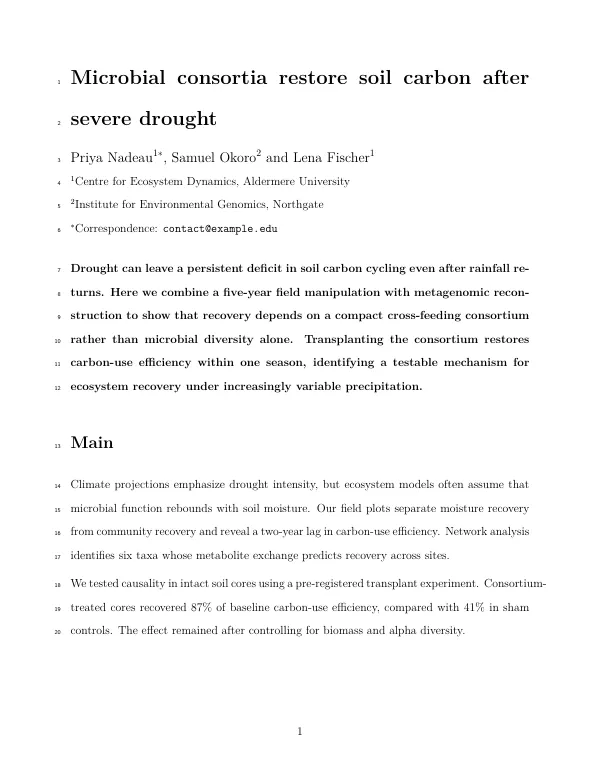
main.tex
% Nature style initial manuscript, recreated with standard packages only.
\documentclass[12pt]{article}
\usepackage[letterpaper,margin=1in]{geometry}
\usepackage{setspace}
\usepackage{lineno}
\usepackage{amsmath}
\usepackage{booktabs}
\usepackage[hidelinks]{hyperref}

\doublespacing
\linenumbers
\setlength{\parindent}{0pt}
\setlength{\parskip}{0.45em}

\begin{document}

{\LARGE\bfseries Microbial consortia restore soil carbon after severe drought\par}
\vspace{0.7em}
{\large Priya Nadeau$^{1*}$, Samuel Okoro$^2$ and Lena Fischer$^1$}\\
$^1$Centre for Ecosystem Dynamics, Aldermere University\\
$^2$Institute for Environmental Genomics, Northgate\\
$^*$Correspondence: \texttt{[email protected]}

\vspace{1em}
\textbf{Drought can leave a persistent deficit in soil carbon cycling even
after rainfall returns. Here we combine a five-year field manipulation with
metagenomic reconstruction to show that recovery depends on a compact
cross-feeding consortium rather than microbial diversity alone. Transplanting
the consortium restores carbon-use efficiency within one season, identifying
a testable mechanism for ecosystem recovery under increasingly variable
precipitation.}

\section*{Main}
Climate projections emphasize drought intensity, but ecosystem models often
assume that microbial function rebounds with soil moisture. Our field plots
separate moisture recovery from community recovery and reveal a two-year lag
in carbon-use efficiency. Network analysis identifies six taxa whose metabolite
exchange predicts recovery across sites.

We tested causality in intact soil cores using a pre-registered transplant
experiment. Consortium-treated cores recovered 87\% of baseline carbon-use
efficiency, compared with 41\% in sham controls. The effect remained after
controlling for biomass and alpha diversity.

\section*{Methods}
\textbf{Design and sampling.} Twenty-four plots were randomized to ambient,
moderate, or severe drought. Allocation, exclusions, and primary outcomes were
registered before the final sampling season.

\textbf{Statistics.} Two-sided hierarchical models included site and plot as
random effects. We report exact sample sizes, 95\% intervals, model diagnostics,
and every planned sensitivity analysis in the Supplementary Information.

\subsection*{Data availability}
Raw reads, processed abundance tables, and de-identified environmental
measurements will be deposited in stable repositories before publication.
Accession numbers and license terms belong here.

\subsection*{Code availability}
Analysis code, environment files, and figure-generation commands will be
archived with a permanent identifier.

\section*{References}
\begin{enumerate}
\item Researcher, A. et al. Microbial memory after climate extremes.
\textit{Ecology Letters} \textbf{28}, 100--112 (2025).
\end{enumerate}

\section*{Acknowledgements}
List funding, facilities, field assistance, and non-author contributions.

\section*{Author contributions}
P.N. designed the study. S.O. performed the genomic analysis. L.F. led the
field experiment. All authors interpreted results and revised the manuscript.

\section*{Competing interests}
The authors declare no competing interests.

\section*{Additional information}
Supplementary information accompanies this manuscript. Correspondence and
requests for materials should be addressed to the corresponding author.

\end{document}
Dans l'application : ouvrez la galerie Nouveau projet, installez le pack {étiquette} sous "Obtenir plus de modèles", et ce modèle apparaît avec un aperçu en direct et une création de projet en un clic. La compilation s'exécute localement sur le moteur fourni.