


Bộ vấn đề
Một bộ vấn đề tốt nghiệp với những vấn đề đầy thách thức và gợi ý.
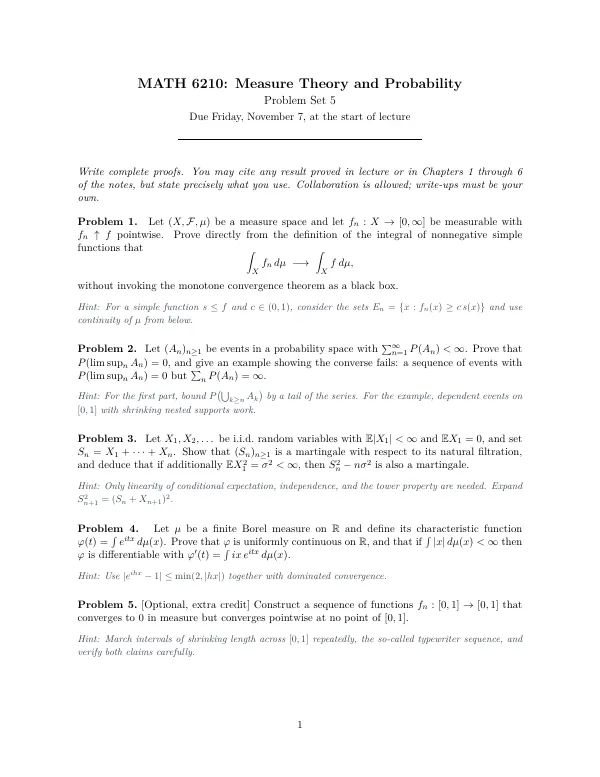
main.tex
\documentclass[11pt]{article}
\usepackage[margin=1.1in]{geometry}
\usepackage{amsmath,amssymb,amsthm}
\usepackage{lmodern}
\usepackage{xcolor}

\definecolor{accent}{HTML}{374151}
\pagestyle{plain}
\setlength{\parindent}{0pt}
\setlength{\parskip}{0.4em}

\newcounter{problem}
\newenvironment{problem}{%
  \refstepcounter{problem}%
  \par\medskip\noindent{\bfseries Problem \theproblem.}\ }{\par}
\newcommand{\hint}[1]{\par\smallskip{\small\itshape\color{accent} Hint: #1}\par\medskip}

\begin{document}

\begin{center}
  {\Large\bfseries MATH 6210: Measure Theory and Probability}\\[3pt]
  {\large Problem Set 5}\\[3pt]
  Due Friday, November 7, at the start of lecture\\[6pt]
  \rule{0.55\linewidth}{0.5pt}
\end{center}

\medskip
\textit{Write complete proofs. You may cite any result proved in lecture or
in Chapters 1 through 6 of the notes, but state precisely what you use.
Collaboration is allowed; write-ups must be your own.}

\begin{problem}
Let $(X, \mathcal{F}, \mu)$ be a measure space and let
$f_n : X \to [0, \infty]$ be measurable with $f_n \uparrow f$ pointwise.
Prove directly from the definition of the integral of nonnegative simple
functions that
\[
  \int_X f_n \, d\mu \;\longrightarrow\; \int_X f \, d\mu,
\]
without invoking the monotone convergence theorem as a black box.
\hint{For a simple function $s \le f$ and $c \in (0,1)$, consider the sets
$E_n = \{x : f_n(x) \ge c\, s(x)\}$ and use continuity of $\mu$ from below.}
\end{problem}

\begin{problem}
Let $(A_n)_{n \ge 1}$ be events in a probability space with
$\sum_{n=1}^{\infty} P(A_n) < \infty$. Prove that
$P(\limsup_n A_n) = 0$, and give an example showing the converse fails:
a sequence of events with $P(\limsup_n A_n) = 0$ but
$\sum_n P(A_n) = \infty$.
\hint{For the first part, bound
$P\bigl(\bigcup_{k \ge n} A_k\bigr)$ by a tail of the series. For the
example, dependent events on $[0,1]$ with shrinking nested supports work.}
\end{problem}

\begin{problem}
Let $X_1, X_2, \dots$ be i.i.d.\ random variables with
$\mathbb{E}|X_1| < \infty$ and $\mathbb{E}X_1 = 0$, and set
$S_n = X_1 + \dots + X_n$. Show that $(S_n)_{n\ge1}$ is a martingale with
respect to its natural filtration, and deduce that if additionally
$\mathbb{E}X_1^2 = \sigma^2 < \infty$, then $S_n^2 - n\sigma^2$ is also a
martingale.
\hint{Only linearity of conditional expectation, independence, and the
tower property are needed. Expand $S_{n+1}^2 = (S_n + X_{n+1})^2$.}
\end{problem}

\begin{problem}
Let $\mu$ be a finite Borel measure on $\mathbb{R}$ and define its
characteristic function $\varphi(t) = \int e^{itx}\, d\mu(x)$. Prove that
$\varphi$ is uniformly continuous on $\mathbb{R}$, and that if
$\int |x| \, d\mu(x) < \infty$ then $\varphi$ is differentiable with
$\varphi'(t) = \int i x\, e^{itx} \, d\mu(x)$.
\hint{Use $|e^{ihx} - 1| \le \min(2, |hx|)$ together with dominated
convergence.}
\end{problem}

\begin{problem}[Optional, extra credit]
Construct a sequence of functions $f_n : [0,1] \to [0,1]$ that converges to
$0$ in measure but converges pointwise at no point of $[0,1]$.
\hint{March intervals of shrinking length across $[0,1]$ repeatedly, the
so-called typewriter sequence, and verify both claims carefully.}
\end{problem}

\end{document}
Trong ứng dụng: mở thư viện Dự án mới, cài đặt gói {nhãn} trong "Nhận thêm mẫu" và mẫu này xuất hiện cùng với bản xem trước trực tiếp và tạo dự án chỉ bằng một cú nhấp chuột. Quá trình biên dịch chạy cục bộ trên công cụ đi kèm.