


Ensemble de problèmes
Un problème d'études supérieures composé de problèmes et d'indices difficiles.
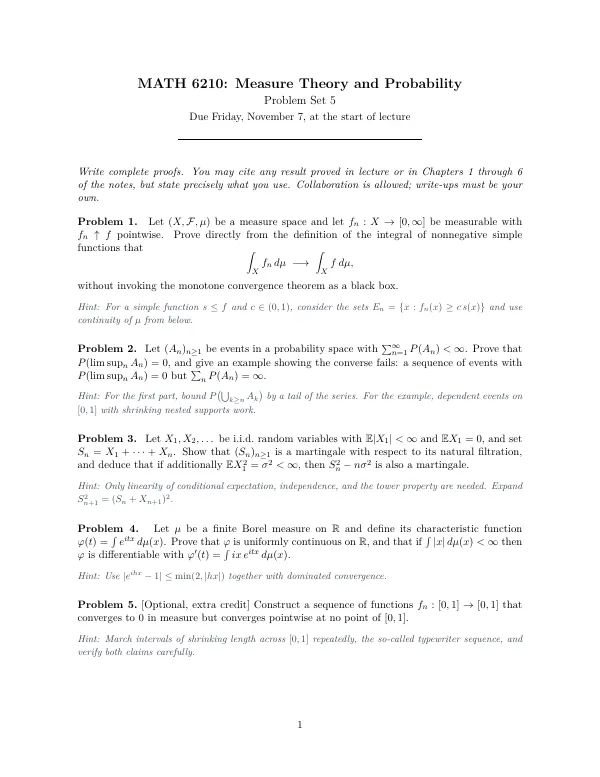
main.tex
\documentclass[11pt]{article}
\usepackage[margin=1.1in]{geometry}
\usepackage{amsmath,amssymb,amsthm}
\usepackage{lmodern}
\usepackage{xcolor}

\definecolor{accent}{HTML}{374151}
\pagestyle{plain}
\setlength{\parindent}{0pt}
\setlength{\parskip}{0.4em}

\newcounter{problem}
\newenvironment{problem}{%
  \refstepcounter{problem}%
  \par\medskip\noindent{\bfseries Problem \theproblem.}\ }{\par}
\newcommand{\hint}[1]{\par\smallskip{\small\itshape\color{accent} Hint: #1}\par\medskip}

\begin{document}

\begin{center}
  {\Large\bfseries MATH 6210: Measure Theory and Probability}\\[3pt]
  {\large Problem Set 5}\\[3pt]
  Due Friday, November 7, at the start of lecture\\[6pt]
  \rule{0.55\linewidth}{0.5pt}
\end{center}

\medskip
\textit{Write complete proofs. You may cite any result proved in lecture or
in Chapters 1 through 6 of the notes, but state precisely what you use.
Collaboration is allowed; write-ups must be your own.}

\begin{problem}
Let $(X, \mathcal{F}, \mu)$ be a measure space and let
$f_n : X \to [0, \infty]$ be measurable with $f_n \uparrow f$ pointwise.
Prove directly from the definition of the integral of nonnegative simple
functions that
\[
  \int_X f_n \, d\mu \;\longrightarrow\; \int_X f \, d\mu,
\]
without invoking the monotone convergence theorem as a black box.
\hint{For a simple function $s \le f$ and $c \in (0,1)$, consider the sets
$E_n = \{x : f_n(x) \ge c\, s(x)\}$ and use continuity of $\mu$ from below.}
\end{problem}

\begin{problem}
Let $(A_n)_{n \ge 1}$ be events in a probability space with
$\sum_{n=1}^{\infty} P(A_n) < \infty$. Prove that
$P(\limsup_n A_n) = 0$, and give an example showing the converse fails:
a sequence of events with $P(\limsup_n A_n) = 0$ but
$\sum_n P(A_n) = \infty$.
\hint{For the first part, bound
$P\bigl(\bigcup_{k \ge n} A_k\bigr)$ by a tail of the series. For the
example, dependent events on $[0,1]$ with shrinking nested supports work.}
\end{problem}

\begin{problem}
Let $X_1, X_2, \dots$ be i.i.d.\ random variables with
$\mathbb{E}|X_1| < \infty$ and $\mathbb{E}X_1 = 0$, and set
$S_n = X_1 + \dots + X_n$. Show that $(S_n)_{n\ge1}$ is a martingale with
respect to its natural filtration, and deduce that if additionally
$\mathbb{E}X_1^2 = \sigma^2 < \infty$, then $S_n^2 - n\sigma^2$ is also a
martingale.
\hint{Only linearity of conditional expectation, independence, and the
tower property are needed. Expand $S_{n+1}^2 = (S_n + X_{n+1})^2$.}
\end{problem}

\begin{problem}
Let $\mu$ be a finite Borel measure on $\mathbb{R}$ and define its
characteristic function $\varphi(t) = \int e^{itx}\, d\mu(x)$. Prove that
$\varphi$ is uniformly continuous on $\mathbb{R}$, and that if
$\int |x| \, d\mu(x) < \infty$ then $\varphi$ is differentiable with
$\varphi'(t) = \int i x\, e^{itx} \, d\mu(x)$.
\hint{Use $|e^{ihx} - 1| \le \min(2, |hx|)$ together with dominated
convergence.}
\end{problem}

\begin{problem}[Optional, extra credit]
Construct a sequence of functions $f_n : [0,1] \to [0,1]$ that converges to
$0$ in measure but converges pointwise at no point of $[0,1]$.
\hint{March intervals of shrinking length across $[0,1]$ repeatedly, the
so-called typewriter sequence, and verify both claims carefully.}
\end{problem}

\end{document}
Dans l'application : ouvrez la galerie Nouveau projet, installez le pack {étiquette} sous "Obtenir plus de modèles", et ce modèle apparaît avec un aperçu en direct et une création de projet en un clic. La compilation s'exécute localement sur le moteur fourni.