


Ghi chú toán học
Làm sạch các ghi chú toán học cá nhân với các định lý được đánh số và sơ đồ giao hoán.
main.tex
\documentclass[11pt]{article}
\usepackage[margin=1.1in]{geometry}
\usepackage{amsmath,amssymb,amsthm}
\usepackage{lmodern}
\usepackage{xcolor}
\usepackage{tikz-cd}

\definecolor{accent}{HTML}{065F46}

\theoremstyle{plain}
\newtheorem{theorem}{Theorem}[section]
\newtheorem{lemma}[theorem]{Lemma}
\theoremstyle{definition}
\newtheorem{definition}[theorem]{Definition}
\theoremstyle{remark}
\newtheorem*{remark}{Remark}

\setlength{\parindent}{0pt}
\setlength{\parskip}{0.55em}
\pagestyle{empty}

\begin{document}

\begin{center}
  {\Large\bfseries\color{accent} Notes: Group Homomorphisms and Quotients}\\[2pt]
  {\small personal notes, Algebra I, Chapter 3}
\end{center}

{\color{accent}\rule{\linewidth}{0.8pt}}

\section{First isomorphism theorem}

\begin{definition}[Group homomorphism]
Let $G$ and $H$ be groups. A map $\varphi : G \to H$ is a
\emph{homomorphism} if $\varphi(ab) = \varphi(a)\varphi(b)$ for all
$a, b \in G$. Its \emph{kernel} is
$\ker\varphi = \{ g \in G : \varphi(g) = e_H \}$.
\end{definition}

\begin{lemma}
For any homomorphism $\varphi : G \to H$, the kernel $\ker\varphi$ is a
normal subgroup of $G$.
\end{lemma}

\emph{Proof.} It is a subgroup by the usual checks. For normality, let
$k \in \ker\varphi$ and $g \in G$. Then
$\varphi(gkg^{-1}) = \varphi(g)\varphi(k)\varphi(g)^{-1}
  = \varphi(g)\,e_H\,\varphi(g)^{-1} = e_H$,
so $gkg^{-1} \in \ker\varphi$. \qedsymbol

\begin{theorem}[First isomorphism theorem]
Let $\varphi : G \to H$ be a homomorphism. Then
$G / \ker\varphi \cong \operatorname{im}\varphi$.
\end{theorem}

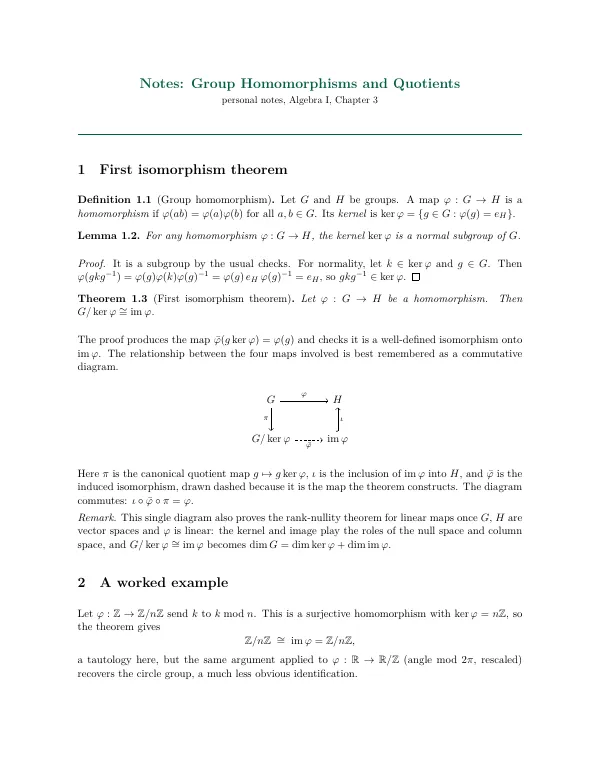
The proof produces the map $\bar\varphi(g\ker\varphi) = \varphi(g)$ and
checks it is a well-defined isomorphism onto $\operatorname{im}\varphi$.
The relationship between the four maps involved is best remembered as a
commutative diagram.

\begin{center}
\begin{tikzcd}[column sep=2.6em, row sep=2.2em]
  G \arrow[r, "\varphi"] \arrow[d, swap, "\pi"] & H \\
  G/\ker\varphi \arrow[r, swap, "\bar\varphi", dashed]
    & \operatorname{im}\varphi \arrow[u, swap, hook, "\iota"]
\end{tikzcd}
\end{center}

Here $\pi$ is the canonical quotient map $g \mapsto g\ker\varphi$, $\iota$
is the inclusion of $\operatorname{im}\varphi$ into $H$, and $\bar\varphi$
is the induced isomorphism, drawn dashed because it is the map the
theorem constructs. The diagram commutes: $\iota \circ \bar\varphi \circ
\pi = \varphi$.

\begin{remark}
This single diagram also proves the rank-nullity theorem for linear maps
once $G$, $H$ are vector spaces and $\varphi$ is linear: the kernel and
image play the roles of the null space and column space, and
$G/\ker\varphi \cong \operatorname{im}\varphi$ becomes
$\dim G = \dim\ker\varphi + \dim\operatorname{im}\varphi$.
\end{remark}

\section{A worked example}

Let $\varphi : \mathbb{Z} \to \mathbb{Z}/n\mathbb{Z}$ send $k$ to
$k \bmod n$. This is a surjective homomorphism with
$\ker\varphi = n\mathbb{Z}$, so the theorem gives
\[
  \mathbb{Z} / n\mathbb{Z} \;\cong\; \operatorname{im}\varphi
  = \mathbb{Z}/n\mathbb{Z},
\]
a tautology here, but the same argument applied to
$\varphi : \mathbb{R} \to \mathbb{R}/\mathbb{Z}$ (angle mod $2\pi$,
rescaled) recovers the circle group, a much less obvious identification.

\end{document}
Trong ứng dụng: mở thư viện Dự án mới, cài đặt gói {nhãn} trong "Nhận thêm mẫu" và mẫu này xuất hiện cùng với bản xem trước trực tiếp và tạo dự án chỉ bằng một cú nhấp chuột. Quá trình biên dịch chạy cục bộ trên công cụ đi kèm.