


Notes mathématiques
Notes mathématiques personnelles claires avec des théorèmes numérotés et un diagramme commutatif.
main.tex
\documentclass[11pt]{article}
\usepackage[margin=1.1in]{geometry}
\usepackage{amsmath,amssymb,amsthm}
\usepackage{lmodern}
\usepackage{xcolor}
\usepackage{tikz-cd}

\definecolor{accent}{HTML}{065F46}

\theoremstyle{plain}
\newtheorem{theorem}{Theorem}[section]
\newtheorem{lemma}[theorem]{Lemma}
\theoremstyle{definition}
\newtheorem{definition}[theorem]{Definition}
\theoremstyle{remark}
\newtheorem*{remark}{Remark}

\setlength{\parindent}{0pt}
\setlength{\parskip}{0.55em}
\pagestyle{empty}

\begin{document}

\begin{center}
  {\Large\bfseries\color{accent} Notes: Group Homomorphisms and Quotients}\\[2pt]
  {\small personal notes, Algebra I, Chapter 3}
\end{center}

{\color{accent}\rule{\linewidth}{0.8pt}}

\section{First isomorphism theorem}

\begin{definition}[Group homomorphism]
Let $G$ and $H$ be groups. A map $\varphi : G \to H$ is a
\emph{homomorphism} if $\varphi(ab) = \varphi(a)\varphi(b)$ for all
$a, b \in G$. Its \emph{kernel} is
$\ker\varphi = \{ g \in G : \varphi(g) = e_H \}$.
\end{definition}

\begin{lemma}
For any homomorphism $\varphi : G \to H$, the kernel $\ker\varphi$ is a
normal subgroup of $G$.
\end{lemma}

\emph{Proof.} It is a subgroup by the usual checks. For normality, let
$k \in \ker\varphi$ and $g \in G$. Then
$\varphi(gkg^{-1}) = \varphi(g)\varphi(k)\varphi(g)^{-1}
  = \varphi(g)\,e_H\,\varphi(g)^{-1} = e_H$,
so $gkg^{-1} \in \ker\varphi$. \qedsymbol

\begin{theorem}[First isomorphism theorem]
Let $\varphi : G \to H$ be a homomorphism. Then
$G / \ker\varphi \cong \operatorname{im}\varphi$.
\end{theorem}

The proof produces the map $\bar\varphi(g\ker\varphi) = \varphi(g)$ and
checks it is a well-defined isomorphism onto $\operatorname{im}\varphi$.
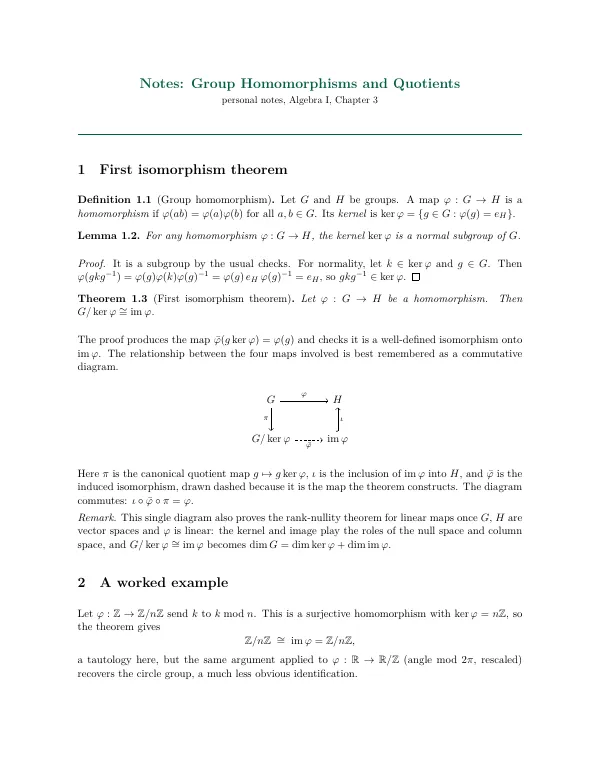
The relationship between the four maps involved is best remembered as a
commutative diagram.

\begin{center}
\begin{tikzcd}[column sep=2.6em, row sep=2.2em]
  G \arrow[r, "\varphi"] \arrow[d, swap, "\pi"] & H \\
  G/\ker\varphi \arrow[r, swap, "\bar\varphi", dashed]
    & \operatorname{im}\varphi \arrow[u, swap, hook, "\iota"]
\end{tikzcd}
\end{center}

Here $\pi$ is the canonical quotient map $g \mapsto g\ker\varphi$, $\iota$
is the inclusion of $\operatorname{im}\varphi$ into $H$, and $\bar\varphi$
is the induced isomorphism, drawn dashed because it is the map the
theorem constructs. The diagram commutes: $\iota \circ \bar\varphi \circ
\pi = \varphi$.

\begin{remark}
This single diagram also proves the rank-nullity theorem for linear maps
once $G$, $H$ are vector spaces and $\varphi$ is linear: the kernel and
image play the roles of the null space and column space, and
$G/\ker\varphi \cong \operatorname{im}\varphi$ becomes
$\dim G = \dim\ker\varphi + \dim\operatorname{im}\varphi$.
\end{remark}

\section{A worked example}

Let $\varphi : \mathbb{Z} \to \mathbb{Z}/n\mathbb{Z}$ send $k$ to
$k \bmod n$. This is a surjective homomorphism with
$\ker\varphi = n\mathbb{Z}$, so the theorem gives
\[
  \mathbb{Z} / n\mathbb{Z} \;\cong\; \operatorname{im}\varphi
  = \mathbb{Z}/n\mathbb{Z},
\]
a tautology here, but the same argument applied to
$\varphi : \mathbb{R} \to \mathbb{R}/\mathbb{Z}$ (angle mod $2\pi$,
rescaled) recovers the circle group, a much less obvious identification.

\end{document}
Dans l'application : ouvrez la galerie Nouveau projet, installez le pack {étiquette} sous "Obtenir plus de modèles", et ce modèle apparaît avec un aperçu en direct et une création de projet en un clic. La compilation s'exécute localement sur le moteur fourni.