


USENIX Style Systems Paper
USENIX inspired two-column systems paper with design, evaluation, ethics, artifact availability, and limitations sections.
main.tex
% USENIX style paper, recreated with standard packages only.
\documentclass[10pt,twocolumn]{article}
\usepackage[letterpaper,textwidth=7in,textheight=9in,top=1in]{geometry}
\usepackage{mathptmx}
\usepackage{amsmath}
\usepackage{booktabs}
\usepackage{titlesec}
\usepackage[hidelinks]{hyperref}

\setlength{\columnsep}{0.33in}
\setlength{\parindent}{1em}
\setlength{\parskip}{0pt}
\pagestyle{plain}
\titleformat{\section}{\large\bfseries}{\thesection}{0.5em}{}
\titleformat{\subsection}{\normalsize\bfseries}{\thesubsection}{0.5em}{}
\titlespacing*{\section}{0pt}{1.4ex plus .3ex}{0.7ex}

\begin{document}
\twocolumn[{
\centering
{\Large\bfseries Quorum: Predictable Recovery for Geo-Replicated Stores\par}
\vskip 12pt
{\large Anonymous submission}
\vskip 18pt
}]

\begin{abstract}
\noindent Partial network partitions make storage recovery unpredictable even
when every replica remains healthy. Quorum synthesizes adversarial connectivity
schedules from a protocol model and replays them against an unmodified cluster.
Across three systems, it finds seven recovery stalls missed by random fault
injection and reduces regression suites from hours to eleven minutes.
\end{abstract}

\section{Introduction}
Production storage incidents often preserve some paths while breaking others.
Randomly dropping links rarely generates these correlated patterns. Quorum
turns a protocol specification into a small, versioned fault corpus that can be
run in continuous integration. Our evaluation answers three questions: whether
the schedules expose new failures, whether the failures reproduce, and whether
the suite is cheap enough for every change.

\section{Design}
The search maximizes time without a successful write under a fixed fault budget:
\begin{equation}
  \max_{\pi\in\Pi_b} T_{\mathrm{recover}}(\pi).
\end{equation}
Schedules are minimized after discovery, stored as human-readable event traces,
and replayed through ordinary network controls.

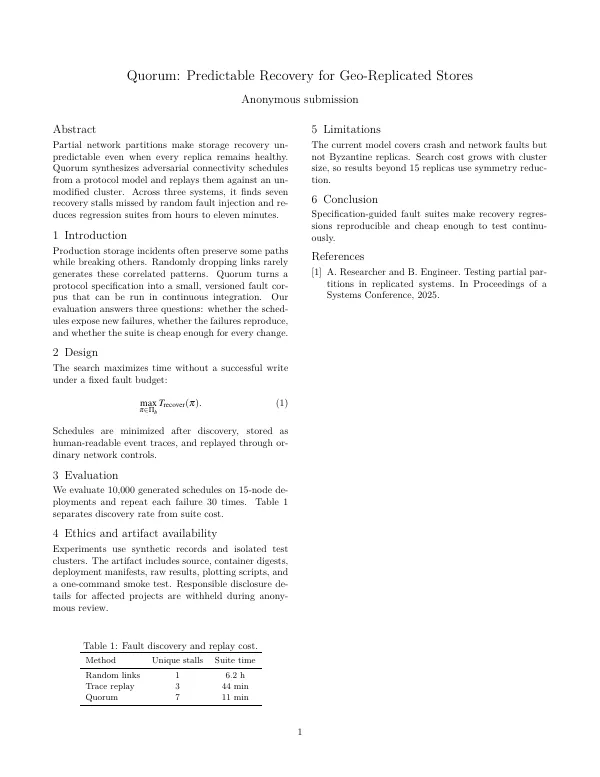
\section{Evaluation}
We evaluate 10{,}000 generated schedules on 15-node deployments and repeat each
failure 30 times. Table~\ref{tab:results} separates discovery rate from suite
cost.
\begin{table}[b]
\caption{Fault discovery and replay cost.}
\label{tab:results}
\centering
\small
\begin{tabular}{lcc}
\toprule
Method & Unique stalls & Suite time \\
\midrule
Random links & 1 & 6.2 h \\
Trace replay & 3 & 44 min \\
Quorum & \textbf{7} & \textbf{11 min} \\
\bottomrule
\end{tabular}
\end{table}

\section{Ethics and artifact availability}
Experiments use synthetic records and isolated test clusters. The artifact
includes source, container digests, deployment manifests, raw results, plotting
scripts, and a one-command smoke test. Responsible disclosure details for
affected projects are withheld during anonymous review.

\section{Limitations}
The current model covers crash and network faults but not Byzantine replicas.
Search cost grows with cluster size, so results beyond 15 replicas use symmetry
reduction.

\section{Conclusion}
Specification-guided fault suites make recovery regressions reproducible and
cheap enough to test continuously.

\begin{thebibliography}{9}
\bibitem{example} A. Researcher and B. Engineer.
Testing partial partitions in replicated systems.
In \textit{Proceedings of a Systems Conference}, 2025.
\end{thebibliography}
\end{document}
In the app: open the New Project gallery, install the Conference preprint styles pack under "Get more templates", and this template appears with a live preview and one-click project creation. Compilation runs locally on the bundled engine.