


Research Proposal
A structured research proposal with specific aims, background, methodology, and a project timeline table.
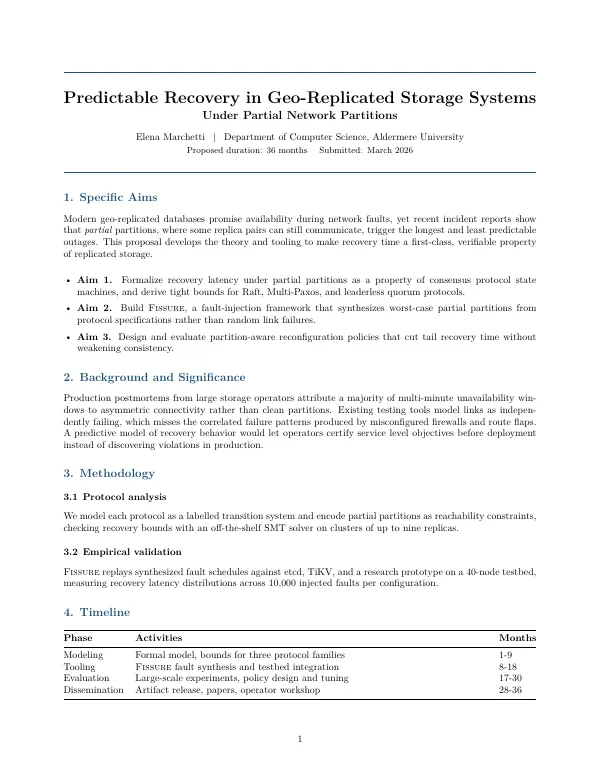
main.tex
\documentclass[10pt]{article}
\usepackage[margin=0.9in]{geometry}
\usepackage{xcolor}
\usepackage{titlesec}
\usepackage{booktabs}
\usepackage{tabularx}
\usepackage{enumitem}
\usepackage[hidelinks]{hyperref}

\definecolor{accent}{HTML}{1F4E79}
\titleformat{\section}{\large\bfseries\color{accent}}{\thesection.}{0.5em}{}
\titlespacing*{\section}{0pt}{1.1em}{0.4em}
\titleformat{\subsection}{\normalsize\bfseries}{\thesubsection}{0.5em}{}
\titlespacing*{\subsection}{0pt}{0.8em}{0.3em}
\setlength{\parindent}{0pt}
\setlength{\parskip}{0.5em}

\begin{document}

\begin{center}
  {\color{accent}\rule{\textwidth}{1.5pt}}\\[0.9em]
  {\LARGE\bfseries Predictable Recovery in Geo-Replicated Storage Systems\\[0.25em]
   \large Under Partial Network Partitions}\\[0.9em]
  {\normalsize Elena Marchetti \, | \, Department of Computer Science, Aldermere University}\\[0.2em]
  {\small Proposed duration: 36 months \quad Submitted: March 2026}\\[0.7em]
  {\color{accent}\rule{\textwidth}{0.6pt}}
\end{center}

\section{Specific Aims}
Modern geo-replicated databases promise availability during network faults, yet
recent incident reports show that \emph{partial} partitions, where some replica
pairs can still communicate, trigger the longest and least predictable outages.
This proposal develops the theory and tooling to make recovery time a
first-class, verifiable property of replicated storage.

\begin{itemize}[leftmargin=1.4em, itemsep=0.1em]
  \item \textbf{Aim 1.} Formalize recovery latency under partial partitions as a
        property of consensus protocol state machines, and derive tight bounds
        for Raft, Multi-Paxos, and leaderless quorum protocols.
  \item \textbf{Aim 2.} Build \textsc{Fissure}, a fault-injection framework that
        synthesizes worst-case partial partitions from protocol specifications
        rather than random link failures.
  \item \textbf{Aim 3.} Design and evaluate partition-aware reconfiguration
        policies that cut tail recovery time without weakening consistency.
\end{itemize}

\section{Background and Significance}
Production postmortems from large storage operators attribute a majority of
multi-minute unavailability windows to asymmetric connectivity rather than
clean partitions. Existing testing tools model links as independently failing,
which misses the correlated failure patterns produced by misconfigured
firewalls and route flaps. A predictive model of recovery behavior would let
operators certify service level objectives before deployment instead of
discovering violations in production.

\section{Methodology}
\subsection{Protocol analysis}
We model each protocol as a labelled transition system and encode partial
partitions as reachability constraints, checking recovery bounds with an
off-the-shelf SMT solver on clusters of up to nine replicas.

\subsection{Empirical validation}
\textsc{Fissure} replays synthesized fault schedules against etcd, TiKV, and a
research prototype on a 40-node testbed, measuring recovery latency
distributions across 10,000 injected faults per configuration.

\section{Timeline}
\begin{tabularx}{\textwidth}{@{}lXl@{}}
\toprule
\textbf{Phase} & \textbf{Activities} & \textbf{Months} \\
\midrule
Modeling      & Formal model, bounds for three protocol families & 1-9 \\
Tooling       & \textsc{Fissure} fault synthesis and testbed integration & 8-18 \\
Evaluation    & Large-scale experiments, policy design and tuning & 17-30 \\
Dissemination & Artifact release, papers, operator workshop & 28-36 \\
\bottomrule
\end{tabularx}

\end{document}
In the app: open the New Project gallery, install the Academic writing pack under "Get more templates", and this template appears with a live preview and one-click project creation. Compilation runs locally on the bundled engine.