


NeurIPS 2026 Style Research Paper
NeurIPS 2026 inspired research paper with anonymous review mode, results table, limitations, broader impacts, and a reproducibility checklist.
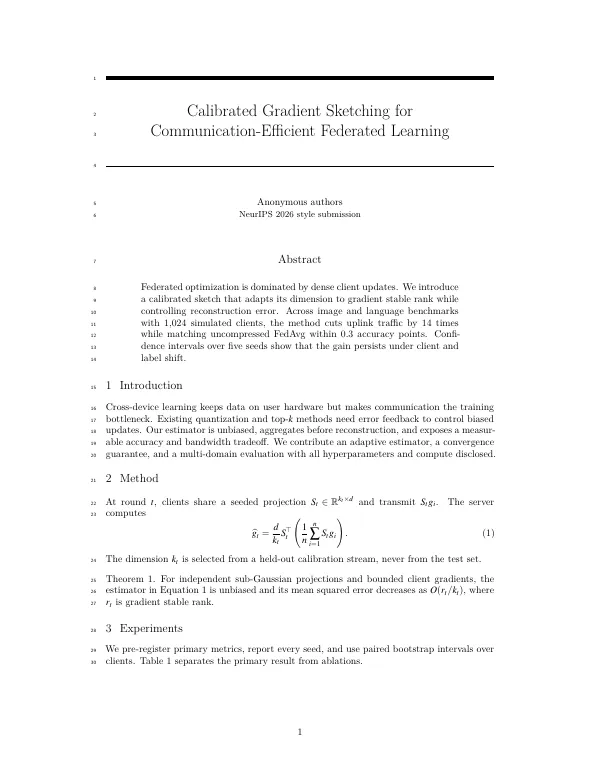
main.tex
% NeurIPS 2026 inspired paper, recreated with standard packages only.
% Before submission, move the content into the official current-year author kit.
\documentclass[10pt]{article}
\usepackage[letterpaper,textwidth=5.5in,textheight=9in,top=1in]{geometry}
\usepackage{mathptmx}
\usepackage{amsmath,amssymb,amsthm}
\usepackage{booktabs}
\usepackage{microtype}
\usepackage{titlesec}
\usepackage{lineno}
\usepackage[hidelinks]{hyperref}

% Set \anonymousfalse for a public preprint or camera-ready manuscript.
\newif\ifanonymous
\anonymoustrue

\titleformat{\section}{\large\bfseries}{\thesection}{0.7em}{}
\titleformat{\subsection}{\normalsize\bfseries}{\thesubsection}{0.7em}{}
\titlespacing*{\section}{0pt}{1.5ex plus .4ex}{0.8ex}
\titlespacing*{\subsection}{0pt}{1.2ex plus .3ex}{0.6ex}
\setlength{\parindent}{0pt}
\setlength{\parskip}{5.5pt}
\newtheorem{theorem}{Theorem}

\begin{document}
\ifanonymous\linenumbers\fi

\noindent\rule{\textwidth}{4pt}
\begin{center}
  \vspace{4pt}
  {\bfseries\fontsize{17}{20}\selectfont Calibrated Gradient Sketching for\\
  Communication-Efficient Federated Learning\par}
  \vspace{6pt}
\end{center}
\noindent\rule{\textwidth}{1pt}

\vspace{12pt}
\begin{center}
\ifanonymous
  {\bfseries Anonymous authors}\\
  {\small NeurIPS 2026 style submission}
\else
  {\bfseries Maya Lindqvist \quad Daniel Okafor \quad Elena Marchetti}\\
  {\small Aalto University \quad University of Edinburgh \quad ETH Zurich}\\
  {\small\texttt{[email protected]}}
\fi
\end{center}

\vspace{10pt}
\begin{center}{\bfseries\large Abstract}\end{center}
\begin{list}{}{\leftmargin=0.5in\rightmargin=0.5in}\item\relax
Federated optimization is dominated by dense client updates. We introduce a
calibrated sketch that adapts its dimension to gradient stable rank while
controlling reconstruction error. Across image and language benchmarks with
1{,}024 simulated clients, the method cuts uplink traffic by 14 times while
matching uncompressed FedAvg within 0.3 accuracy points. Confidence intervals
over five seeds show that the gain persists under client and label shift.
\end{list}

\section{Introduction}
Cross-device learning keeps data on user hardware but makes communication the
training bottleneck. Existing quantization and top-$k$ methods need error
feedback to control biased updates. Our estimator is unbiased, aggregates
before reconstruction, and exposes a measurable accuracy and bandwidth
tradeoff. We contribute an adaptive estimator, a convergence guarantee, and a
multi-domain evaluation with all hyperparameters and compute disclosed.

\section{Method}
At round $t$, clients share a seeded projection
$S_t\in\mathbb{R}^{k_t\times d}$ and transmit $S_tg_i$. The server computes
\begin{equation}
  \widehat g_t=\frac{d}{k_t}S_t^\top
  \left(\frac{1}{n}\sum_{i=1}^{n}S_tg_i\right).
  \label{eq:sketch}
\end{equation}
The dimension $k_t$ is selected from a held-out calibration stream, never from
the test set.

\begin{theorem}
For independent sub-Gaussian projections and bounded client gradients,
the estimator in Equation~\ref{eq:sketch} is unbiased and its mean squared
error decreases as $O(r_t/k_t)$, where $r_t$ is gradient stable rank.
\end{theorem}

\section{Experiments}
We pre-register primary metrics, report every seed, and use paired bootstrap
intervals over clients. Table~\ref{tab:results} separates the primary result
from ablations.

\begin{table}[h]
\caption{Mean test accuracy and client upload per round. Intervals are 95\%
bootstrap confidence intervals across five seeds.}
\label{tab:results}
\centering
\small
\begin{tabular}{lcc}
\toprule
Method & Accuracy (\%) & Upload (MB) \\
\midrule
FedAvg & $84.7\pm0.2$ & 48.0 \\
Top-$k$ with feedback & $84.4\pm0.4$ & 6.2 \\
Calibrated sketch & $\mathbf{84.6\pm0.2}$ & $\mathbf{3.4}$ \\
\bottomrule
\end{tabular}
\end{table}

\section{Limitations and broader impacts}
The calibration assumes that recent gradient spectra predict the next round,
which can fail after abrupt population shifts. Communication savings may widen
access to federated training, but more efficient training can also increase
the scale of privacy-sensitive deployments. The method is not a replacement
for differential privacy, secure aggregation, or participant consent.

\section*{Reproducibility checklist}
\begin{itemize}
  \item Claims, assumptions, and theorem scope are stated next to the results.
  \item Dataset versions, licenses, splits, and preprocessing are documented.
  \item Every hyperparameter, seed, stopping rule, and selection metric is listed.
  \item Hardware, runtime, memory, and total compute are reported.
  \item Error bars are defined, and raw per-seed results accompany the artifact.
  \item Code, environment lockfile, and exact reproduction commands are archived.
\end{itemize}

\begin{thebibliography}{9}
\bibitem{example1} A. Researcher and B. Scientist.
Communication-efficient learning with unbiased sketches.
\textit{Transactions on Machine Learning Research}, 2025.
\bibitem{example2} C. Analyst.
Reliable uncertainty reporting for multi-seed benchmarks.
\textit{Journal of Machine Learning Research}, 27:1--31, 2026.
\end{thebibliography}

\end{document}
In the app: open the New Project gallery, install the Conference preprint styles pack under "Get more templates", and this template appears with a live preview and one-click project creation. Compilation runs locally on the bundled engine.