


Journal Manuscript (Submission)
A double-spaced, line-numbered journal manuscript with a title page in the style journals request for review.
main.tex
\documentclass[12pt]{article}
\usepackage[margin=1in]{geometry}
\usepackage{setspace}
\usepackage{lineno}
\usepackage[hidelinks]{hyperref}

\doublespacing
\linenumbers
\setlength{\parindent}{0.4in}

\begin{document}

% ---------- Title page ----------
\begin{titlepage}
\begin{center}
\vspace*{1.2in}
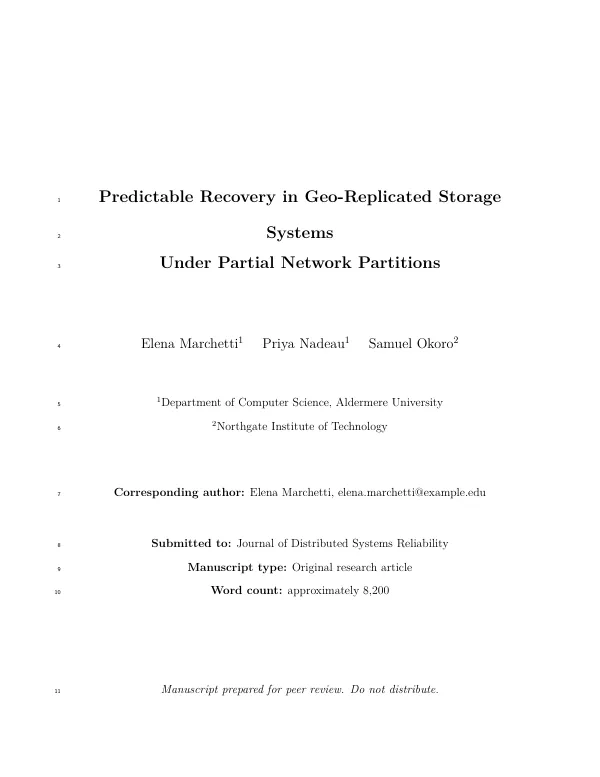
{\Large\bfseries Predictable Recovery in Geo-Replicated Storage Systems\\[0.4em]
Under Partial Network Partitions}\\[0.8in]

{\large Elena Marchetti$^{1}$ \quad Priya Nadeau$^{1}$ \quad Samuel Okoro$^{2}$}\\[0.5in]

$^{1}$Department of Computer Science, Aldermere University\\
$^{2}$Northgate Institute of Technology\\[0.6in]

\textbf{Corresponding author:} Elena Marchetti, [email protected]\\[0.4in]

\textbf{Submitted to:} Journal of Distributed Systems Reliability\\
\textbf{Manuscript type:} Original research article\\
\textbf{Word count:} approximately 8{,}200
\end{center}
\vfill
\begin{center}
\textit{Manuscript prepared for peer review. Do not distribute.}
\end{center}
\end{titlepage}

% ---------- Body ----------
\begin{center}
{\large\bfseries Abstract}
\end{center}
\noindent Geo-replicated storage systems are engineered to remain available
during network faults, yet operational experience shows that partial network
partitions, in which some replica pairs retain connectivity while others do
not, cause the longest and least predictable outages. We present a formal model
of recovery latency under asymmetric connectivity and derive tight bounds for
leader-based and leaderless consensus protocols. We further introduce a fault
synthesis method that constructs worst-case partitions from a protocol
specification and evaluate it on a 40-node testbed. Synthesized faults reproduce
three published production incidents that randomized testing failed to surface.

\bigskip
\noindent\textbf{Keywords:} distributed systems, consensus, fault tolerance,
network partitions, reliability testing

\section{Introduction}
Replication across geographic regions is the standard defense against
correlated failure in modern storage infrastructure. The implicit assumption
behind most designs is that network faults are symmetric, that a severed link
disrupts communication equally in both directions. Field studies contradict this
assumption. Asymmetric faults arising from one-directional firewall rules and
transient congestion produce a distinct failure mode in which a cluster neither
fails cleanly nor continues correctly. In this paper we treat recovery latency
under such faults as a property to be modeled, bounded, and tested rather than
observed only in production.

\section{Background}
We review the consensus protocols relevant to wide-area replication and the
existing literature on fault injection, then identify the gap that motivates our
approach: current tools sample link failures at random and therefore rarely
construct the correlated, asymmetric partitions that dominate real incidents.

\end{document}
In the app: open the New Project gallery, install the Academic writing pack under "Get more templates", and this template appears with a live preview and one-click project creation. Compilation runs locally on the bundled engine.