


Literature Review
A structured literature review with themed sections and a synthesis matrix comparing prior work.
main.tex
\documentclass[11pt]{article}
\usepackage[margin=1in]{geometry}
\usepackage{xcolor}
\usepackage{titlesec}
\usepackage{booktabs}
\usepackage{tabularx}
\usepackage[hidelinks]{hyperref}

\definecolor{accent}{HTML}{5B3A8C}
\titleformat{\section}{\large\bfseries\color{accent}}{\thesection}{0.6em}{}
\titlespacing*{\section}{0pt}{1.0em}{0.35em}
\setlength{\parindent}{0pt}
\setlength{\parskip}{0.5em}
\newcolumntype{C}{>{\centering\arraybackslash}X}

\begin{document}

\begin{center}
  {\LARGE\bfseries A Review of Fault-Tolerant Consensus in\\ Wide-Area Distributed Systems}\\[0.4em]
  {\normalsize Elena Marchetti \quad\textbullet\quad Aldermere University}\\[0.3em]
  {\small\color{accent}\rule{0.35\textwidth}{0.8pt}}
\end{center}

\vspace{0.3em}
This review surveys two decades of work on agreement protocols for
geographically distributed replicas, organized around three themes: latency
optimization, membership reconfiguration, and behavior under asymmetric faults.
We close with a synthesis matrix that positions each line of work along the
dimensions most relevant to practitioners.

\section{Latency-Optimized Agreement}
Early leader-based protocols paid a round trip to a single coordinator, a cost
that dominates in wide-area settings. Leaderless and quorum-rotation designs
reduced this by letting any replica propose, at the price of higher conflict
rates under contention. The consensus of this literature is that no single
placement wins across workloads, motivating adaptive designs.

\section{Reconfiguration and Membership}
A second thread treats the replica set as dynamic. Joint-consensus approaches
change membership through an intermediate configuration, while lease-based
schemes trade availability for simpler reasoning. Reported failure cases
cluster around reconfiguration that overlaps with network faults.

\section{Behavior Under Asymmetric Faults}
The most recent and least settled theme concerns partial partitions. Field
studies show these faults dominate real outages, yet formal treatment remains
thin, and most testing tools still assume symmetric link failure.

\section{Synthesis Matrix}
\begin{tabularx}{\textwidth}{@{}lCCCC@{}}
\toprule
\textbf{Line of work} & \textbf{WAN latency} & \textbf{Dynamic membership} & \textbf{Partial partitions} & \textbf{Formal proof} \\
\midrule
Leader-based    & Weak   & Partial & No      & Strong \\
Leaderless      & Strong & Partial & Partial & Partial \\
Quorum rotation & Strong & Weak    & No      & Partial \\
Reconfigurable  & Partial& Strong  & Weak    & Strong \\
Partition-aware & Partial& Partial & Strong  & Weak   \\
\bottomrule
\end{tabularx}

\vspace{0.4em}
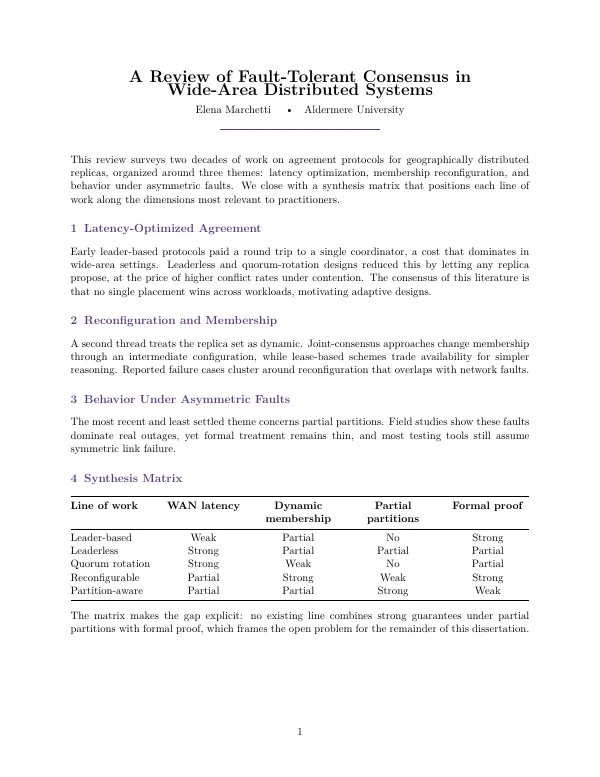
The matrix makes the gap explicit: no existing line combines strong guarantees
under partial partitions with formal proof, which frames the open problem for
the remainder of this dissertation.

\end{document}
In the app: open the New Project gallery, install the Academic writing pack under "Get more templates", and this template appears with a live preview and one-click project creation. Compilation runs locally on the bundled engine.