


Academic Essay
A double-spaced MLA-like academic essay with a student header block and running title.
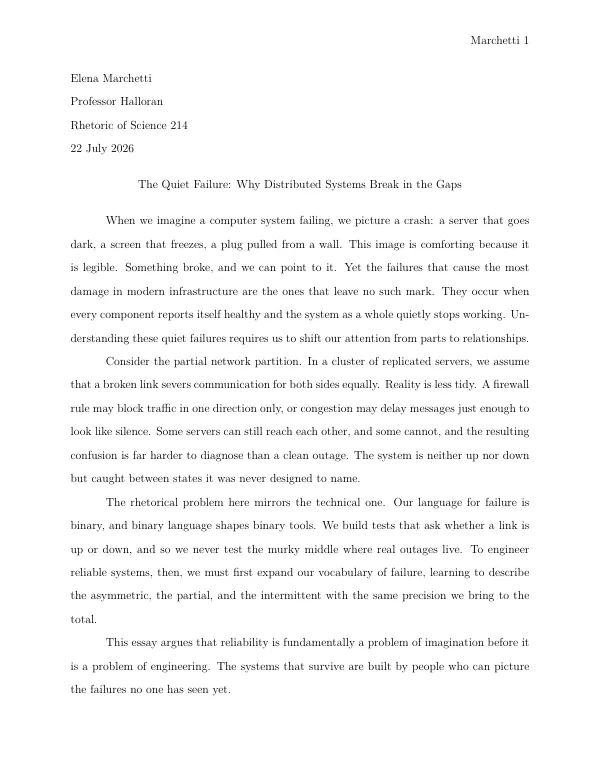
main.tex
\documentclass[12pt]{article}
\usepackage[margin=1in]{geometry}
\usepackage{setspace}
\usepackage{fancyhdr}
\usepackage[hidelinks]{hyperref}

\pagestyle{fancy}
\fancyhf{}
\rhead{Marchetti \thepage}
\renewcommand{\headrulewidth}{0pt}
\setlength{\parindent}{0.5in}
\doublespacing

\begin{document}

\begin{flushleft}
Elena Marchetti\\
Professor Halloran\\
Rhetoric of Science 214\\
22 July 2026
\end{flushleft}

\begin{center}
The Quiet Failure: Why Distributed Systems Break in the Gaps
\end{center}

When we imagine a computer system failing, we picture a crash: a server that
goes dark, a screen that freezes, a plug pulled from a wall. This image is
comforting because it is legible. Something broke, and we can point to it. Yet
the failures that cause the most damage in modern infrastructure are the ones
that leave no such mark. They occur when every component reports itself healthy
and the system as a whole quietly stops working. Understanding these quiet
failures requires us to shift our attention from parts to relationships.

Consider the partial network partition. In a cluster of replicated servers, we
assume that a broken link severs communication for both sides equally. Reality
is less tidy. A firewall rule may block traffic in one direction only, or
congestion may delay messages just enough to look like silence. Some servers can
still reach each other, and some cannot, and the resulting confusion is far
harder to diagnose than a clean outage. The system is neither up nor down but
caught between states it was never designed to name.

The rhetorical problem here mirrors the technical one. Our language for failure
is binary, and binary language shapes binary tools. We build tests that ask
whether a link is up or down, and so we never test the murky middle where real
outages live. To engineer reliable systems, then, we must first expand our
vocabulary of failure, learning to describe the asymmetric, the partial, and the
intermittent with the same precision we bring to the total.

This essay argues that reliability is fundamentally a problem of imagination
before it is a problem of engineering. The systems that survive are built by
people who can picture the failures no one has seen yet.

\end{document}
In the app: open the New Project gallery, install the Academic writing pack under "Get more templates", and this template appears with a live preview and one-click project creation. Compilation runs locally on the bundled engine.