


arXiv Preprint
Clean single column preprint with an arXiv style rotated identifier stamp in the left margin.
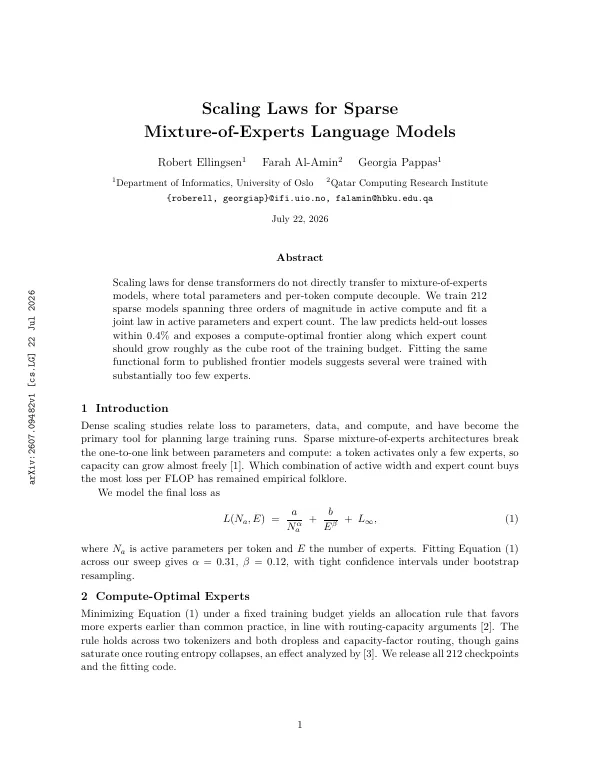
main.tex
% arXiv style preprint with a rotated margin stamp, standard packages only.
\documentclass[11pt]{article}
\usepackage[letterpaper,textwidth=6.2in,textheight=8.9in,top=1in]{geometry}
\usepackage{lmodern}
\usepackage{amsmath}
\usepackage{titlesec}
\usepackage{tikz}

\titleformat{\section}{\large\bfseries}{\thesection}{0.7em}{}
\titleformat{\subsection}{\normalsize\bfseries}{\thesubsection}{0.7em}{}
\titlespacing*{\section}{0pt}{1.6ex plus .4ex}{0.9ex}

\begin{document}

\begin{tikzpicture}[remember picture, overlay]
  \node[rotate=90, anchor=center, xshift=0pt]
    at ([xshift=0.45in]current page.west)
    {\ttfamily\small arXiv:2607.09482v1 [cs.LG] 22 Jul 2026};
\end{tikzpicture}

\begin{center}
  {\LARGE\bfseries Scaling Laws for Sparse\\[2pt] Mixture-of-Experts Language Models\par}
  \vskip 16pt
  {\large Robert Ellingsen$^{1}$ \quad Farah Al-Amin$^{2}$ \quad Georgia Pappas$^{1}$}\\[6pt]
  {\small $^{1}$Department of Informatics, University of Oslo \quad
          $^{2}$Qatar Computing Research Institute}\\[2pt]
  {\small\texttt{\{roberell, georgiap\}@ifi.uio.no, [email protected]}}\\[8pt]
  {\small July 22, 2026}
\end{center}

\vskip 14pt
\begin{center}{\bfseries Abstract}\end{center}
\begin{list}{}{\leftmargin=0.45in\rightmargin=0.45in}\item\relax
Scaling laws for dense transformers do not directly transfer to
mixture-of-experts models, where total parameters and per-token compute
decouple. We train 212 sparse models spanning three orders of magnitude in
active compute and fit a joint law in active parameters and expert count.
The law predicts held-out losses within 0.4\% and exposes a compute-optimal
frontier along which expert count should grow roughly as the cube root of
the training budget. Fitting the same functional form to published frontier
models suggests several were trained with substantially too few experts.
\end{list}
\vskip 8pt

\section{Introduction}
Dense scaling studies relate loss to parameters, data, and compute, and have
become the primary tool for planning large training runs. Sparse
mixture-of-experts architectures break the one-to-one link between
parameters and compute: a token activates only a few experts, so capacity
can grow almost freely~\cite{navarro2023moescale}. Which combination of
active width and expert count buys the most loss per FLOP has remained
empirical folklore.

We model the final loss as
\begin{equation}
  L(N_a, E) \;=\; \frac{a}{N_a^{\alpha}} \;+\; \frac{b}{E^{\beta}} \;+\; L_{\infty},
  \label{eq:law}
\end{equation}
where $N_a$ is active parameters per token and $E$ the number of experts.
Fitting Equation~\eqref{eq:law} across our sweep gives $\alpha = 0.31$,
$\beta = 0.12$, with tight confidence intervals under bootstrap resampling.

\section{Compute-Optimal Experts}
Minimizing Equation~\eqref{eq:law} under a fixed training budget yields an
allocation rule that favors more experts earlier than common practice, in
line with routing-capacity arguments~\cite{svoboda2024routing}. The rule
holds across two tokenizers and both dropless and capacity-factor routing,
though gains saturate once routing entropy collapses, an effect analyzed
by~\cite{lindholm2022entropy}. We release all 212 checkpoints and the
fitting code.

\begin{thebibliography}{9}
\bibitem{navarro2023moescale} D. Navarro and K. Whitmore.
Decoupling capacity from compute in sparse expert models.
\textit{arXiv preprint arXiv:2303.11077}, 2023.
\bibitem{svoboda2024routing} P. Svoboda, A. Rezaei, and M. Toussaint.
Routing capacity limits in mixture-of-experts transformers.
\textit{arXiv preprint arXiv:2401.05561}, 2024.
\bibitem{lindholm2022entropy} E. Lindholm and C. Braga.
Entropy collapse in learned sparse routing.
\textit{arXiv preprint arXiv:2210.14329}, 2022.
\end{thebibliography}

\end{document}
In the app: open the New Project gallery, install the Conference preprint styles pack under "Get more templates", and this template appears with a live preview and one-click project creation. Compilation runs locally on the bundled engine.