


AAAI Style Paper
Two column AI paper in the AAAI look with compact centered headings and tight spacing.
main.tex
% AAAI style paper, recreated with standard packages only.
\documentclass[10pt,twocolumn]{article}
\usepackage[letterpaper,margin=0.75in,top=0.95in]{geometry}
\usepackage{mathptmx}
\usepackage{amsmath}
\usepackage{titlesec}

\setlength{\columnsep}{0.25in}
\pagestyle{empty}

\titleformat{\section}{\centering\large\bfseries}{\thesection}{0.5em}{}
\titleformat{\subsection}{\normalsize\bfseries}{\thesubsection}{0.5em}{}
\titlespacing*{\section}{0pt}{1.1ex plus .3ex}{0.5ex}
\titlespacing*{\subsection}{0pt}{0.9ex plus .2ex}{0.4ex}

\begin{document}

\twocolumn[{
  \centering
  {\Large\bfseries Curriculum Reinforcement Learning for\\ Multi-Agent Warehouse Coordination\par}
  \vskip 12pt
  {\bfseries Sofia Andrade,$^{1}$ Marcus Whitfield,$^{2}$ Chen Yiran$^{1}$}\\[4pt]
  {\small $^{1}$Instituto Superior T\'ecnico, University of Lisbon\\
          $^{2}$School of Computer Science, University of Waterloo\\
          \texttt{[email protected], [email protected], [email protected]}}
  \vskip 18pt
}]
\thispagestyle{empty}

\begin{center}{\bfseries Abstract}\end{center}
\noindent Coordinating hundreds of picking robots in a shared warehouse is a
cooperative multi-agent problem with sparse rewards and severe congestion
externalities. Training from scratch at full scale fails: agents never
discover cooperative routing before gridlock dominates the reward signal. We
introduce a congestion-driven curriculum that grows the fleet whenever a
learned congestion index stays below a threshold, together with a shaped
reward that prices lane occupancy. On fleets of up to 800 agents our policies
deliver 23\% more totes per hour than the strongest operations-research
baseline and generalize zero-shot to unseen warehouse layouts.

\section{Introduction}
Modern fulfillment centers route mobile robots through narrow lanes shared by
the whole fleet. Classical multi-agent path finding solves each episode
optimally but replans poorly under stochastic pick times, while flat
multi-agent RL collapses at scale~\cite{brennan2023mapf}. Curricula over
agent count are a natural fix, yet fixed schedules either stall or advance
into gridlock.

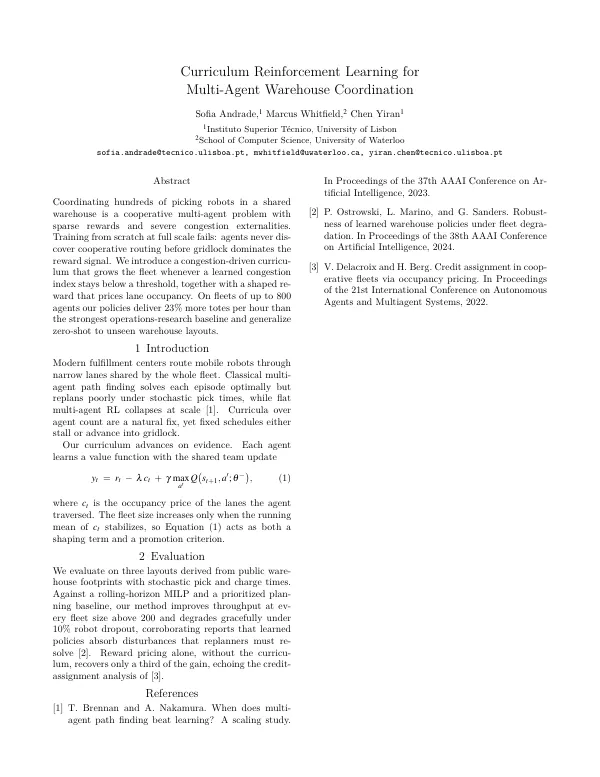
Our curriculum advances on evidence. Each agent learns a value function with
the shared team update
\begin{equation}
  y_t \;=\; r_t \;-\; \lambda\, c_t \;+\; \gamma\, \max_{a'} Q\bigl(s_{t+1}, a'; \theta^{-}\bigr),
  \label{eq:shaped}
\end{equation}
where $c_t$ is the occupancy price of the lanes the agent traversed. The
fleet size increases only when the running mean of $c_t$ stabilizes, so
Equation~\eqref{eq:shaped} acts as both a shaping term and a promotion
criterion.

\section{Evaluation}
We evaluate on three layouts derived from public warehouse footprints with
stochastic pick and charge times. Against a rolling-horizon MILP and a
prioritized planning baseline, our method improves throughput at every fleet
size above 200 and degrades gracefully under 10\% robot dropout,
corroborating reports that learned policies absorb disturbances that
replanners must re-solve~\cite{ostrowski2024robust}. Reward pricing alone,
without the curriculum, recovers only a third of the gain, echoing the
credit-assignment analysis of~\cite{delacroix2022credit}.

\begin{thebibliography}{9}
\bibitem{brennan2023mapf} T. Brennan and A. Nakamura.
When does multi-agent path finding beat learning? A scaling study.
In \textit{Proceedings of the 37th AAAI Conference on Artificial Intelligence}, 2023.
\bibitem{ostrowski2024robust} P. Ostrowski, L. Marino, and G. Sanders.
Robustness of learned warehouse policies under fleet degradation.
In \textit{Proceedings of the 38th AAAI Conference on Artificial Intelligence}, 2024.
\bibitem{delacroix2022credit} V. Delacroix and H. Berg.
Credit assignment in cooperative fleets via occupancy pricing.
In \textit{Proceedings of the 21st International Conference on Autonomous Agents and Multiagent Systems}, 2022.
\end{thebibliography}

\end{document}
In the app: open the New Project gallery, install the Conference preprint styles pack under "Get more templates", and this template appears with a live preview and one-click project creation. Compilation runs locally on the bundled engine.