


PLOS ONE 风格文章
PLOS ONE 启发了提交手稿,包括 IMRaD 部分、道德规范、支持信息、数据可用性和提交系统提醒。
main.tex
% PLOS ONE style submission manuscript, recreated with standard packages only.
\documentclass[12pt]{article}
\usepackage[letterpaper,margin=1in]{geometry}
\usepackage{setspace}
\usepackage{lineno}
\usepackage{amsmath}
\usepackage{booktabs}
\usepackage[hidelinks]{hyperref}

\doublespacing
\linenumbers
\setlength{\parindent}{0pt}
\setlength{\parskip}{0.5em}

\begin{document}
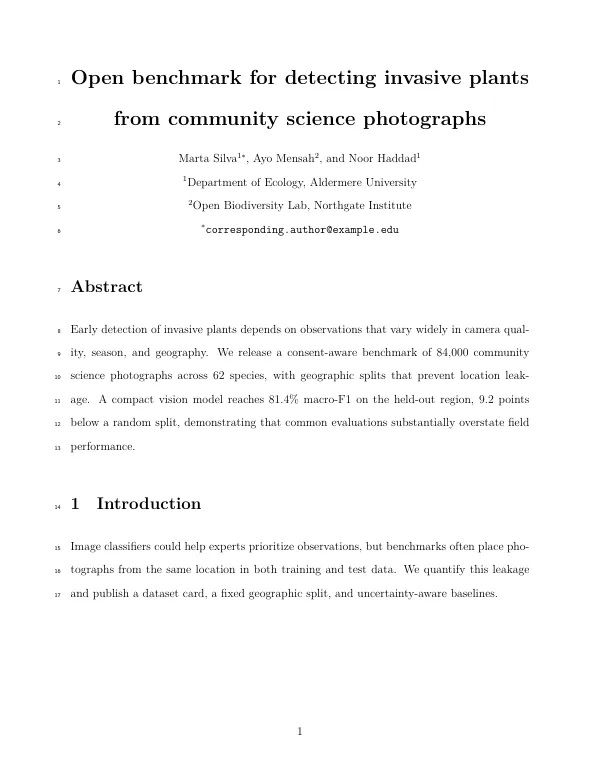
\begin{center}
{\LARGE\bfseries Open benchmark for detecting invasive plants from community
science photographs\par}
\vspace{0.7em}
Marta Silva$^{1*}$, Ayo Mensah$^2$, and Noor Haddad$^1$\\
$^1$Department of Ecology, Aldermere University\\
$^2$Open Biodiversity Lab, Northgate Institute\\
$^*$\texttt{[email protected]}
\end{center}

\section*{Abstract}
Early detection of invasive plants depends on observations that vary widely in
camera quality, season, and geography. We release a consent-aware benchmark of
84{,}000 community science photographs across 62 species, with geographic
splits that prevent location leakage. A compact vision model reaches 81.4\%
macro-F1 on the held-out region, 9.2 points below a random split, demonstrating
that common evaluations substantially overstate field performance.

\section{Introduction}
Image classifiers could help experts prioritize observations, but benchmarks
often place photographs from the same location in both training and test data.
We quantify this leakage and publish a dataset card, a fixed geographic split,
and uncertainty-aware baselines.

\section{Materials and methods}
\subsection{Ethics and permissions}
Only observations with redistribution-compatible licenses are included.
Contributor identifiers and precise coordinates for sensitive species are
removed. The institutional review determination and consent procedure belong
here.

\subsection{Dataset and analysis}
Primary performance is macro-F1 on a region held out before model development.
Confidence intervals use 2{,}000 stratified bootstrap samples. All exclusions,
hyperparameters, and stopping rules are reported in the protocol.

\section{Results}
\begin{table}[h]
\caption{Performance under random and geographic evaluation splits.}
\centering
\begin{tabular}{lcc}
\toprule
Split & Macro-F1 & Calibration error \\
\midrule
Random & $90.6\pm0.4$ & 0.031 \\
Geographic & $81.4\pm0.7$ & 0.079 \\
\bottomrule
\end{tabular}
\end{table}

\section{Discussion}
Random splits substantially overestimate deployment performance. The benchmark
does not cover rare species with fewer than 100 licensed images, and regional
performance should not be extrapolated globally without local validation.

\section*{Supporting information}
\textbf{S1 Protocol.} Sampling, exclusions, model selection, and planned
analyses. \textbf{S1 Data.} Per-species metrics and confidence intervals.

\section*{Data availability}
Provide repository identifiers, licenses, access restrictions, and a data
dictionary. State exactly which records are excluded and why.

\section*{Acknowledgments}
Credit community contributors, curators, and facilities here. Enter funding,
CRediT author roles, the data availability statement, and competing interests
in the journal's submission system as requested.

\begin{thebibliography}{9}
\bibitem{example} A. Author and B. Author. Geographic leakage in ecological
image benchmarks. \textit{Open Ecology}. 2025;4:1--14.
\end{thebibliography}
\end{document}
应用内:打开新建项目图库,在「获取更多模板」下安装 会议预印本样式 包,即可带实时预览并一键创建项目。编译在捆绑引擎上本地运行。