


Giấy hai cột
Bố cục bài nghiên cứu hai cột trung tính phù hợp với mọi bài viết kỹ thuật không xác định địa điểm.
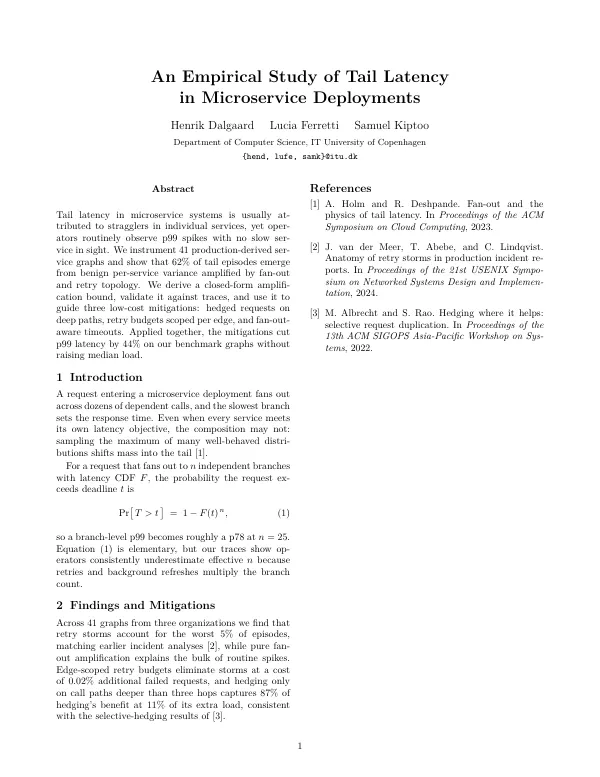
main.tex
% Neutral two column research paper, standard packages only.
\documentclass[10pt,twocolumn]{article}
\usepackage[letterpaper,margin=0.8in,top=1in]{geometry}
\usepackage{lmodern}
\usepackage{amsmath}
\usepackage{titlesec}

\setlength{\columnsep}{0.28in}
\pagestyle{plain}

\titleformat{\section}{\large\bfseries}{\thesection}{0.6em}{}
\titleformat{\subsection}{\normalsize\bfseries}{\thesubsection}{0.6em}{}
\titlespacing*{\section}{0pt}{1.4ex plus .4ex}{0.8ex}

\begin{document}

\twocolumn[{
  \centering
  {\LARGE\bfseries An Empirical Study of Tail Latency\\ in Microservice Deployments\par}
  \vskip 14pt
  {\large Henrik Dalgaard \quad Lucia Ferretti \quad Samuel Kiptoo}\\[5pt]
  {\small Department of Computer Science, IT University of Copenhagen}\\[2pt]
  {\small\texttt{\{hend, lufe, samk\}@itu.dk}}
  \vskip 22pt
}]

\begin{center}{\bfseries Abstract}\end{center}
\noindent Tail latency in microservice systems is usually attributed to
stragglers in individual services, yet operators routinely observe p99
spikes with no slow service in sight. We instrument 41 production-derived
service graphs and show that 62\% of tail episodes emerge from benign
per-service variance amplified by fan-out and retry topology. We derive a
closed-form amplification bound, validate it against traces, and use it to
guide three low-cost mitigations: hedged requests on deep paths, retry
budgets scoped per edge, and fan-out-aware timeouts. Applied together, the
mitigations cut p99 latency by 44\% on our benchmark graphs without
raising median load.

\section{Introduction}
A request entering a microservice deployment fans out across dozens of
dependent calls, and the slowest branch sets the response time. Even when
every service meets its own latency objective, the composition may not:
sampling the maximum of many well-behaved distributions shifts mass into
the tail~\cite{holm2023fanout}.

For a request that fans out to $n$ independent branches with latency CDF
$F$, the probability the request exceeds deadline $t$ is
\begin{equation}
  \Pr\bigl[\,T > t\,\bigr] \;=\; 1 - F(t)^{\,n},
  \label{eq:tail}
\end{equation}
so a branch-level p99 becomes roughly a p78 at $n = 25$.
Equation~\eqref{eq:tail} is elementary, but our traces show operators
consistently underestimate effective $n$ because retries and background
refreshes multiply the branch count.

\section{Findings and Mitigations}
Across 41 graphs from three organizations we find that retry storms account
for the worst 5\% of episodes, matching earlier incident
analyses~\cite{vandermeer2024retries}, while pure fan-out amplification
explains the bulk of routine spikes. Edge-scoped retry budgets eliminate
storms at a cost of 0.02\% additional failed requests, and hedging only on
call paths deeper than three hops captures 87\% of hedging's benefit at
11\% of its extra load, consistent with the selective-hedging results
of~\cite{albrecht2022hedging}.

\begin{thebibliography}{9}
\bibitem{holm2023fanout} A. Holm and R. Deshpande.
Fan-out and the physics of tail latency.
In \textit{Proceedings of the ACM Symposium on Cloud Computing}, 2023.
\bibitem{vandermeer2024retries} J. van der Meer, T. Abebe, and C. Lindqvist.
Anatomy of retry storms in production incident reports.
In \textit{Proceedings of the 21st USENIX Symposium on Networked Systems Design and Implementation}, 2024.
\bibitem{albrecht2022hedging} M. Albrecht and S. Rao.
Hedging where it helps: selective request duplication.
In \textit{Proceedings of the 13th ACM SIGOPS Asia-Pacific Workshop on Systems}, 2022.
\end{thebibliography}

\end{document}
Trong ứng dụng: mở thư viện Dự án mới, cài đặt gói {nhãn} trong "Nhận thêm mẫu" và mẫu này xuất hiện cùng với bản xem trước trực tiếp và tạo dự án chỉ bằng một cú nhấp chuột. Quá trình biên dịch chạy cục bộ trên công cụ đi kèm.