


Báo cáo phòng thí nghiệm & kỹ thuật
Báo cáo khoa học
Một báo cáo khoa học chính thức có hộp tóm tắt được đánh dấu, các phương pháp, số liệu kết quả và kết luận được đánh số.
main.tex
\documentclass[10pt]{article}
\usepackage[margin=0.8in]{geometry}
\usepackage{xcolor}
\usepackage{siunitx}
\usepackage{pgfplots}
\pgfplotsset{compat=1.17}
\usepackage{tcolorbox}
\usepackage{enumitem}
\usepackage[hidelinks]{hyperref}
\usepackage{titlesec}
\definecolor{accent}{HTML}{0F766E}
\titleformat*{\section}{\large\bfseries\color{accent}}
\titlespacing*{\section}{0pt}{0.7em}{0.25em}
\setlength{\parindent}{0pt}
\setlength{\parskip}{0.35em}
\pagestyle{empty}

\begin{document}

\begin{center}
  {\LARGE\bfseries Convective Cooling of a Heated Aluminium Block}\\[0.4em]
  {\large A Test of Newton's Law of Cooling in Still Air}\\[0.5em]
  S. Ferreira and T. Nakamura\\
  Department of Mechanical Engineering, Halden Institute of Technology\\
  Report HIT-ME-2026-014 \quad | \quad 22 April 2026
\end{center}

\begin{tcolorbox}[colback=accent!6, colframe=accent, boxrule=0.8pt,
  title=\textbf{Abstract}, left=6pt, right=6pt, top=4pt, bottom=4pt]
A \SI{250}{\gram} aluminium block was heated to \SI{80}{\celsius} and allowed
to cool in still air at \SI{21.0}{\celsius} while its temperature was logged
every \SI{30}{\second} with a calibrated thermocouple. The temperature excess
decayed exponentially with a time constant of \SI{18.3\pm0.4}{\minute},
consistent with Newton's law of cooling for a lumped body. The inferred
convective coefficient, \SI{11.2}{\watt\per\metre\squared\per\kelvin}, falls
within the accepted range for natural convection from a small vertical surface.
\end{tcolorbox}

\section*{1. Introduction}
Newton's law of cooling predicts that a body whose internal conduction is fast
compared with surface convection loses heat at a rate proportional to its
temperature excess over the surroundings. The block used here has a Biot
number of 0.004, well below the 0.1 limit for the lumped approximation.

\section*{2. Methods}
The block ($60 \times 50 \times 30$ \si{\milli\metre}) was heated on a laboratory hot
plate, transferred to an insulating stand, and left to cool away from drafts.
A K-type thermocouple embedded at the block centre fed a data logger sampling
at \SI{30}{\second} intervals for \SI{45}{\minute}. Ambient temperature was
monitored with a second sensor and drifted by less than \SI{0.2}{\celsius}.
The excess temperature $\theta(t) = T(t) - T_\infty$ was fitted with
$\theta_0 e^{-t/\tau}$ by least squares.

\section*{3. Results}
\begin{center}
\begin{tikzpicture}
\begin{axis}[
  width=10cm, height=5cm,
  xlabel={Time (\si{\minute})}, ylabel={Excess temperature (\si{\celsius})},
  xmin=0, xmax=45, ymin=0, ymax=62,
  grid=major, grid style={dashed, gray!30},
  legend style={draw=none, font=\small},
  tick label style={font=\small}, label style={font=\small},
]
\addplot[only marks, mark=*, mark size=1.6pt, color=accent] coordinates {
  (0,59.0) (5,44.9) (10,34.2) (15,26.0) (20,19.8) (25,15.1)
  (30,11.5) (35,8.7) (40,6.6) (45,5.1)
};
\addlegendentry{Measured}
\addplot[thick, color=accent!60!black, domain=0:45, samples=60] {59*exp(-x/18.3)};
\addlegendentry{Fit: $\theta = 59\,e^{-t/18.3}$}
\end{axis}
\end{tikzpicture}
\end{center}

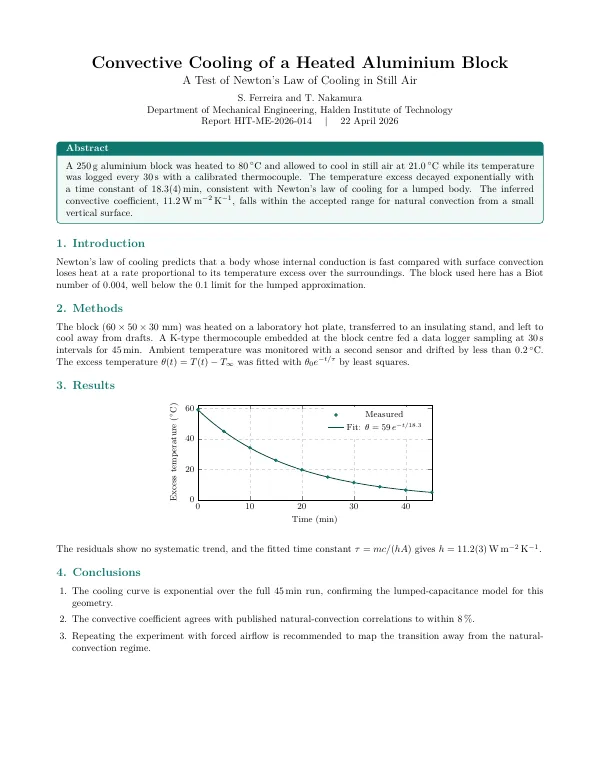
The residuals show no systematic trend, and the fitted time constant
$\tau = mc/(hA)$ gives $h = \SI{11.2\pm0.3}{\watt\per\metre\squared\per\kelvin}$.

\section*{4. Conclusions}
\begin{enumerate}[leftmargin=1.6em, itemsep=0.1em]
  \item The cooling curve is exponential over the full \SI{45}{\minute} run,
        confirming the lumped-capacitance model for this geometry.
  \item The convective coefficient agrees with published natural-convection
        correlations to within \SI{8}{\percent}.
  \item Repeating the experiment with forced airflow is recommended to map
        the transition away from the natural-convection regime.
\end{enumerate}

\end{document}
Trong ứng dụng: mở thư viện Dự án mới, cài đặt gói {nhãn} trong "Nhận thêm mẫu" và mẫu này xuất hiện cùng với bản xem trước trực tiếp và tạo dự án chỉ bằng một cú nhấp chuột. Quá trình biên dịch chạy cục bộ trên công cụ đi kèm.