


Ghi chú tính toán lượng tử
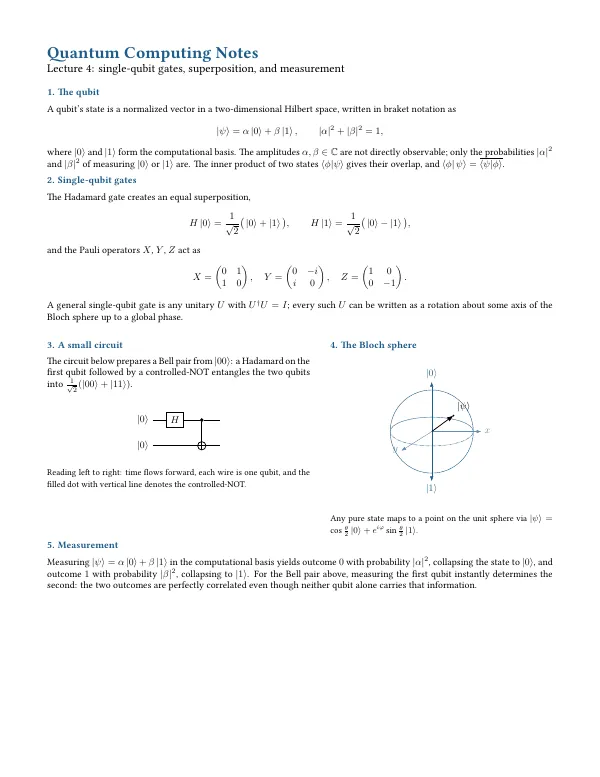
Ghi chú bài giảng về điện toán lượng tử với ký hiệu Braket, mạch lượng tử nhỏ trong TikZ và bản phác thảo hình cầu Bloch.
main.tex
\documentclass[10pt]{article}
\usepackage[margin=1.7cm]{geometry}
\usepackage{libertine}
\usepackage{amsmath, amssymb}
\usepackage{physics}
\usepackage{xcolor}
\usepackage{tikz}
\usetikzlibrary{quantikz}
\pagestyle{empty}
\setlength{\parindent}{0pt}
\setlength{\parskip}{0.5em}

\definecolor{accent}{HTML}{1E5C8A}
\definecolor{panel}{HTML}{EEF3F8}

\newcommand{\heading}[1]{{\bfseries\color{accent} #1}}

\begin{document}

{\LARGE\bfseries\color{accent} Quantum Computing Notes}\\[0.1em]
{\large Lecture 4: single-qubit gates, superposition, and measurement}

\vspace{0.7em}
\heading{1. The qubit}

A qubit's state is a normalized vector in a two-dimensional Hilbert space,
written in braket notation as
\[
  \ket{\psi} = \alpha \ket{0} + \beta \ket{1}, \qquad |\alpha|^2 + |\beta|^2 = 1,
\]
where $\ket{0}$ and $\ket{1}$ form the computational basis. The amplitudes
$\alpha,\beta \in \mathbb{C}$ are not directly observable; only the
probabilities $|\alpha|^2$ and $|\beta|^2$ of measuring $\ket{0}$ or $\ket{1}$
are. The inner product of two states $\braket{\phi}{\psi}$ gives their
overlap, and $\bra{\phi}\psi\rangle = \overline{\braket{\psi}{\phi}}$.

\heading{2. Single-qubit gates}

The Hadamard gate creates an equal superposition,
\[
  H\ket{0} = \frac{1}{\sqrt{2}}\big(\ket{0} + \ket{1}\big), \qquad
  H\ket{1} = \frac{1}{\sqrt{2}}\big(\ket{0} - \ket{1}\big),
\]
and the Pauli operators $X$, $Y$, $Z$ act as
\[
  X = \begin{pmatrix} 0 & 1 \\ 1 & 0 \end{pmatrix}, \quad
  Y = \begin{pmatrix} 0 & -i \\ i & 0 \end{pmatrix}, \quad
  Z = \begin{pmatrix} 1 & 0 \\ 0 & -1 \end{pmatrix}.
\]
A general single-qubit gate is any unitary $U$ with $U^\dagger U = I$; every
such $U$ can be written as a rotation about some axis of the Bloch sphere up
to a global phase.

\vspace{0.5em}
\noindent
\begin{minipage}[t]{0.52\textwidth}
\heading{3. A small circuit}

\vspace{0.4em}
The circuit below prepares a Bell pair from $\ket{00}$: a Hadamard on the
first qubit followed by a controlled-NOT entangles the two qubits into
$\frac{1}{\sqrt{2}}(\ket{00} + \ket{11})$.

\vspace{0.6em}
\begin{center}
\begin{quantikz}
\lstick{$\ket{0}$} & \gate{H} & \ctrl{1} & \qw \\
\lstick{$\ket{0}$} & \qw      & \targ{}  & \qw
\end{quantikz}
\end{center}

\vspace{0.5em}
{\small Reading left to right: time flows forward, each wire is one qubit,
and the filled dot with vertical line denotes the controlled-NOT.}
\end{minipage}%
\hfill
\begin{minipage}[t]{0.44\textwidth}
\heading{4. The Bloch sphere}

\vspace{0.4em}
\begin{center}
\begin{tikzpicture}[scale=1.15]
  \draw[accent!40] (0,0) ellipse (1.3 and 0.45);
  \draw[accent] (0,0) circle (1.3);
  \draw[accent!70, dashed] (-1.3,0) arc (180:360:1.3 and 0.45);
  \draw[accent!70] (-1.3,0) arc (180:0:1.3 and 0.45);
  \draw[-{Latex}, accent] (0,0) -- (0,1.55) node[above] {$\ket{0}$};
  \draw[-{Latex}, accent] (0,0) -- (0,-1.55) node[below] {$\ket{1}$};
  \draw[-{Latex}, accent!70] (0,0) -- (1.55,0) node[right] {$x$};
  \draw[-{Latex}, accent!70] (0,0) -- (-0.95,-0.6) node[left] {$y$};
  \draw[-{Latex}, black, thick] (0,0) -- (0.68,0.5) node[above right] {$\ket{\psi}$};
  \fill[black] (0.68,0.5) circle (0.9pt);
\end{tikzpicture}
\end{center}

\vspace{0.3em}
{\small Any pure state maps to a point on the unit sphere via
$\ket{\psi} = \cos\frac{\theta}{2}\ket{0} + e^{i\varphi}\sin\frac{\theta}{2}\ket{1}$.}
\end{minipage}

\heading{5. Measurement}

Measuring $\ket{\psi} = \alpha\ket{0} + \beta\ket{1}$ in the computational
basis yields outcome $0$ with probability $|\alpha|^2$, collapsing the state
to $\ket{0}$, and outcome $1$ with probability $|\beta|^2$, collapsing to
$\ket{1}$. For the Bell pair above, measuring the first qubit instantly
determines the second: the two outcomes are perfectly correlated even though
neither qubit alone carries that information.

\end{document}
Trong ứng dụng: mở thư viện Dự án mới, cài đặt gói {nhãn} trong "Nhận thêm mẫu" và mẫu này xuất hiện cùng với bản xem trước trực tiếp và tạo dự án chỉ bằng một cú nhấp chuột. Quá trình biên dịch chạy cục bộ trên công cụ đi kèm.