


Ghi chú sinh học phân tử
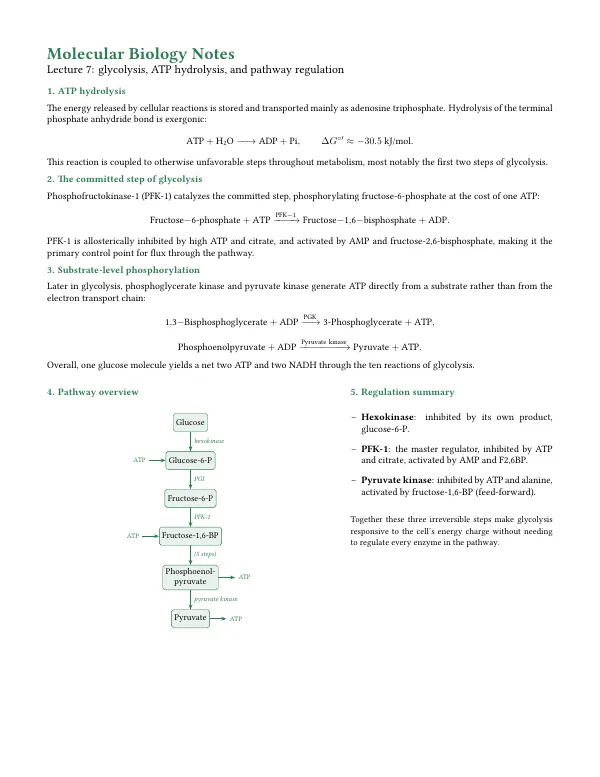
Ghi chú bài giảng về sinh học phân tử với sơ đồ phản ứng mhchem và sơ đồ đường dẫn TikZ.
main.tex
\documentclass[10pt]{article}
\usepackage[margin=1.7cm]{geometry}
\usepackage{libertine}
\usepackage{amsmath}
\usepackage[version=4]{mhchem}
\usepackage{xcolor}
\usepackage{tikz}
\usepackage{enumitem}
\usetikzlibrary{arrows.meta, positioning}
\pagestyle{empty}
\setlength{\parindent}{0pt}
\setlength{\parskip}{0.5em}

\definecolor{accent}{HTML}{2E7D4F}
\definecolor{panel}{HTML}{EEF6F0}

\newcommand{\heading}[1]{{\bfseries\color{accent} #1}}

\begin{document}

{\LARGE\bfseries\color{accent} Molecular Biology Notes}\\[0.1em]
{\large Lecture 7: glycolysis, ATP hydrolysis, and pathway regulation}

\vspace{0.5em}
\heading{1. ATP hydrolysis}

The energy released by cellular reactions is stored and transported mainly as
adenosine triphosphate. Hydrolysis of the terminal phosphate anhydride bond is
exergonic:
\[
  \ce{ATP + H2O -> ADP + Pi}, \qquad \Delta G^{\circ\prime} \approx -30.5\ \text{kJ/mol}.
\]
This reaction is coupled to otherwise unfavorable steps throughout metabolism,
most notably the first two steps of glycolysis.

\heading{2. The committed step of glycolysis}

Phosphofructokinase-1 (PFK-1) catalyzes the committed step, phosphorylating
fructose-6-phosphate at the cost of one ATP:
\[
  \ce{Fructose-6-phosphate + ATP ->[PFK-1] Fructose-1,6-bisphosphate + ADP}.
\]
PFK-1 is allosterically inhibited by high \ce{ATP} and citrate, and activated
by \ce{AMP} and fructose-2,6-bisphosphate, making it the primary control point
for flux through the pathway.

\heading{3. Substrate-level phosphorylation}

Later in glycolysis, phosphoglycerate kinase and pyruvate kinase generate ATP
directly from a substrate rather than from the electron transport chain:
\[
  \ce{1,3-Bisphosphoglycerate + ADP ->[PGK] 3-Phosphoglycerate + ATP},
\]
\[
  \ce{Phosphoenolpyruvate + ADP ->[Pyruvate\ kinase] Pyruvate + ATP}.
\]
Overall, one glucose molecule yields a net two ATP and two NADH through the
ten reactions of glycolysis.

\vspace{0.4em}
\noindent
\begin{minipage}[t]{0.56\textwidth}
\heading{4. Pathway overview}

\vspace{0.5em}
\begin{center}
\begin{tikzpicture}[
    node distance=7mm and 9mm,
    every node/.style={font=\small},
    met/.style={draw=accent, fill=accent!10, rounded corners=2pt,
      minimum height=6.5mm, align=center, inner sep=3pt},
    enz/.style={font=\scriptsize\itshape, accent},
    arr/.style={-{Stealth[length=1.8mm]}, accent, thick}
  ]
  \node[met] (glu)  {Glucose};
  \node[met, below=of glu] (g6p) {Glucose-6-P};
  \node[met, below=of g6p] (f6p) {Fructose-6-P};
  \node[met, below=of f6p] (f16bp) {Fructose-1,6-BP};
  \node[met, below=of f16bp] (pep) {Phosphoenol-\\pyruvate};
  \node[met, below=of pep] (pyr) {Pyruvate};

  \draw[arr] (glu)   -- (g6p)   node[midway, enz, right] {hexokinase};
  \draw[arr] (g6p)   -- (f6p)   node[midway, enz, right] {PGI};
  \draw[arr] (f6p)   -- (f16bp) node[midway, enz, right] {PFK-1};
  \draw[arr] (f16bp) -- (pep)   node[midway, enz, right] {(5 steps)};
  \draw[arr] (pep)   -- (pyr)   node[midway, enz, right] {pyruvate kinase};

  \node[left=6mm of g6p, accent, font=\scriptsize] (atp1) {ATP};
  \draw[arr] (atp1) -- (g6p);
  \node[left=6mm of f16bp, accent, font=\scriptsize] (atp2) {ATP};
  \draw[arr] (atp2) -- (f16bp);
  \node[right=6mm of pep, accent, font=\scriptsize] (atp3) {ATP};
  \draw[arr] (pep) -- (atp3);
  \node[right=6mm of pyr, accent, font=\scriptsize] (atp4) {ATP};
  \draw[arr] (pyr) -- (atp4);
\end{tikzpicture}
\end{center}
\end{minipage}%
\hfill
\begin{minipage}[t]{0.4\textwidth}
\heading{5. Regulation summary}

\vspace{0.4em}
\begin{itemize}[leftmargin=1.1em]
  \item[--] \textbf{Hexokinase}: inhibited by its own product, glucose-6-P.
  \item[--] \textbf{PFK-1}: the master regulator, inhibited by ATP and
    citrate, activated by AMP and F2,6BP.
  \item[--] \textbf{Pyruvate kinase}: inhibited by ATP and alanine,
    activated by fructose-1,6-BP (feed-forward).
\end{itemize}

\vspace{0.6em}
{\small Together these three irreversible steps make glycolysis responsive
to the cell's energy charge without needing to regulate every enzyme in the
pathway.}
\end{minipage}

\end{document}
Trong ứng dụng: mở thư viện Dự án mới, cài đặt gói {nhãn} trong "Nhận thêm mẫu" và mẫu này xuất hiện cùng với bản xem trước trực tiếp và tạo dự án chỉ bằng một cú nhấp chuột. Quá trình biên dịch chạy cục bộ trên công cụ đi kèm.