


Chương sách
Phần mở đầu chương sách có một dòng chữ và chữ viết hoa ở đoạn đầu tiên.
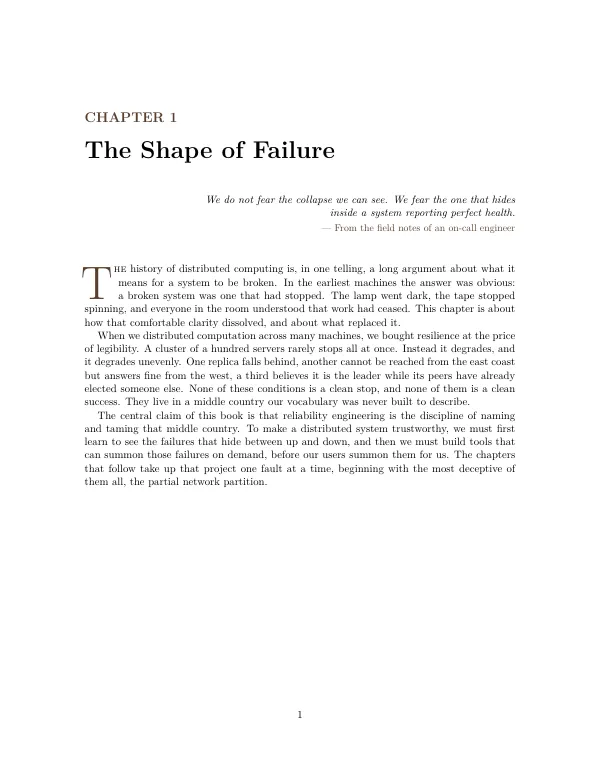
main.tex
\documentclass[11pt, oneside]{book}
\usepackage[margin=1.2in]{geometry}
\usepackage{xcolor}
\usepackage{lettrine}
\usepackage{titlesec}
\usepackage[hidelinks]{hyperref}

\definecolor{accent}{HTML}{5A3E2B}
\setlength{\parindent}{1.2em}

\titleformat{\chapter}[display]
  {\normalfont\filright}
  {\Large\color{accent}\bfseries CHAPTER \thechapter}
  {0.6em}
  {\Huge\bfseries}
\titlespacing*{\chapter}{0pt}{10pt}{28pt}

\newcommand{\epigraph}[2]{%
  \begin{flushright}\begin{minipage}{0.72\textwidth}\raggedleft
    \itshape #1\par\vspace{0.3em}\upshape\small\color{accent}--- #2
  \end{minipage}\end{flushright}\vspace{1.8em}}

\begin{document}

\chapter{The Shape of Failure}

\epigraph{We do not fear the collapse we can see. We fear the one that hides
inside a system reporting perfect health.}{From the field notes of an on-call engineer}

\lettrine[lines=3, lhang=0.1, findent=0.1em, nindent=0.4em]{\color{accent}T}{he}
history of distributed computing is, in one telling, a long argument about what
it means for a system to be broken. In the earliest machines the answer was
obvious: a broken system was one that had stopped. The lamp went dark, the tape
stopped spinning, and everyone in the room understood that work had ceased. This
chapter is about how that comfortable clarity dissolved, and about what replaced
it.

When we distributed computation across many machines, we bought resilience at
the price of legibility. A cluster of a hundred servers rarely stops all at
once. Instead it degrades, and it degrades unevenly. One replica falls behind,
another cannot be reached from the east coast but answers fine from the west, a
third believes it is the leader while its peers have already elected someone
else. None of these conditions is a clean stop, and none of them is a clean
success. They live in a middle country our vocabulary was never built to
describe.

The central claim of this book is that reliability engineering is the discipline
of naming and taming that middle country. To make a distributed system
trustworthy, we must first learn to see the failures that hide between up and
down, and then we must build tools that can summon those failures on demand,
before our users summon them for us. The chapters that follow take up that
project one fault at a time, beginning with the most deceptive of them all, the
partial network partition.

\end{document}
Trong ứng dụng: mở thư viện Dự án mới, cài đặt gói {nhãn} trong "Nhận thêm mẫu" và mẫu này xuất hiện cùng với bản xem trước trực tiếp và tạo dự án chỉ bằng một cú nhấp chuột. Quá trình biên dịch chạy cục bộ trên công cụ đi kèm.