


Amaç Beyanı
Başvurduğunuz programı adlandıran bir başlığa sahip, temiz bir kişisel makale düzeni.
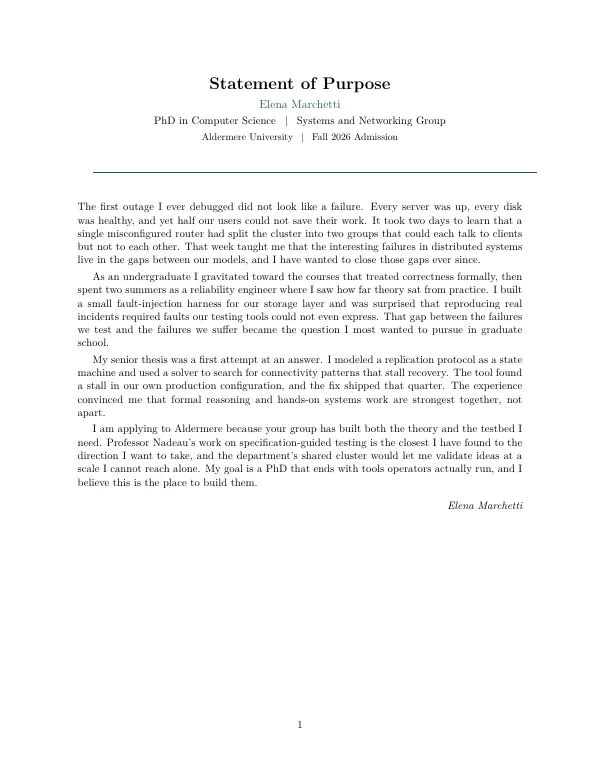
main.tex
\documentclass[11pt]{article}
\usepackage[margin=1.1in]{geometry}
\usepackage{xcolor}
\usepackage[hidelinks]{hyperref}

\definecolor{accent}{HTML}{26506B}
\setlength{\parindent}{1.4em}
\setlength{\parskip}{0.3em}

\begin{document}

\begin{center}
  {\LARGE\bfseries Statement of Purpose}\\[0.5em]
  {\large\color{accent} Elena Marchetti}\\[0.3em]
  {\normalsize PhD in Computer Science \, | \, Systems and Networking Group}\\[0.2em]
  {\small Aldermere University \, | \, Fall 2026 Admission}
\end{center}

\vspace{0.4em}
{\color{accent}\rule{\textwidth}{0.8pt}}
\vspace{0.8em}

\noindent The first outage I ever debugged did not look like a failure. Every
server was up, every disk was healthy, and yet half our users could not save
their work. It took two days to learn that a single misconfigured router had
split the cluster into two groups that could each talk to clients but not to
each other. That week taught me that the interesting failures in distributed
systems live in the gaps between our models, and I have wanted to close those
gaps ever since.

As an undergraduate I gravitated toward the courses that treated correctness
formally, then spent two summers as a reliability engineer where I saw how far
theory sat from practice. I built a small fault-injection harness for our storage
layer and was surprised that reproducing real incidents required faults our
testing tools could not even express. That gap between the failures we test and
the failures we suffer became the question I most wanted to pursue in graduate
school.

My senior thesis was a first attempt at an answer. I modeled a replication
protocol as a state machine and used a solver to search for connectivity patterns
that stall recovery. The tool found a stall in our own production configuration,
and the fix shipped that quarter. The experience convinced me that formal
reasoning and hands-on systems work are strongest together, not apart.

I am applying to Aldermere because your group has built both the theory and the
testbed I need. Professor Nadeau's work on specification-guided testing is the
closest I have found to the direction I want to take, and the department's
shared cluster would let me validate ideas at a scale I cannot reach alone. My
goal is a PhD that ends with tools operators actually run, and I believe this is
the place to build them.

\vspace{0.6em}
\noindent\hfill{\itshape Elena Marchetti}

\end{document}
Uygulamada: Yeni Proje galerisini açın, "Daha fazla şablon edinin" altındaki {etiket} paketi'i yükleyin; bu şablon, canlı önizleme ve tek tıklamayla proje oluşturmayla birlikte görünür. Derleme, birlikte verilen motorda yerel olarak çalışır.