


ICLR 스타일 사전 인쇄
작은 대문자 섹션 헤드와 검토 중인 실행 헤더가 있는 ICLR 모양의 단일 열 사전 인쇄입니다.
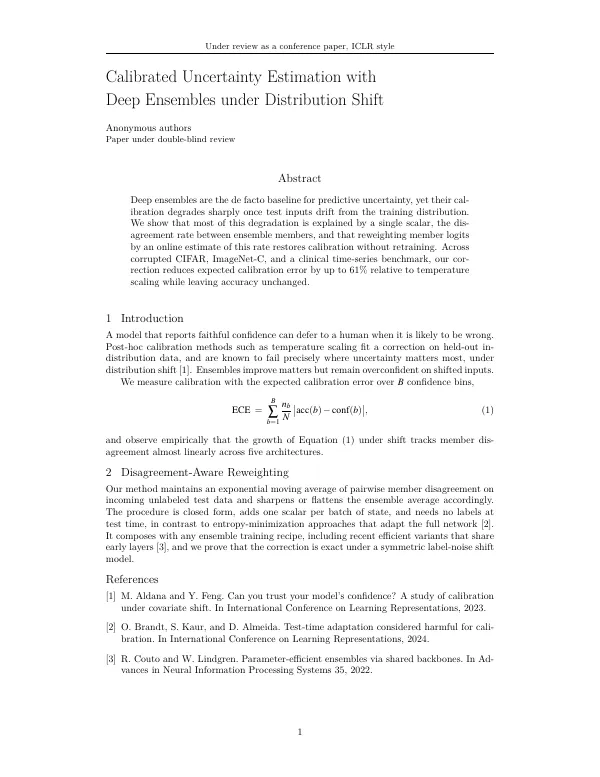
main.tex
% ICLR style preprint, recreated with standard packages only.
\documentclass[10pt]{article}
\usepackage[letterpaper,textwidth=5.5in,textheight=9in,top=1in,headheight=12pt,headsep=18pt]{geometry}
\usepackage{mathptmx}
\usepackage{amsmath}
\usepackage{titlesec}
\usepackage{fancyhdr}

\pagestyle{fancy}
\fancyhf{}
\fancyhead[C]{\small Under review as a conference paper, ICLR style}
\renewcommand{\headrulewidth}{0.4pt}
\fancyfoot[C]{\thepage}

\titleformat{\section}{\large\scshape}{\thesection}{0.8em}{}
\titleformat{\subsection}{\normalsize\scshape}{\thesubsection}{0.8em}{}
\titlespacing*{\section}{0pt}{1.8ex plus .4ex}{1ex}

\begin{document}
\thispagestyle{fancy}

\noindent{\LARGE\bfseries Calibrated Uncertainty Estimation with\\[2pt] Deep Ensembles under Distribution Shift\par}
\vspace{14pt}

\noindent{\bfseries Anonymous authors}\\
{\small Paper under double-blind review}
\vspace{18pt}

\begin{center}{\scshape\large Abstract}\end{center}
\begin{list}{}{\leftmargin=0.35in\rightmargin=0.35in}\item\relax
Deep ensembles are the de facto baseline for predictive uncertainty, yet their
calibration degrades sharply once test inputs drift from the training
distribution. We show that most of this degradation is explained by a single
scalar, the disagreement rate between ensemble members, and that reweighting
member logits by an online estimate of this rate restores calibration without
retraining. Across corrupted CIFAR, ImageNet-C, and a clinical time-series
benchmark, our correction reduces expected calibration error by up to 61\%
relative to temperature scaling while leaving accuracy unchanged.
\end{list}
\vspace{6pt}

\section{Introduction}
A model that reports faithful confidence can defer to a human when it is
likely to be wrong. Post-hoc calibration methods such as temperature scaling
fit a correction on held-out in-distribution data, and are known to fail
precisely where uncertainty matters most, under distribution
shift~\cite{aldana2023shift}. Ensembles improve matters but remain
overconfident on shifted inputs.

We measure calibration with the expected calibration error over $B$
confidence bins,
\begin{equation}
  \mathrm{ECE} \;=\; \sum_{b=1}^{B} \frac{n_b}{N}\,
  \bigl| \mathrm{acc}(b) - \mathrm{conf}(b) \bigr|,
  \label{eq:ece}
\end{equation}
and observe empirically that the growth of Equation~\eqref{eq:ece} under
shift tracks member disagreement almost linearly across five architectures.

\section{Disagreement-Aware Reweighting}
Our method maintains an exponential moving average of pairwise member
disagreement on incoming unlabeled test data and sharpens or flattens the
ensemble average accordingly. The procedure is closed form, adds one scalar
per batch of state, and needs no labels at test time, in contrast to
entropy-minimization approaches that adapt the full
network~\cite{brandt2024tta}. It composes with any ensemble training recipe,
including recent efficient variants that share early
layers~\cite{couto2022batchens}, and we prove that the correction is exact
under a symmetric label-noise shift model.

\begin{thebibliography}{9}
\bibitem{aldana2023shift} M. Aldana and Y. Feng.
Can you trust your model's confidence? A study of calibration under covariate shift.
In \textit{International Conference on Learning Representations}, 2023.
\bibitem{brandt2024tta} O. Brandt, S. Kaur, and D. Almeida.
Test-time adaptation considered harmful for calibration.
In \textit{International Conference on Learning Representations}, 2024.
\bibitem{couto2022batchens} R. Couto and W. Lindgren.
Parameter-efficient ensembles via shared backbones.
In \textit{Advances in Neural Information Processing Systems 35}, 2022.
\end{thebibliography}

\end{document}
앱에서: 새 프로젝트 갤러리를 열고 "템플릿 더 받기"에서 컨퍼런스 사전 인쇄 스타일 팩을(를) 설치하면 실시간 미리보기와 원클릭 생성이 됩니다. 컴파일은 번들 엔진으로 로컬 실행됩니다.