


Styles de préimpression de conférence
Style Springer LNCS
Papier à une seule colonne au look Springer LNCS avec un bloc de texte étroit, un résumé d'exécution, des mots-clés et des en-têtes courants.
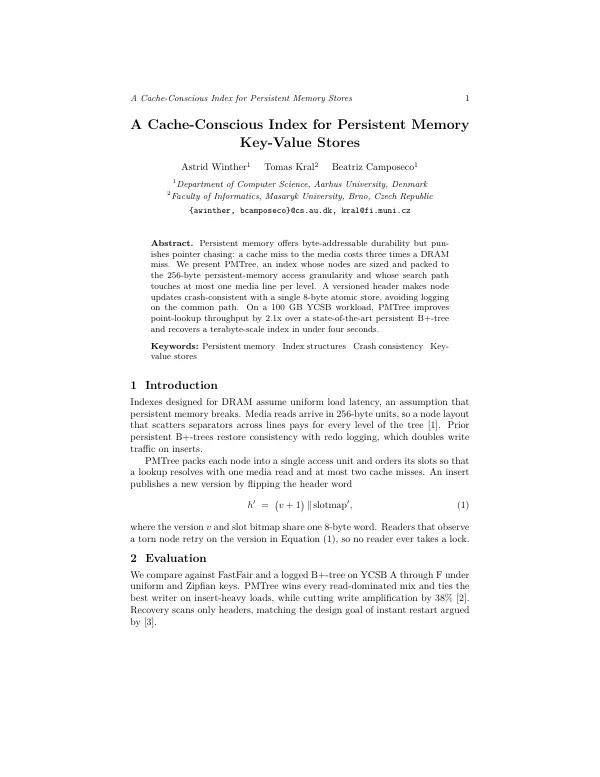
main.tex
% Springer LNCS style, recreated with standard packages only.
\documentclass[10pt]{article}
\usepackage[textwidth=12.2cm,textheight=19.3cm,centering,headheight=12pt,headsep=16pt]{geometry}
\usepackage{lmodern}
\usepackage{amsmath}
\usepackage{titlesec}
\usepackage{fancyhdr}

\pagestyle{fancy}
\fancyhf{}
\fancyhead[L]{\small\itshape A Cache-Conscious Index for Persistent Memory Stores}
\fancyhead[R]{\small\thepage}
\renewcommand{\headrulewidth}{0pt}

\titleformat{\section}{\large\bfseries}{\thesection}{0.7em}{}
\titleformat{\subsection}{\normalsize\bfseries}{\thesubsection}{0.7em}{}
\titlespacing*{\section}{0pt}{1.6ex plus .4ex}{0.9ex}

\begin{document}

\begin{center}
  {\Large\bfseries A Cache-Conscious Index for Persistent Memory\\ Key-Value Stores\par}
  \vskip 12pt
  {Astrid Winther$^{1}$ \quad Tomas Kral$^{2}$ \quad Beatriz Camposeco$^{1}$}\\[6pt]
  {\small\itshape $^{1}$Department of Computer Science, Aarhus University, Denmark\\
   $^{2}$Faculty of Informatics, Masaryk University, Brno, Czech Republic}\\[3pt]
  {\small\texttt{\{awinther, bcamposeco\}@cs.au.dk, [email protected]}}
\end{center}

\vskip 14pt
\begin{center}
\begin{minipage}{0.88\textwidth}\small
\textbf{Abstract.} Persistent memory offers byte-addressable durability but
punishes pointer chasing: a cache miss to the media costs three times a DRAM
miss. We present PMTree, an index whose nodes are sized and packed to the
256-byte persistent-memory access granularity and whose search path touches
at most one media line per level. A versioned header makes node updates
crash-consistent with a single 8-byte atomic store, avoiding logging on the
common path. On a 100 GB YCSB workload, PMTree improves point-lookup
throughput by 2.1x over a state-of-the-art persistent B+-tree and recovers a
terabyte-scale index in under four seconds.

\medskip
\textbf{Keywords:} Persistent memory \; Index structures \; Crash consistency \; Key-value stores
\end{minipage}
\end{center}
\vskip 10pt

\section{Introduction}
Indexes designed for DRAM assume uniform load latency, an assumption that
persistent memory breaks. Media reads arrive in 256-byte units, so a node
layout that scatters separators across lines pays for every level of the
tree~\cite{eriksen2023pmlat}. Prior persistent B+-trees restore consistency
with redo logging, which doubles write traffic on inserts.

PMTree packs each node into a single access unit and orders its slots so
that a lookup resolves with one media read and at most two cache misses. An
insert publishes a new version by flipping the header word
\begin{equation}
  h' \;=\; \bigl(v + 1\bigr) \,\Vert\, \mathrm{slotmap}',
  \label{eq:header}
\end{equation}
where the version $v$ and slot bitmap share one 8-byte word. Readers that
observe a torn node retry on the version in Equation~\eqref{eq:header}, so
no reader ever takes a lock.

\section{Evaluation}
We compare against FastFair and a logged B+-tree on YCSB A through F under
uniform and Zipfian keys. PMTree wins every read-dominated mix and ties the
best writer on insert-heavy loads, while cutting write amplification by
38\%~\cite{dubois2024wa}. Recovery scans only headers, matching the
design goal of instant restart argued by~\cite{martins2022restart}.

\begin{thebibliography}{9}
\bibitem{eriksen2023pmlat} H. Eriksen and Y. Sato.
Measuring the memory hierarchy of commercial persistent memory.
In \textit{Proceedings of the 2023 International Conference on Management of Data}, 2023.
\bibitem{dubois2024wa} C. Dubois, F. Lang, and O. Petersen.
Write amplification in persistent index structures.
\textit{Proceedings of the VLDB Endowment}, 17(9):2201--2214, 2024.
\bibitem{martins2022restart} R. Martins and K. Cho.
The case for instant-restart storage engines.
In \textit{Proceedings of the 12th Annual Conference on Innovative Data Systems Research}, 2022.
\end{thebibliography}

\end{document}
Dans l'application : ouvrez la galerie Nouveau projet, installez le pack {étiquette} sous "Obtenir plus de modèles", et ce modèle apparaît avec un aperçu en direct et une création de projet en un clic. La compilation s'exécute localement sur le moteur fourni.