


Cours de revues et de conférences
Article sur la physique APS (REVTeX)
Article en deux colonnes REVTeX 4.2 pour les revues APS (PRL, PRB, PRX) avec résumé, équations et bibliographie.
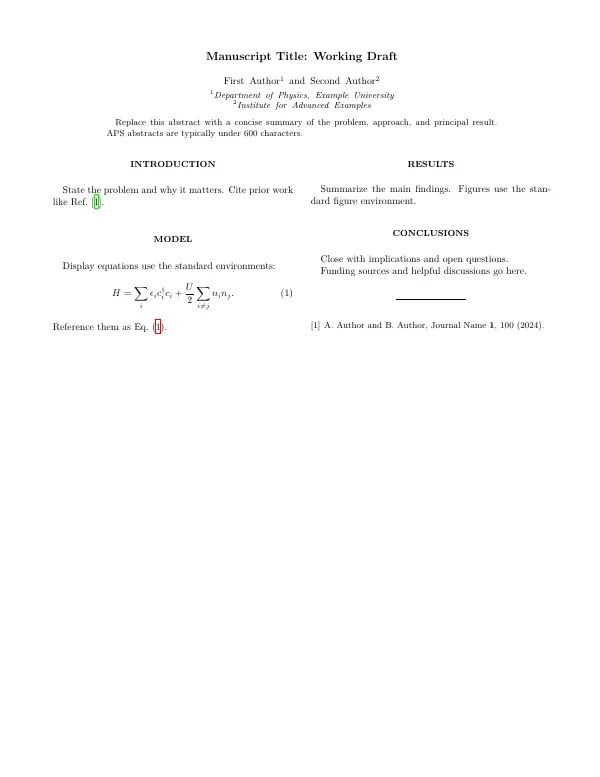
main.tex
\documentclass[aps,prl,twocolumn,superscriptaddress]{revtex4-2}
\usepackage{amsmath,amssymb}
\usepackage{graphicx}
\usepackage{hyperref}

\begin{document}

\title{Manuscript Title: Working Draft}
\author{First Author}
\affiliation{Department of Physics, Example University}
\author{Second Author}
\affiliation{Institute for Advanced Examples}

\begin{abstract}
Replace this abstract with a concise summary of the problem, approach, and
principal result. APS abstracts are typically under 600 characters.
\end{abstract}

\maketitle

\section{Introduction}
State the problem and why it matters. Cite prior work like
Ref.~\cite{example2024}.

\section{Model}
Display equations use the standard environments:
\begin{equation}
  H = \sum_{i} \epsilon_i c_i^\dagger c_i + \frac{U}{2} \sum_{i \ne j} n_i n_j.
  \label{eq:model}
\end{equation}
Reference them as Eq.~(\ref{eq:model}).

\section{Results}
Summarize the main findings. Figures use the standard figure environment.

\section{Conclusions}
Close with implications and open questions.

\begin{acknowledgments}
Funding sources and helpful discussions go here.
\end{acknowledgments}

\begin{thebibliography}{9}
\bibitem{example2024} A. Author and B. Author, Journal Name \textbf{1}, 100 (2024).
\end{thebibliography}

\end{document}
Dans l'application : ouvrez la galerie Nouveau projet, installez le pack {étiquette} sous "Obtenir plus de modèles", et ce modèle apparaît avec un aperçu en direct et une création de projet en un clic. La compilation s'exécute localement sur le moteur fourni.