


Déclaration de recherche
Un récit de recherche élégant sur une seule colonne avec des paragraphes nommés pour les candidatures aux professeurs et aux bourses.
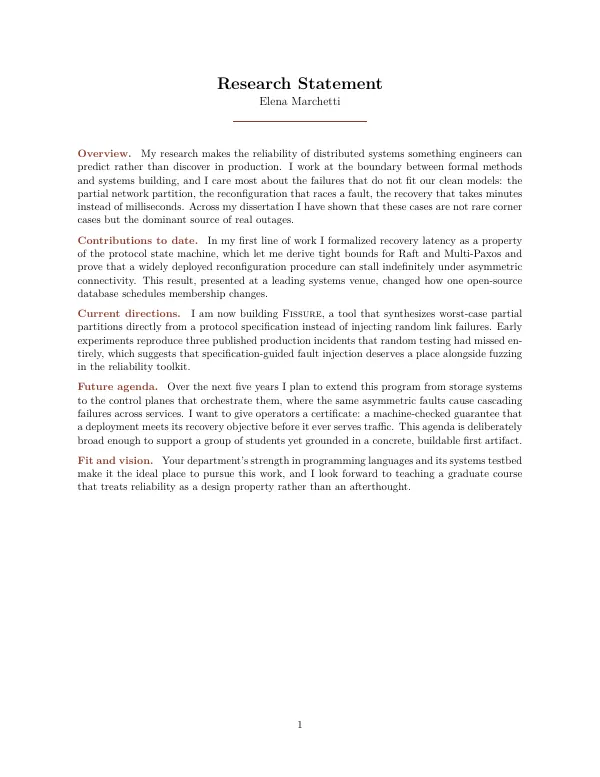
main.tex
\documentclass[11pt]{article}
\usepackage[margin=1.1in]{geometry}
\usepackage{xcolor}
\usepackage[hidelinks]{hyperref}

\definecolor{accent}{HTML}{8C3A2B}
\setlength{\parindent}{0pt}
\setlength{\parskip}{0.65em}
\newcommand{\lead}[1]{{\color{accent}\bfseries #1.}\hspace{0.4em}}

\begin{document}

\begin{center}
  {\LARGE\bfseries Research Statement}\\[0.3em]
  {\large Elena Marchetti}\\[0.2em]
  {\small\color{accent}\rule{0.3\textwidth}{0.8pt}}
\end{center}

\vspace{0.4em}

\lead{Overview}
My research makes the reliability of distributed systems something engineers can
predict rather than discover in production. I work at the boundary between formal
methods and systems building, and I care most about the failures that do not fit
our clean models: the partial network partition, the reconfiguration that races a
fault, the recovery that takes minutes instead of milliseconds. Across my
dissertation I have shown that these cases are not rare corner cases but the
dominant source of real outages.

\lead{Contributions to date}
In my first line of work I formalized recovery latency as a property of the
protocol state machine, which let me derive tight bounds for Raft and
Multi-Paxos and prove that a widely deployed reconfiguration procedure can stall
indefinitely under asymmetric connectivity. This result, presented at a leading
systems venue, changed how one open-source database schedules membership
changes.

\lead{Current directions}
I am now building \textsc{Fissure}, a tool that synthesizes worst-case partial
partitions directly from a protocol specification instead of injecting random
link failures. Early experiments reproduce three published production incidents
that random testing had missed entirely, which suggests that specification-guided
fault injection deserves a place alongside fuzzing in the reliability toolkit.

\lead{Future agenda}
Over the next five years I plan to extend this program from storage systems to
the control planes that orchestrate them, where the same asymmetric faults cause
cascading failures across services. I want to give operators a certificate: a
machine-checked guarantee that a deployment meets its recovery objective before
it ever serves traffic. This agenda is deliberately broad enough to support a
group of students yet grounded in a concrete, buildable first artifact.

\lead{Fit and vision}
Your department's strength in programming languages and its systems testbed make
it the ideal place to pursue this work, and I look forward to teaching a graduate
course that treats reliability as a design property rather than an afterthought.

\end{document}
Dans l'application : ouvrez la galerie Nouveau projet, installez le pack {étiquette} sous "Obtenir plus de modèles", et ce modèle apparaît avec un aperçu en direct et une création de projet en un clic. La compilation s'exécute localement sur le moteur fourni.