


Thèse de monographie minimale
Une thèse KOMA-Script bilatérale et sobre avec déclaration, résumé, déclaration de reproductibilité, têtes d'exécution et disponibilité des données.
main.tex
% A portable thesis monograph built on KOMA-Script.
\documentclass[11pt,twoside,openany,headings=small]{scrbook}
\usepackage[inner=1.25in,outer=1in,top=1in,bottom=1.1in]{geometry}
\usepackage{lmodern}
\usepackage{microtype}
\usepackage{xcolor}
\usepackage{amsmath}
\usepackage{booktabs}
\usepackage{scrlayer-scrpage}
\usepackage[hidelinks,bookmarksnumbered]{hyperref}

\definecolor{accent}{HTML}{243B53}
\clearpairofpagestyles
\ihead{\headmark}
\ohead{\pagemark}
\automark[section]{chapter}
\setkomafont{pageheadfoot}{\small}
\setkomafont{chapter}{\normalfont\huge\bfseries\color{accent}}
\setkomafont{section}{\normalfont\Large\bfseries\color{accent}}
\setlength{\parindent}{1.2em}
\setlength{\parskip}{0pt}

\begin{document}

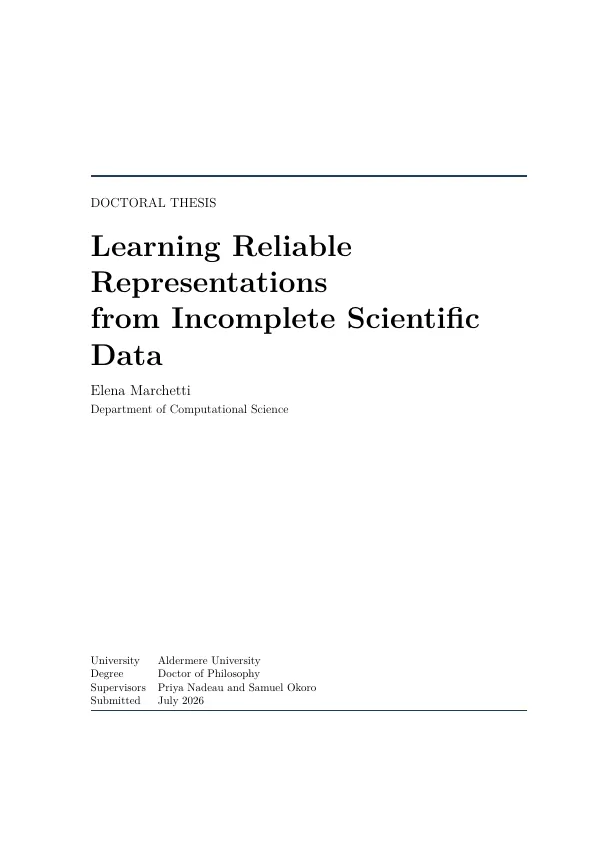
\begin{titlepage}
\raggedright
\vspace*{1.1in}
{\color{accent}\rule{\textwidth}{2pt}}\\[1.5em]
{\fontsize{13}{16}\selectfont DOCTORAL THESIS}\\[1.2em]
{\fontsize{30}{36}\selectfont\bfseries Learning Reliable Representations\\
from Incomplete Scientific Data\par}
\vspace{1.5em}
{\Large Elena Marchetti}\\[0.4em]
{\large Department of Computational Science}

\vfill
\begin{tabular}{@{}ll@{}}
University & Aldermere University \\
Degree & Doctor of Philosophy \\
Supervisors & Priya Nadeau and Samuel Okoro \\
Submitted & July 2026 \\
\end{tabular}
\vspace{0.8in}
{\color{accent}\rule{\textwidth}{0.6pt}}
\end{titlepage}

\frontmatter
\chapter*{Declaration}
I declare that this thesis is my own work, that all collaborative contributions
are identified, and that no material has been submitted for another degree.
Replace this text with the exact declaration required by your institution.

\chapter*{Abstract}
Scientific datasets are often incomplete in ways that correlate with the
phenomenon being measured. This thesis develops representation-learning
methods that model the observation process alongside the data, establishes
identifiability conditions, and evaluates the methods across climate,
neuroimaging, and materials datasets. The resulting models improve calibration
under structured missingness while making their failure conditions explicit.

\chapter*{Reproducibility statement}
Data accession numbers, software versions, environment files, random seeds,
and exact commands for every figure are archived with a permanent identifier.
Restricted data are documented with a synthetic validation path.

\tableofcontents

\mainmatter
\chapter{Introduction}
Missing data are rarely missing at random. Sensors fail under extreme
conditions, participants leave studies for outcome-related reasons, and
laboratories preferentially measure promising samples. Treating the observed
matrix as a neutral subsample can therefore produce confident but incorrect
conclusions.

\section{Research questions}
This thesis asks when the observation process is learnable, which inductive
biases remain identifiable, and how uncertainty should be reported when the
missingness mechanism is only partially observed.

\section{Contributions}
\begin{table}[h]
\centering
\begin{tabular}{@{}p{0.2\textwidth}p{0.68\textwidth}@{}}
\toprule
Chapter & Contribution \\
\midrule
2 & A causal model of structured scientific missingness \\
3 & An identifiable objective with finite-sample guarantees \\
4 & Cross-domain evaluation and calibrated sensitivity analysis \\
\bottomrule
\end{tabular}
\end{table}

\section{Notation}
For observations $x$ and mask $m$, the joint objective is
\begin{equation}
  \mathcal{L}(\theta,\phi)
  = -\log p_{\theta}(x_{\mathrm{obs}}\mid m)
    -\lambda\log p_{\phi}(m\mid x_{\mathrm{obs}}).
\end{equation}
Define symbols at first use and keep a consistent notation across chapters.

\backmatter
\chapter*{Data and code availability}
List stable repository identifiers, licenses, access restrictions, retention
periods, and the tested reproduction workflow.

\begin{thebibliography}{9}
\bibitem{example} A. Researcher and B. Scientist.
Inference under informative missingness.
\textit{Journal of Reliable Data Science}, 8:1--28, 2025.
\end{thebibliography}

\end{document}
Dans l'application : ouvrez la galerie Nouveau projet, installez le pack {étiquette} sous "Obtenir plus de modèles", et ce modèle apparaît avec un aperçu en direct et une création de projet en un clic. La compilation s'exécute localement sur le moteur fourni.