


Styles de préimpression de conférence
Papier de style interdiscours
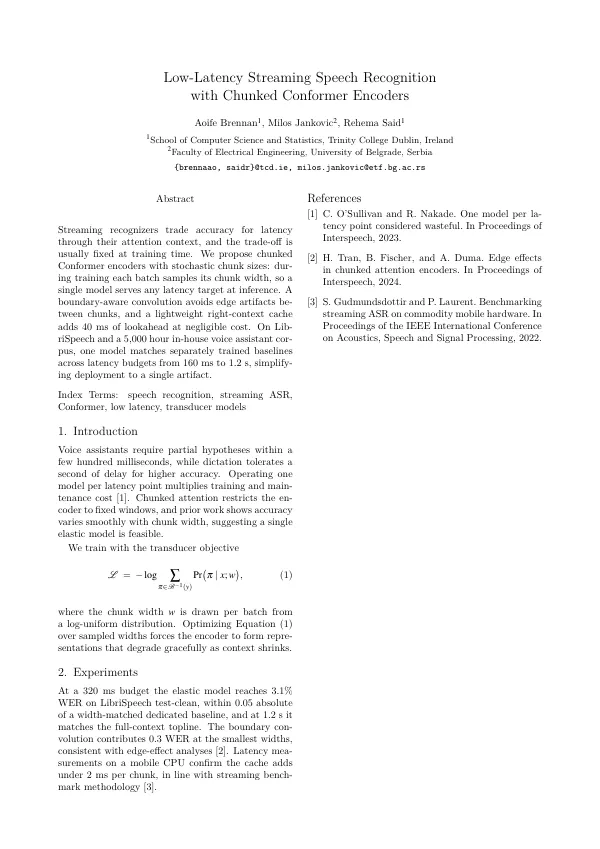
Document de traitement vocal à deux colonnes au look Interspeech avec une ligne de termes d'index sous le résumé.
main.tex
% Interspeech style paper, recreated with standard packages only.
\documentclass[10pt,twocolumn]{article}
\usepackage[a4paper,margin=0.8in,top=1in]{geometry}
\usepackage{mathptmx}
\usepackage{amsmath}
\usepackage{titlesec}

\setlength{\columnsep}{0.2in}
\pagestyle{empty}

\titleformat{\section}{\large\bfseries}{\thesection.}{0.5em}{}
\titleformat{\subsection}{\normalsize\bfseries}{\thesubsection.}{0.5em}{}
\titlespacing*{\section}{0pt}{1.3ex plus .3ex}{0.7ex}

\begin{document}

\twocolumn[{
  \centering
  {\Large\bfseries Low-Latency Streaming Speech Recognition\\ with Chunked Conformer Encoders\par}
  \vskip 14pt
  {\itshape Aoife Brennan$^{1}$, Milos Jankovic$^{2}$, Rehema Said$^{1}$}\\[5pt]
  {\small $^{1}$School of Computer Science and Statistics, Trinity College Dublin, Ireland\\
          $^{2}$Faculty of Electrical Engineering, University of Belgrade, Serbia}\\[3pt]
  {\small\texttt{\{brennaao, saidr\}@tcd.ie, [email protected]}}
  \vskip 20pt
}]
\thispagestyle{empty}

\begin{center}{\bfseries Abstract}\end{center}
\noindent Streaming recognizers trade accuracy for latency through their
attention context, and the trade-off is usually fixed at training time. We
propose chunked Conformer encoders with stochastic chunk sizes: during
training each batch samples its chunk width, so a single model serves any
latency target at inference. A boundary-aware convolution avoids edge
artifacts between chunks, and a lightweight right-context cache adds 40 ms
of lookahead at negligible cost. On LibriSpeech and a 5{,}000 hour in-house
voice assistant corpus, one model matches separately trained baselines
across latency budgets from 160 ms to 1.2 s, simplifying deployment to a
single artifact.

\vskip 6pt
\noindent{\bfseries Index Terms:} speech recognition, streaming ASR, Conformer, low latency, transducer models

\section{Introduction}
Voice assistants require partial hypotheses within a few hundred
milliseconds, while dictation tolerates a second of delay for higher
accuracy. Operating one model per latency point multiplies training and
maintenance cost~\cite{osullivan2023latency}. Chunked attention restricts
the encoder to fixed windows, and prior work shows accuracy varies smoothly
with chunk width, suggesting a single elastic model is feasible.

We train with the transducer objective
\begin{equation}
  \mathcal{L} \;=\; -\log \sum_{\pi \in \mathcal{B}^{-1}(y)} \Pr\bigl(\pi \mid x; w\bigr),
  \label{eq:rnnt}
\end{equation}
where the chunk width $w$ is drawn per batch from a log-uniform
distribution. Optimizing Equation~\eqref{eq:rnnt} over sampled widths
forces the encoder to form representations that degrade gracefully as
context shrinks.

\section{Experiments}
At a 320 ms budget the elastic model reaches 3.1\% WER on
LibriSpeech test-clean, within 0.05 absolute of a width-matched dedicated
baseline, and at 1.2 s it matches the full-context topline. The boundary
convolution contributes 0.3 WER at the smallest widths, consistent with
edge-effect analyses~\cite{tran2024chunk}. Latency measurements on a mobile
CPU confirm the cache adds under 2 ms per chunk, in line with streaming
benchmark methodology~\cite{gudmund2022bench}.

\begin{thebibliography}{9}
\bibitem{osullivan2023latency} C. O'Sullivan and R. Nakade.
One model per latency point considered wasteful.
In \textit{Proceedings of Interspeech}, 2023.
\bibitem{tran2024chunk} H. Tran, B. Fischer, and A. Duma.
Edge effects in chunked attention encoders.
In \textit{Proceedings of Interspeech}, 2024.
\bibitem{gudmund2022bench} S. Gudmundsdottir and P. Laurent.
Benchmarking streaming ASR on commodity mobile hardware.
In \textit{Proceedings of the IEEE International Conference on Acoustics, Speech and Signal Processing}, 2022.
\end{thebibliography}

\end{document}
Dans l'application : ouvrez la galerie Nouveau projet, installez le pack {étiquette} sous "Obtenir plus de modèles", et ce modèle apparaît avec un aperçu en direct et une création de projet en un clic. La compilation s'exécute localement sur le moteur fourni.