


Styles de préimpression de conférence
Papier de style IJCAI
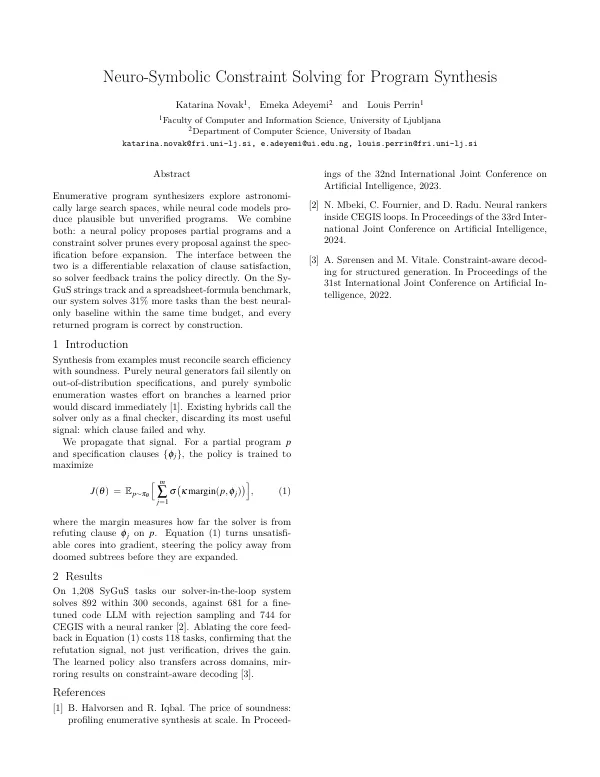
Article sur l'IA à deux colonnes au look IJCAI avec un titre centré en gras et des titres numérotés propres.
main.tex
% IJCAI style paper, recreated with standard packages only.
\documentclass[10pt,twocolumn]{article}
\usepackage[letterpaper,margin=0.75in,top=1in]{geometry}
\usepackage{mathptmx}
\usepackage{amsmath}
\usepackage{amssymb}
\usepackage{titlesec}

\setlength{\columnsep}{0.25in}
\pagestyle{empty}

\titleformat{\section}{\large\bfseries}{\thesection}{0.6em}{}
\titleformat{\subsection}{\normalsize\bfseries}{\thesubsection}{0.6em}{}
\titlespacing*{\section}{0pt}{1.4ex plus .3ex}{0.7ex}

\begin{document}

\twocolumn[{
  \centering
  {\LARGE\bfseries Neuro-Symbolic Constraint Solving for Program Synthesis\par}
  \vskip 14pt
  {\bfseries Katarina Novak$^{1}$, \; Emeka Adeyemi$^{2}$ \; and \; Louis Perrin$^{1}$}\\[4pt]
  {\small $^{1}$Faculty of Computer and Information Science, University of Ljubljana\\
          $^{2}$Department of Computer Science, University of Ibadan\\
          \texttt{[email protected], [email protected], [email protected]}}
  \vskip 20pt
}]
\thispagestyle{empty}

\begin{center}{\bfseries Abstract}\end{center}
\noindent Enumerative program synthesizers explore astronomically large
search spaces, while neural code models produce plausible but unverified
programs. We combine both: a neural policy proposes partial programs and a
constraint solver prunes every proposal against the specification before
expansion. The interface between the two is a differentiable relaxation of
clause satisfaction, so solver feedback trains the policy directly. On the
SyGuS strings track and a spreadsheet-formula benchmark, our system solves
31\% more tasks than the best neural-only baseline within the same time
budget, and every returned program is correct by construction.

\section{Introduction}
Synthesis from examples must reconcile search efficiency with soundness.
Purely neural generators fail silently on out-of-distribution
specifications, and purely symbolic enumeration wastes effort on branches a
learned prior would discard immediately~\cite{halvorsen2023enum}. Existing
hybrids call the solver only as a final checker, discarding its most useful
signal: which clause failed and why.

We propagate that signal. For a partial program $p$ and specification
clauses $\{\phi_j\}$, the policy is trained to maximize
\begin{equation}
  J(\theta) \;=\; \mathbb{E}_{p \sim \pi_{\theta}}
  \Bigl[\, \sum_{j=1}^{m} \sigma\bigl(\kappa\, \mathrm{margin}(p, \phi_j)\bigr) \Bigr],
  \label{eq:relax}
\end{equation}
where the margin measures how far the solver is from refuting clause
$\phi_j$ on $p$. Equation~\eqref{eq:relax} turns unsatisfiable cores into
gradient, steering the policy away from doomed subtrees before they are
expanded.

\section{Results}
On 1{,}208 SyGuS tasks our solver-in-the-loop system solves 892 within 300
seconds, against 681 for a fine-tuned code LLM with rejection sampling and
744 for CEGIS with a neural ranker~\cite{mbeki2024cegis}. Ablating the core
feedback in Equation~\eqref{eq:relax} costs 118 tasks, confirming that the
refutation signal, not just verification, drives the gain. The learned
policy also transfers across domains, mirroring results on constraint-aware
decoding~\cite{sorensen2022decode}.

\begin{thebibliography}{9}
\bibitem{halvorsen2023enum} B. Halvorsen and R. Iqbal.
The price of soundness: profiling enumerative synthesis at scale.
In \textit{Proceedings of the 32nd International Joint Conference on Artificial Intelligence}, 2023.
\bibitem{mbeki2024cegis} N. Mbeki, C. Fournier, and D. Radu.
Neural rankers inside CEGIS loops.
In \textit{Proceedings of the 33rd International Joint Conference on Artificial Intelligence}, 2024.
\bibitem{sorensen2022decode} A. S\o rensen and M. Vitale.
Constraint-aware decoding for structured generation.
In \textit{Proceedings of the 31st International Joint Conference on Artificial Intelligence}, 2022.
\end{thebibliography}

\end{document}
Dans l'application : ouvrez la galerie Nouveau projet, installez le pack {étiquette} sous "Obtenir plus de modèles", et ce modèle apparaît avec un aperçu en direct et une création de projet en un clic. La compilation s'exécute localement sur le moteur fourni.